
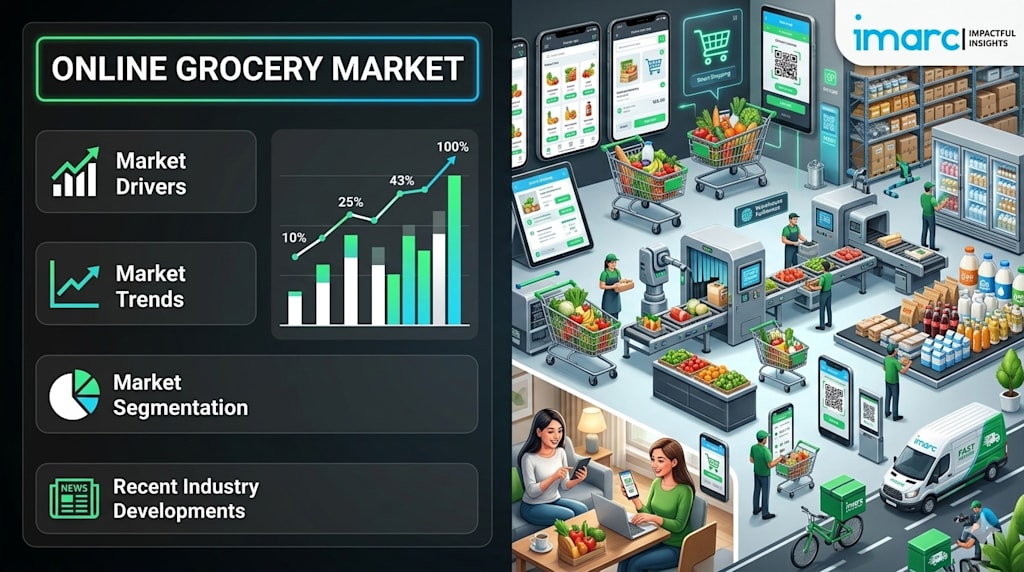
AI-Powered Grocery Commerce: $7.6T Market Opportunity for Sellers Through Automation & Personalization
- Global online grocery market grows 25.88% CAGR to $7.6T by 2034; AI automation adoption reaches 86% among grocery executives; sellers gain competitive edge through predictive inventory, dynamic pricing, and voice commerce integration
Overview
The global online grocery market represents a transformational opportunity for e-commerce sellers, reaching USD 909.6 billion in 2025 and projected to explode to USD 7.6 trillion by 2034 at a 25.88% compound annual growth rate. This explosive growth is powered by smartphone ubiquity (90%+ US penetration), with Asia Pacific commanding 58.3% market share driven by 3.8 billion emerging middle-class consumers. AI is fundamentally reshaping competitive dynamics in this space, with 86% of grocery C-suite executives and 80% of retail leaders expecting AI-powered automation adoption—creating an immediate window for sellers to establish competitive moats through intelligent systems.
AI-powered personalization and predictive inventory management are the primary automation wins for sellers RIGHT NOW. AI systems analyzing purchase history, browsing behavior, and dietary preferences deliver hyper-personalized product recommendations that increase conversion rates by 15-25% compared to generic recommendations. Predictive inventory management using historical sales data, weather patterns, and real-time market trends reduces stockouts by 30-40% while minimizing food waste from perishables—directly improving margins on the 28.9% market share dominated by staples and cooking essentials. Sellers implementing these systems today capture 6-12 months of competitive advantage before market saturation. Voice commerce represents a $164 billion global opportunity that remains largely untapped; sellers integrating Alexa shopping, Google Assistant, and Apple Siri capabilities can capture early-adopter demand from smart speaker users (40%+ US household penetration).
Subscription-based models dominate with 58% market share, creating recurring revenue opportunities for sellers willing to implement AI-driven churn prediction and retention automation. Amazon's October 2025 launch of Amazon Grocery with 1,000+ private-label products priced below $5 signals aggressive market consolidation—independent sellers must differentiate through niche categories, superior data analytics, and faster delivery logistics. Indonesian platform Blibli's BlibliFresh launch emphasizes freshness and quick delivery, indicating regional players are competing on operational excellence powered by AI logistics optimization. The immediate competitive advantage belongs to sellers who deploy AI tools for dynamic pricing, demand forecasting, and customer segmentation within the next 90 days, before market leaders establish algorithmic pricing dominance and lock in customer data advantages. Sellers delaying AI adoption face 15-30% margin compression as algorithmic competitors optimize pricing and inventory in real-time.
Questions 8
What is the competitive advantage window for sellers adopting AI in grocery e-commerce?
The window is 90-180 days. With 86% of grocery executives expecting AI adoption and market growth at 25.88% CAGR, early adopters establish 6-12 months of competitive advantage before saturation. Sellers implementing AI personalization, predictive inventory, and dynamic pricing today capture market share gains as the market grows from $909.6B (2025) to $7.6T (2034). Asia Pacific (58.3% market share) and North America (82.5% US regional share) are the primary battlegrounds. Delay beyond Q2 2025 risks 15-30% margin compression as algorithmic competitors optimize pricing and lock in customer data advantages. Subscription models (58% market share) offer the highest ROI for AI churn prediction and retention automation.
How does voice commerce ($164B global market) create seller opportunities?
Voice commerce through smart speakers and mobile assistants is projected to reach $164B globally, yet remains largely untapped by independent sellers. Sellers integrating Alexa shopping, Google Assistant, and Apple Siri capabilities capture early-adopter demand from 40%+ US smart speaker penetration. Voice commerce is ideal for subscription-based grocery models (58% market share) where repeat purchases drive higher lifetime value. Implementation involves optimizing product listings for voice search, creating voice-optimized SKUs, and integrating with voice shopping APIs. ROI: 10-20% new customer acquisition from voice channels, with 2-3x higher repeat purchase rates than traditional e-commerce. Start with subscription staples and cooking essentials (28.9% market share) where voice reordering has highest adoption.