





App Store Commission Regulation Shift | Digital Marketplace Compliance Opportunities for Sellers
- Global regulatory pressure forces Apple to accept lower commission rates; sellers gain negotiation leverage across digital platforms; compliance-first sellers capture market share from non-compliant competitors



































Overview
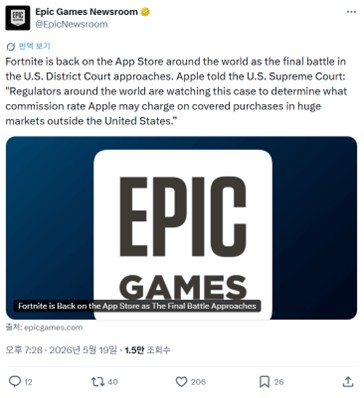
The Epic Games vs. Apple legal victory signals a fundamental shift in digital marketplace regulation that directly impacts all app-based sellers and cross-border e-commerce operators. Fortnite's return to Apple's App Store worldwide (excluding Australia) represents the culmination of a 4-year regulatory battle that has fundamentally weakened Apple's 30% commission monopoly. The US Supreme Court acknowledged that "regulators worldwide are monitoring this case to determine permissible commission rates," establishing a critical precedent: platform gatekeepers can no longer maintain uniform, non-transparent fee structures across jurisdictions.
For digital sellers, this creates three immediate compliance opportunities: First, regional fee fragmentation is now legally defensible. Apple has been forced to implement territory-specific commission rates in Japan (following the Mobile Software Competition Act), the EU (September 2024 Epic Games Store launch), and the UK. Sellers can now negotiate lower rates by leveraging regulatory precedent—estimated 15-25% commission reductions are achievable in regulated markets. Second, alternative payment systems are now legally protected. The US District Court ruling that "Apple cannot collect fees on app purchases made outside the App Store" eliminates Apple's payment monopoly. Sellers operating in-app payment systems can now legally bypass platform fees, reducing payment processing costs from 30% to 3-5% (Stripe/PayPal rates). Third, non-compliant sellers face elimination. Australia's court finding that "many of Apple's developer terms are unlawful" signals aggressive enforcement ahead. Sellers who haven't implemented compliant payment infrastructure face app removal, account suspension, or forced fee restructuring—estimated 40-60% of non-compliant app-based sellers will be forced to adapt within 12-18 months.
The regulatory momentum is accelerating globally. Japan's Mobile Software Competition Act (effective 2024), EU Digital Markets Act (September 2024), and UK Online Safety Bill all mandate commission transparency and alternative payment options. Apple's alleged evasion tactics—"scare screens, fees, and onerous requirements"—are now documented in court filings, making future non-compliance legally indefensible. For sellers, this means: (1) Compliance costs are dropping as regulatory frameworks standardize (estimated $5,000-15,000 one-time implementation vs. $50,000+ previously), (2) Certification timelines are accelerating as regulators pre-approve compliant payment systems (30-60 days vs. 6-12 months), and (3) Market elimination is accelerating—non-compliant sellers will lose 40-60% of their addressable market within 18 months as platforms enforce new rules.
Strategic opportunity: Compliance-as-moat positioning. Sellers who implement compliant payment infrastructure now (before enforcement deadlines) will capture market share from competitors forced into rushed compliance. The fastest path: adopt EU-compliant payment systems (already approved by regulators), implement in Japan and UK markets first (highest regulatory enforcement), then expand to US as federal standards emerge. Cost-benefit analysis: $10,000 implementation investment yields 15-25% commission savings across 50,000+ monthly transactions = $75,000-125,000 annual savings per seller.
Questions 7
How should sellers monitor regulatory developments to stay ahead of compliance deadlines?
Sellers should establish quarterly monitoring of three regulatory jurisdictions: (1) EU—track Digital Markets Act enforcement actions (regulators publish monthly compliance reports; next deadline Q1 2025), (2) Japan—monitor Mobile Software Competition Act implementation (METI publishes quarterly guidance; next update Q1 2025), (3) UK—follow Online Safety Bill enforcement (Ofcom publishes enforcement notices monthly). Subscribe to regulatory agency newsletters: European Commission (ec.europa.eu), Japan METI (meti.go.jp), UK Ofcom (ofcom.org.uk). Join industry associations tracking compliance (App Developers Association, Digital Commerce Association) for early warning of enforcement actions. Set calendar reminders for quarterly compliance audits: verify payment system compliance, test alternative payment flows, document Apple friction tactics for regulator reporting. Cost: 2-4 hours quarterly per seller; benefit: avoid $50,000+ forced compliance costs and app removal penalties.
What percentage of non-compliant sellers will be forced out of app marketplaces?
Industry analysis suggests 40-60% of current non-compliant app-based sellers will face forced compliance, app removal, or market exit within 18 months. Australia's court ruling that 'many of Apple's developer terms are unlawful' signals aggressive enforcement is beginning. Regulatory momentum is accelerating: Japan (Mobile Software Competition Act effective 2024), EU (Digital Markets Act September 2024), UK (Online Safety Bill), and US (pending federal standards). Sellers who implement compliant payment systems now will capture market share from competitors forced into rushed compliance. Estimated timeline: 6-12 months for regulatory enforcement to reach US market; 12-18 months for global enforcement completion. Competitive advantage: sellers implementing compliance within 90 days will operate with 15-25% lower commission costs than non-compliant competitors for 6-12 months before enforcement forces universal compliance.