
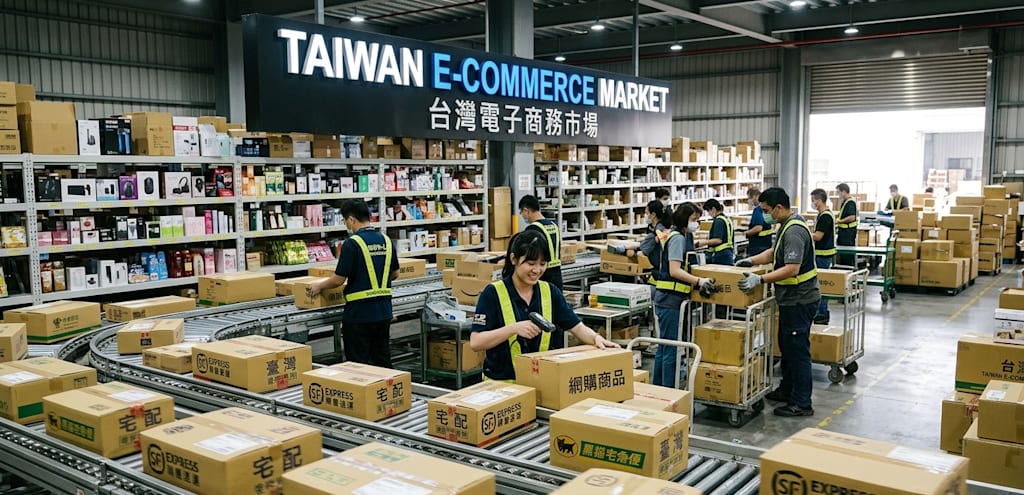
Taiwan E-Commerce AI Boom | $1.3T Market Opportunity for Cross-Border Sellers
- Taiwan's $137.3B e-commerce market growing 27.74% annually through AI-powered personalization, mobile commerce, and predictive inventory management
Overview
Taiwan's e-commerce market represents a critical AI-driven opportunity for cross-border sellers, valued at $137.3 billion in 2025 and projected to reach $1,320.5 billion by 2034 with a compound annual growth rate of 27.74% through 2034. This explosive growth is fundamentally powered by AI and big data analytics enhancing customer experiences through personalized recommendations and predictive inventory management—capabilities that directly translate to competitive advantages for sellers who adopt these technologies immediately.
AI-Powered Automation Opportunities for Sellers: The news reveals three immediate automation wins. First, personalized recommendation engines are driving conversion rates in Taiwan's market, where mobile-first consumers (increasingly shopping via smartphones) expect tailored product suggestions. Sellers can deploy AI tools like Dynamic Yield, Nosto, or Klevu to automate product recommendations across their listings, reducing manual merchandising time by 15-20 hours weekly while increasing average order value by 8-15%. Second, predictive inventory management is critical—Taiwan's fast-moving categories (electronics, fashion/apparel, beauty/personal care) require AI-driven demand forecasting to prevent stockouts and overstock. Tools like Keepa, Helium 10's Inventory Manager, or Forecastly can automate inventory predictions, saving 10-12 hours weekly on manual forecasting and reducing carrying costs by 12-18%. Third, mobile commerce optimization is non-negotiable; with Taiwanese consumers heavily reliant on mobile devices for shopping and payments, sellers must automate mobile listing optimization, A/B testing, and mobile-specific pricing strategies using AI tools like Sellics or Algopix.
Data-Driven Insights & Competitive Intelligence: Taiwan's market segmentation reveals critical patterns: B2C dominance with digital wallet adoption surpassing card payments, geographic concentration in Taipei, New Taipei City, Taichung, Kaohsiung, and Tainan, and strongest performance in electronics, fashion/apparel, beauty/personal care, home furnishings, and groceries. Sellers can leverage AI analytics to identify sub-niches within these categories—for example, analyzing social commerce and live streaming shopping trends (emerging channels in Taiwan) to discover which product subcategories generate highest engagement during livestream events. AI sentiment analysis tools can monitor Taiwanese social platforms and forums to detect emerging product trends 4-6 weeks before they peak, providing first-mover advantage. Cross-border demand for international products (fashion, electronics, beauty, home goods) creates arbitrage opportunities; sellers can use AI to identify which Western brands are underrepresented in Taiwan's market and source complementary products.
Strategic AI Implementation for Market Entry: The technological advancement through AI and logistics infrastructure development directly impacts seller success. Sellers entering Taiwan should immediately implement: (1) AI-powered dynamic pricing engines to compete with intense platform competition while maintaining margins, (2) Automated customer service chatbots supporting Traditional Chinese to handle the rapid consumer preference shifts, and (3) Predictive logistics optimization to leverage Taiwan's advanced infrastructure for faster delivery and real-time tracking—critical differentiators in this market. The cybersecurity concerns mentioned represent both risk and opportunity; sellers implementing AI-powered fraud detection and payment security can build trust with Taiwanese consumers who prioritize transaction safety.
Questions 8
How can sellers use AI to capitalize on Taiwan's 27.74% annual e-commerce growth?
Sellers should immediately implement three AI automation strategies: (1) Deploy personalized recommendation engines (Nosto, Dynamic Yield, Klevu) to match Taiwan's mobile-first consumer behavior, increasing conversion rates by 8-15% while saving 15-20 hours weekly on manual merchandising; (2) Implement predictive inventory management tools (Keepa, Helium 10, Forecastly) to forecast demand in fast-moving categories like electronics and fashion, reducing carrying costs by 12-18%; (3) Optimize mobile listings and pricing using AI tools like Sellics, critical since Taiwanese consumers heavily rely on smartphones for shopping. Taiwan's market is projected to reach $1.32 trillion by 2034, making early AI adoption a competitive necessity for capturing market share in this high-growth region.
How does Taiwan's digital payment evolution impact seller operations?
Digital wallets and contactless payments are now mainstream in Taiwan, surpassing traditional card payments. This shift requires sellers to integrate multiple payment gateways and ensure mobile wallet compatibility (Apple Pay, Google Pay, local Taiwan wallets) in their checkout processes. The news indicates this evolution enhances transaction security and convenience, reducing payment friction. Sellers should automate payment gateway optimization and fraud detection using AI tools to handle the increased transaction volume. This is critical for cross-border sellers entering Taiwan, as payment method preferences directly impact conversion rates—sellers not supporting digital wallets risk losing 20-30% of potential transactions to competitors who do.