




AI Market Consolidation Risk | Sellers Must Build Proprietary Advantages Now
- Microsoft CEO warns concentrated AI power threatens seller independence; sellers need differentiation strategies beyond generic AI tools











Overview
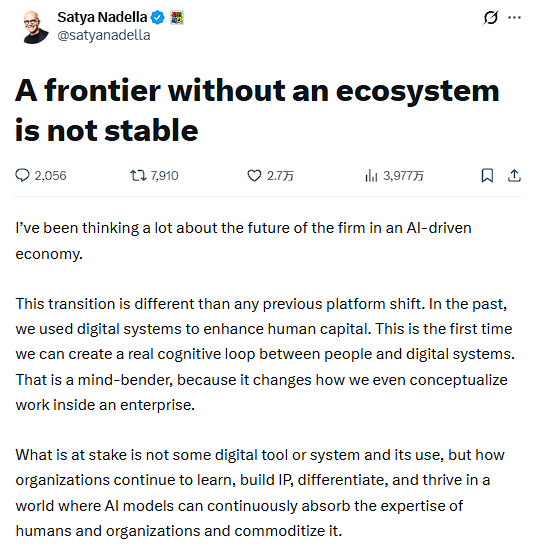
Microsoft CEO Satya Nadella's June 15, 2026 warning about AI market consolidation represents a critical inflection point for cross-border e-commerce sellers. Nadella cautioned that if a handful of AI providers capture most economic value while companies lose ownership of proprietary knowledge systems, entire industries could be "hollowed out"—mirroring globalization's devastating effects on manufacturing economies. This consolidation risk directly threatens sellers who rely on AI-powered tools for product research, pricing optimization, customer service, and inventory management.
The core threat: AI commoditization of seller capabilities. When generic large language models democratize expert-level knowledge work across professions, sellers lose competitive differentiation. Snowflake CEO Sridhar Ramaswamy warned in February that software companies risk becoming "mere data sources" for AI model makers, while Box CEO Aaron Levie noted in January that companies must differentiate through proprietary context rather than generic intelligence. For e-commerce sellers, this means relying solely on ChatGPT, Claude, or other mainstream AI tools for product selection, pricing, and customer service creates zero defensibility—competitors using identical tools achieve identical results.
Immediate automation opportunities exist within proprietary data frameworks. Sellers can immediately automate repetitive tasks (product research, listing optimization, customer service responses) using existing AI tools, but the competitive advantage window is closing rapidly. Sellers who build proprietary AI systems trained on their own sales data, customer behavior patterns, and category-specific insights will maintain 6-12 month advantages over competitors using generic models. For example, a seller using AI to analyze their own 50,000 historical orders can identify micro-trends and seasonal patterns invisible to competitors using public data. This proprietary context—not the AI tool itself—creates defensibility.
Platform dynamics will shift as consolidation accelerates. Amazon, Shopify, and other platforms may increasingly lock sellers into their proprietary AI tools (Amazon's AI-powered product recommendations, Shopify's Sidekick AI assistant) rather than allowing independent tool integration. Sellers currently using third-party AI tools for pricing optimization, demand forecasting, or content generation should expect reduced API access and higher integration costs as platforms consolidate AI capabilities internally. The risk: sellers become dependent on platform-controlled AI with limited customization, reducing pricing power and operational flexibility.
Strategic response requires immediate action. Sellers must invest in proprietary data collection and analysis infrastructure NOW—before AI consolidation makes independent tools prohibitively expensive. Building custom AI models trained on proprietary sales data, customer feedback, and category insights creates defensible competitive advantages. Sellers should also diversify across multiple platforms and AI tool providers to avoid single-vendor lock-in, and prioritize tools that enable data ownership rather than cloud-dependent solutions.
Questions 7
What immediate AI automation actions should sellers take now?
Sellers should immediately automate repetitive tasks using existing AI tools (ChatGPT, Claude, Midjourney) for product research, listing optimization, customer service responses, and demand forecasting—capturing 2-4 hours/week time savings per seller. However, the competitive advantage window is closing rapidly. Simultaneously, sellers must begin collecting and organizing proprietary data (sales history, customer behavior, category trends) to train custom AI models that competitors cannot replicate. Sellers who invest in proprietary AI infrastructure in the next 3-6 months will maintain 6-12 month competitive advantages before consolidation forces everyone onto platform-controlled tools.
How does AI commoditization affect cross-border e-commerce sellers specifically?
When expert-level knowledge work (product research, pricing, customer service) gets democratized through generic AI models, all sellers gain access to identical capabilities simultaneously. A seller using ChatGPT for product research gets the same insights as 10,000 competitors using ChatGPT. Snowflake CEO Ramaswamy warned in February that software companies risk becoming 'mere data sources' for AI makers, meaning sellers lose pricing power and operational control. For cross-border sellers, this creates urgency to build proprietary AI systems using their own sales data, customer feedback, and regional market insights before platform consolidation makes independent tools prohibitively expensive or unavailable.