


Developer Tool Security Breaches Expose E-Commerce Infrastructure Risk | Supply Chain Vulnerability Alert
- 1,500+ compromised packages in 24 hours; 400+ hijacked via "Atomic Arch" campaign; developer credentials stolen affecting GitHub, npm, cloud platforms used by e-commerce infrastructure teams
Overview
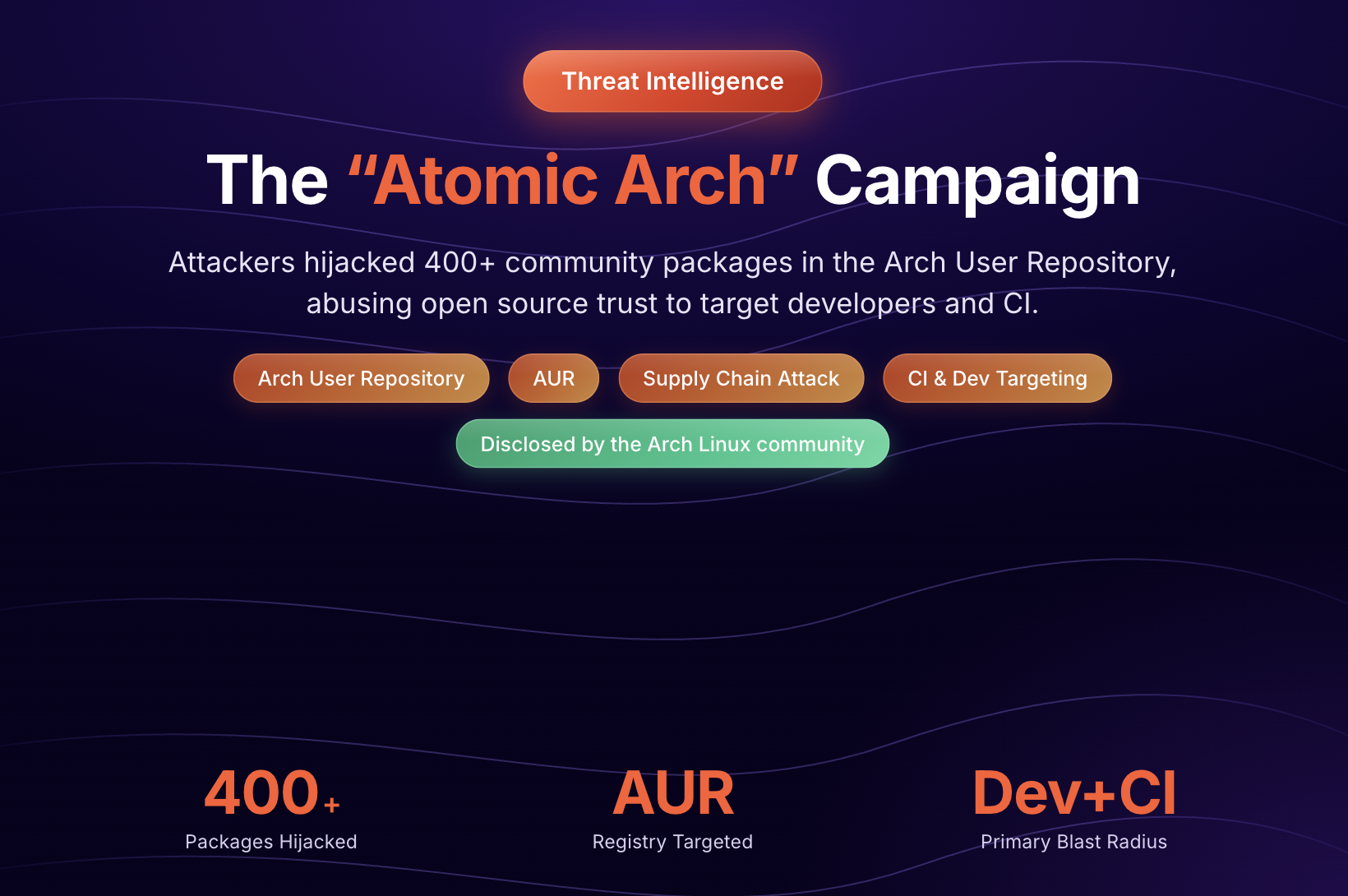
The Arch Linux AUR (Arch User Repository) experienced two coordinated supply-chain attack waves within 24 hours, compromising over 1,500 packages initially and 400+ packages through the sophisticated "Atomic Arch" campaign disclosed June 11, 2026. This represents a critical infrastructure vulnerability for e-commerce sellers and platform operators who rely on open-source development tools. The attacks exploited AUR's community-contribution model through package ownership hijacking, injecting malicious code into Node.js packages, Firefox extensions, and developer tools that execute during installation. The malware payload—written in Rust—steals high-value credentials including GitHub tokens, SSH keys, npm authentication, cloud access keys, and session tokens from Slack/Discord/Teams, creating direct pathways into production environments controlling e-commerce platforms, payment systems, and inventory management infrastructure.
For e-commerce sellers and platform operators, the operational impact is severe. Developers using Arch Linux or WSL2 on Windows who work on e-commerce infrastructure (Shopify stores, Amazon seller tools, payment integrations, inventory systems) face credential compromise. If these developers have administrative access to GitHub repositories, npm packages, or cloud accounts (AWS, Azure, GCP) hosting e-commerce applications, attackers can pivot directly into production environments. The "Atomic Arch" campaign's systematic targeting of orphaned packages with existing user bases demonstrates attackers understand supply-chain leverage: compromising trusted, widely-used tools provides broader attack surface than typosquatting. Organizations running self-hosted CI/CD runners on Arch Linux—common in mid-market e-commerce operations—are directly vulnerable to eBPF-based persistence mechanisms that hide malicious processes from detection.
The incident reveals structural weaknesses in open-source security governance affecting e-commerce infrastructure. AUR's decentralized review process, where community members submit packages with minimal verification, mirrors vulnerabilities in npm ecosystem (which supplies Node.js packages for e-commerce platforms). The rapid succession of attacks within 24 hours, with attackers adapting obfuscation techniques to evade AI-based detection (using Gemma E2B models), indicates sophisticated threat actors targeting developer infrastructure specifically. E-commerce sellers using Arch-based development environments, self-hosted CI/CD pipelines, or cloud infrastructure built on compromised dependencies face potential data breaches, payment system compromise, and inventory manipulation. The incident also signals broader risk: if developer machines are compromised, attackers can modify e-commerce application code before deployment, affecting customer data security and platform integrity across all operating systems and cloud platforms downstream.
Questions 7
What is the timeline and scale of the Arch Linux AUR attacks?
**First wave:** Over 1,500 packages compromised, reported by developer a821 on the official Arch Linux mailing list. **Second wave (within 24 hours):** Additional sophisticated malware instances discovered using AI detection (Gemma E2B model), described as 'more elaborate' in concealing malicious actions. **Third wave (June 11, 2026):** 'Atomic Arch' campaign disclosed, revealing 400+ packages hijacked through systematic ownership-transfer exploitation. The rapid succession and escalating sophistication indicate attackers are adapting methods to bypass detection. For e-commerce operations, this suggests ongoing threat activity rather than isolated incident.
Which e-commerce development tools and platforms are directly affected by the AUR attacks?
Directly affected package categories include **Node.js packages, Plasma 6 applets, Firefox packages, Aura browser, LibreWolf extensions, and NeoVim plugins**. For e-commerce specifically, Node.js packages are critical—they power Shopify custom apps, payment integrations, inventory systems, and API clients. The malware targeted diverse categories, suggesting attackers aimed for maximum infrastructure penetration. Windows developers using Arch under WSL2 are also directly vulnerable. While GitHub-hosted runners aren't directly vulnerable, self-hosted CI/CD runners on Arch Linux are fully compromised, affecting deployment pipelines for e-commerce applications.