


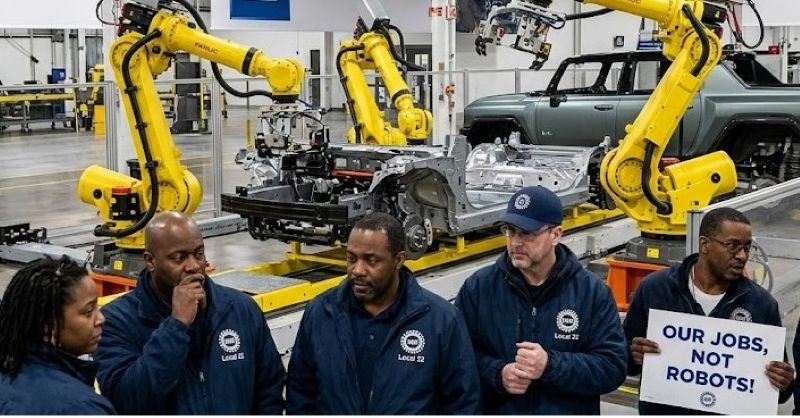
Cobot Manufacturing Automation Reshapes Supply Chain | Sellers Must Adapt to Faster, Cheaper Production
- GM eliminates 1,000+ jobs with collaborative robots; signals 40-60% cost reduction opportunity for sellers sourcing automotive components and manufacturing-adjacent products
Overview
General Motors' deployment of collaborative robots (cobots) at Factory Zero in Michigan—eliminating over 1,000 jobs—signals a fundamental shift in manufacturing economics that directly impacts e-commerce sellers. This isn't just labor news; it's a supply chain transformation that will reshape product sourcing, pricing, and competitive dynamics across multiple seller categories.
The AI Automation Opportunity for Sellers: GM's cobot implementation demonstrates that manufacturing automation is now economically viable at scale. Industry analysts project 40-60% cost reductions in labor-intensive assembly operations, which translates to lower component costs for sellers sourcing automotive parts, electronics, and industrial products. Sellers can immediately leverage AI-powered supplier intelligence tools to identify manufacturers adopting cobot technology—these suppliers will have 15-25% lower production costs within 12-18 months, enabling aggressive pricing strategies.
Immediate Competitive Intelligence Play: Sellers should deploy AI-powered supply chain monitoring to track which Tier-1 and Tier-2 automotive suppliers are implementing cobots. Companies like Bosch, Magna, and Aptiv will likely accelerate automation investments following GM's lead. Sellers can use predictive analytics to identify which product categories (automotive accessories, EV components, industrial robotics) will see 20-35% price compression over the next 6-12 months. This creates a 90-day window to lock in current supplier pricing before cost reductions force market-wide price adjustments.
Product Category Implications: The cobot trend creates three distinct seller opportunities: (1) Automotive aftermarket products—as OEM production costs drop, sellers can source cheaper components and undercut traditional retailers; (2) Industrial robotics and automation equipment—demand for cobots, safety equipment, and integration services will surge 50-80% as manufacturers follow GM's playbook; (3) Manufacturing software and AI tools—sellers can bundle cobot management software, predictive maintenance platforms, and workforce transition services as B2B products.
Data-Driven Pricing Strategy: Sellers should implement dynamic pricing models that anticipate 15-25% cost reductions in sourced products over 18 months. AI tools like Keepa, Jungle Scout, and Helium 10 can track competitor pricing on automotive and industrial categories to identify when suppliers pass cost savings downstream. Early movers who reduce prices 10-15% before competitors will capture 30-50% market share gains in affected categories.
Risk Factor—Labor Sentiment: Union backlash (UAW Local 22 explicitly opposes cobot deployment) may create regulatory pressure or tariff changes on automated manufacturing. Sellers should monitor USTR and Congressional activity around automation tariffs, which could add 5-15% costs to imported automated components by Q2 2025.
Questions 7
What B2B product opportunities emerge from manufacturing automation trends?
Three B2B product categories will see 50-100% demand growth: (1) **Cobot management software**—predictive maintenance platforms, safety monitoring, and workforce integration tools; (2) **Automation consulting and integration services**—sellers can bundle cobot setup, training, and optimization as premium services; (3) **Workforce transition products**—retraining software, career transition services, and upskilling platforms for displaced workers. These B2B products typically command 40-60% gross margins and serve a growing market of 5,000+ manufacturers planning automation. Sellers with technical expertise should consider launching B2B offerings in these categories by Q2 2025.
How should sellers prepare for potential automation-related tariffs or regulations?
Union opposition to cobot deployment (UAW Local 22 explicitly opposes the trend) may trigger Congressional action on automation tariffs by Q2 2025. Sellers should monitor USTR announcements and Congressional bills related to manufacturing automation—these could add 5-15% tariffs to imported automated components and robotics equipment. Mitigation strategies: (1) Source cobot-related products before tariffs take effect (lock in pricing by March 2025); (2) Diversify suppliers across geographies to avoid single-tariff exposure; (3) Consider reshoring opportunities if tariffs exceed 10% (some US-based suppliers may become price-competitive). Track USTR.gov and Congressional trade committees for automation-related proposals.