



Gaming Hardware Scalping Surge | eBay Resale Markup 60-100% Above MSRP
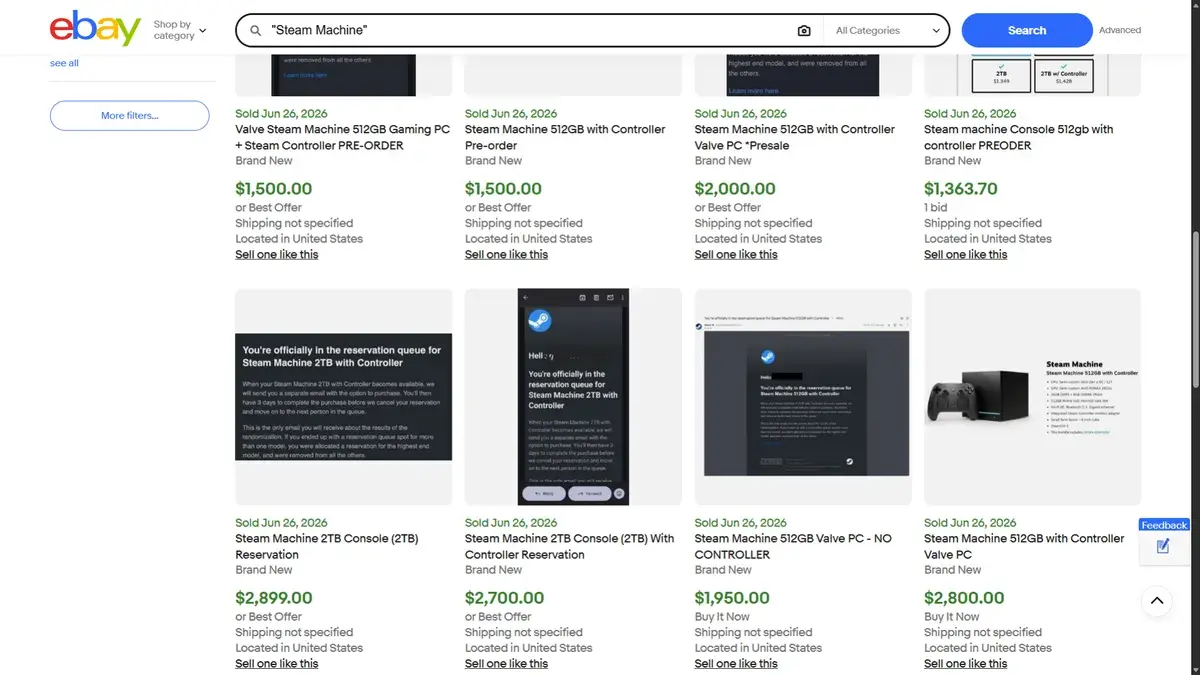
- Valve Steam Machine resale prices spike to $2,900 within 1 week of launch; scalpers bypass anti-fraud measures on secondary marketplaces
Overview
The scalping phenomenon surrounding Valve's Steam Machine launch reveals critical e-commerce dynamics for sellers operating in high-demand hardware categories. Resellers are listing the compact PC at 60-100% markups above official retail prices ($1,049-$1,428), with eBay listings reaching $2,900 for the 2TB variant just one week after Valve opened reservations. This surge demonstrates how secondary marketplaces like eBay become arbitrage channels when official supply constraints exist, creating both opportunities and risks for sellers.
The underlying supply constraint stems from AI data center competition for components. Valve originally planned a $750 entry price but increased it due to component cost inflation driven by AI infrastructure demand—a macro trend affecting the entire gaming hardware sector. This cost pressure cascades through the supply chain: manufacturers face higher component costs, official retailers maintain lower margins, and secondary market resellers capture the price differential. For sellers sourcing gaming hardware, this signals sustained component scarcity and pricing power in the category through 2025.
Scalpers successfully circumvented Valve's anti-scalping measures (randomized queue, account history requirements, one-unit-per-household limits) by listing reservation rights on secondary platforms. This reveals a critical vulnerability: platform-level restrictions cannot prevent secondary market arbitrage. Sellers can exploit this pattern by: (1) identifying products with official purchase limits, (2) acquiring through authorized channels, and (3) reselling on platforms with weaker anti-scalping enforcement. eBay's current enforcement appears lighter than Amazon's, making it the preferred arbitrage destination.
Consumer risk is substantial but creates seller opportunity. Valve explicitly stated it cannot provide warranty support for third-party purchases, yet consumers continue buying at 2x MSRP. This indicates strong demand inelasticity in gaming hardware—buyers prioritize access over price. Sellers can capitalize by emphasizing authenticity, warranty coverage, and fast shipping in listings. The $1,700-$2,900 price range suggests healthy margins for resellers acquiring at official prices ($1,049-$1,428), with gross profit potential of $650-$1,472 per unit before platform fees (12-15% on eBay).
This trend extends beyond Steam Machine to broader gaming PC market dynamics. Limited availability of high-performance GPUs, CPUs, and pre-built systems creates recurring scalping opportunities. Sellers should monitor product launches from Nvidia, AMD, and major OEMs for similar patterns. The gaming hardware category is projected to see 8-12% price premiums on secondary markets through Q2 2025 as AI demand continues pressuring component supply.
Questions 7
How can sellers identify future gaming hardware launches with scalping potential?
Monitor three indicators: (1) Official purchase limits (one-per-household signals scarcity expectations), (2) Component supply constraints (track GPU/CPU availability and AI demand trends), and (3) Pre-order demand signals (reservation queue length, social media mentions). Valve's Steam Machine showed all three: official limits, AI-driven component inflation, and massive pre-order demand. Similar patterns will emerge with Nvidia's next-gen GPU launches, AMD Ryzen releases, and gaming console refreshes. Set up alerts on manufacturer websites and gaming forums for launch announcements. Estimate demand elasticity by analyzing historical price premiums—gaming hardware typically sustains 40-80% markups on secondary markets. Begin sourcing 2-4 weeks before official launch to acquire inventory before secondary market prices spike.
What profit margins can sellers expect from gaming hardware resale arbitrage?
Based on Steam Machine pricing, gross profit potential ranges from $650-$1,472 per unit (acquiring at $1,049-$1,428 MSRP, reselling at $1,700-$2,900). After eBay fees (12-15%), payment processing (2-3%), and shipping costs ($30-50), net margins are approximately 35-45% per unit. This assumes successful sales within 30 days before eBay return windows close. Risk factors include: inventory holding costs, platform fee changes, and demand volatility. Sellers should model conservative scenarios (40% markup, 20% return rate) yielding 20-25% net margins. The category is most profitable for high-volume sellers (100+ units/month) who can absorb returns and optimize logistics.