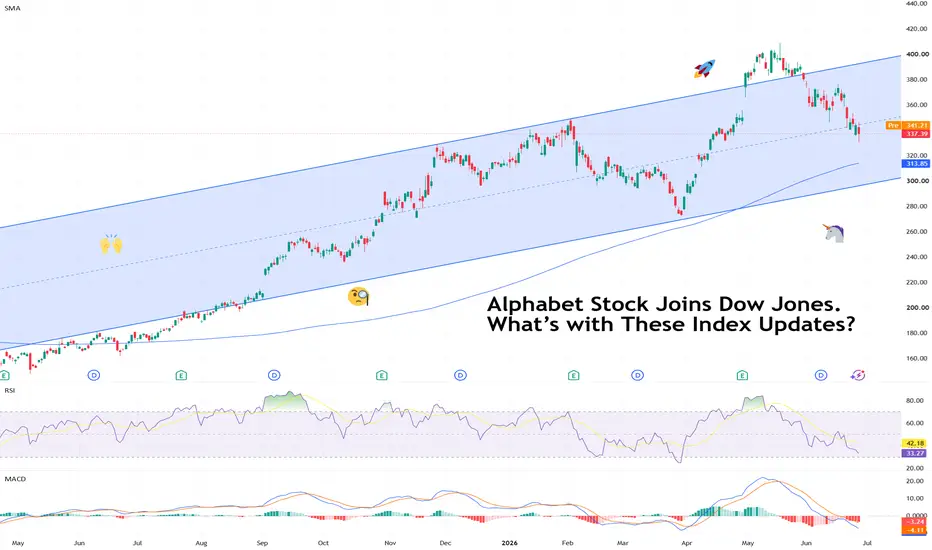


Alphabet's addition to the Dow Jones Industrial Average marks a watershed moment for cross-border e-commerce sellers, signaling that Google's advertising platforms—Google Shopping, Google Ads, and YouTube—will face intensifying cost pressures as the company prioritizes AI infrastructure investment. The news reflects Alphabet's dominance in digital advertising and cloud computing, but the underlying market context reveals a critical challenge: strategists estimate nearly 60% of S&P 500 earnings growth this quarter derives from AI infrastructure stocks, creating a concentration risk that directly impacts seller acquisition costs.
For e-commerce sellers, the immediate implication is straightforward: Google Ads costs are rising. As Alphabet invests heavily in AI computational infrastructure to compete with OpenAI and Microsoft, the company must offset these expenses through higher advertising rates. Sellers relying on Google Shopping for product visibility and Google Ads for customer acquisition should expect 8-15% budget increases throughout 2025. Small sellers (those spending $500-2,000/month on Google Ads) will feel this pressure acutely, as they lack negotiating power with Google's sales teams. Mid-market sellers ($2,000-10,000/month) can partially offset costs through AI-powered bidding optimization, while enterprise sellers may secure volume discounts. The volatility in S&P 500 and Nasdaq—driven by AI infrastructure concerns—also signals investor caution about sustainability, meaning Google may accelerate monetization of its advertising platforms to justify AI spending to shareholders.
The strategic opportunity lies in portfolio diversification. Sellers currently over-reliant on Google Ads (>40% of paid acquisition budget) should immediately audit their channel mix and test alternative platforms: Amazon Advertising (which benefits from Amazon's own AI infrastructure investments), TikTok Shop (lower CPC in emerging markets), and Shopify's native advertising tools (which leverage first-party data). Sellers in high-margin categories (electronics, beauty, home goods) can absorb 10-12% cost increases; those in low-margin categories (apparel, home décor) must shift to organic channels or accept margin compression. The Dow inclusion also signals institutional investor confidence in Alphabet's long-term profitability, suggesting Google Ads will remain a critical channel—but sellers must negotiate rates proactively and implement AI-powered optimization tools (like Google's Performance Max campaigns) to maintain ROI as costs rise.
The news reports that nearly **60% of S&P 500 earnings growth this quarter derives from AI infrastructure stocks**, creating a concentration risk that signals aggressive monetization strategies. For sellers, this means **Google, Amazon, Microsoft, and Nvidia will prioritize AI-related revenue streams**, including advertising, cloud services, and data analytics. Google will likely increase advertising rates to justify AI infrastructure spending to shareholders. Amazon will expand its advertising platform (which already generates $40B+ annually) to offset cloud computing costs. This concentration also creates volatility: if AI spending growth slows, advertising rates may stabilize or decline. Sellers should monitor quarterly earnings reports from Alphabet and Amazon for guidance on advertising rate changes. Diversify your marketing spend across platforms to reduce exposure to any single company's monetization strategy. Consider investing in owned channels (email, SMS, social media) that don't depend on paid advertising platforms.
**Within 7 days:** Audit your current Google Ads spending by campaign type (Search, Shopping, YouTube) and calculate your cost-per-acquisition (CPA) for each channel. Identify which campaigns are most profitable and which are marginal. **Within 14 days:** Set up conversion tracking in Amazon Advertising and TikTok Shop if not already active, and allocate $200-500 test budget to each platform. **Within 30 days:** Implement Performance Max campaigns for your top 5 products and monitor conversion efficiency. Shift 10-15% of Google Ads budget to alternative platforms. **Ongoing:** Monitor your Google Ads dashboard for bid increases and adjust budgets monthly. Review quarterly earnings reports from Alphabet and Amazon for guidance on advertising rate changes. Sellers in high-margin categories should prioritize maintaining Google presence; low-margin sellers should accelerate shift to organic and owned channels. This proactive approach will minimize margin compression as costs rise throughout 2025.
**Amazon Advertising** is the primary alternative, as Amazon benefits from its own AI infrastructure investments and offers lower CPCs in many categories. **TikTok Shop** provides emerging market opportunities with significantly lower customer acquisition costs (30-50% below Google Ads in Southeast Asia and Latin America). **Shopify's native advertising tools** leverage first-party customer data for better targeting efficiency. **eBay Promoted Listings** offer lower costs for sellers with established inventory. The strategic approach: maintain 40-50% of budget on Google Ads (still essential for visibility), allocate 25-30% to Amazon Advertising, and test 15-20% on TikTok Shop or Shopify tools. Sellers in electronics and beauty should prioritize Amazon; those in apparel and home goods should test TikTok Shop. Implement this portfolio shift within 30 days to lock in current rates before Q1 2025 increases.
**Performance Max** is Google's AI-powered campaign type that automatically optimizes bids, creatives, and placements across Google's entire advertising network (Search, Display, YouTube, Gmail, Maps). It uses machine learning to maximize conversions within your target cost-per-acquisition (CPA), making it more efficient than manual bidding as costs rise. The campaign requires conversion tracking and typically needs 50+ conversions per month to train effectively. Sellers implementing Performance Max report 15-25% improvement in conversion efficiency, which can offset 8-12% cost increases. To implement: set up conversion tracking in Google Ads, create 3-5 ad variations (headlines, descriptions, images), define your target CPA, and allocate $500-1,000/month minimum budget for 30-60 days of learning. Monitor performance weekly and adjust CPA targets based on profitability. This is critical for sellers facing 2025 cost increases.
Alphabet's Dow addition signals institutional investor confidence in its AI infrastructure strategy, which directly impacts **Google Ads pricing**. As Alphabet invests heavily in AI computational capacity to compete with OpenAI and Microsoft, it must offset these costs through higher advertising rates. The news reports that nearly **60% of S&P 500 earnings growth this quarter derives from AI infrastructure stocks**, indicating Alphabet will prioritize monetization of its advertising platforms. Sellers should expect **8-15% increases in Google Ads costs throughout 2025**, particularly for Google Shopping and YouTube advertising. Immediate action: audit your Google Ads spending and test alternative platforms like Amazon Advertising and TikTok Shop to diversify acquisition channels.
Google's AI infrastructure investments create upward pressure on advertising rates across all platforms—Google Ads, Google Shopping, and YouTube. Small sellers ($500-2,000/month spend) will experience the most acute impact, as they lack negotiating power and cannot access volume discounts. Mid-market sellers ($2,000-10,000/month) can partially offset costs by implementing **Performance Max campaigns** and AI-powered bidding optimization, which improve conversion efficiency. The market context shows S&P 500 and Nasdaq volatility driven by AI infrastructure concerns, suggesting Google may accelerate rate increases to justify shareholder expectations. Sellers in high-margin categories (electronics, beauty) can absorb 10-12% cost increases; low-margin sellers (apparel, home décor) should shift 20-30% of budget to organic channels or accept margin compression. Monitor your Google Ads dashboard weekly for bid adjustments and test alternative platforms immediately.
YouTube advertising is a critical channel for cross-border sellers, particularly in electronics, beauty, and home goods categories. Alphabet's Dow inclusion signals that **YouTube will receive increased investment in AI-powered recommendation and targeting capabilities**, which improves campaign efficiency but also increases costs. YouTube advertising costs have risen 12-18% annually over the past three years, and this trend will accelerate as Alphabet monetizes AI infrastructure. Sellers should expect **15-20% cost increases for YouTube campaigns in 2025**. To offset this: implement **YouTube Performance Max campaigns** (which use AI to optimize placements), focus on high-intent keywords and audiences, and test **YouTube Shorts** (lower CPM than traditional YouTube ads). Sellers with video content should prioritize YouTube; those without should test **TikTok Shop** or **Instagram Reels** as alternatives. Allocate 15-20% of your video advertising budget to YouTube, with the remainder split between TikTok, Instagram, and Amazon Video Ads. Monitor YouTube campaign performance weekly and adjust bids based on ROAS (return on ad spend).
The answer depends on your product category, profit margins, and current ROAS (return on ad spend). **High-margin sellers** (electronics, beauty, luxury goods with 40%+ gross margins) should maintain or increase Google Ads spending, as they can absorb 8-15% cost increases while remaining profitable. **Mid-margin sellers** (home goods, apparel with 25-40% margins) should shift 15-25% of budget to organic channels (SEO, content marketing, social media) while maintaining core Google Ads campaigns. **Low-margin sellers** (commodity products with <25% margins) should reduce Google Ads by 30-40% and prioritize organic growth, Amazon Advertising (which has lower CPCs for commodity products), and TikTok Shop. The strategic approach: calculate your break-even CPA for each product category, then determine how much cost increase you can absorb. If Google Ads costs rise above your break-even CPA, shift budget to alternative platforms or organic channels. Implement this analysis within 30 days and adjust quarterly as costs change. Avoid abandoning Google entirely—maintain 30-40% of budget for brand protection and high-intent keywords.
The news reports that nearly **60% of S&P 500 earnings growth this quarter derives from AI infrastructure stocks**, creating a concentration risk that signals aggressive monetization strategies. For sellers, this means **Google, Amazon, Microsoft, and Nvidia will prioritize AI-related revenue streams**, including advertising, cloud services, and data analytics. Google will likely increase advertising rates to justify AI infrastructure spending to shareholders. Amazon will expand its advertising platform (which already generates $40B+ annually) to offset cloud computing costs. This concentration also creates volatility: if AI spending growth slows, advertising rates may stabilize or decline. Sellers should monitor quarterly earnings reports from Alphabet and Amazon for guidance on advertising rate changes. Diversify your marketing spend across platforms to reduce exposure to any single company's monetization strategy. Consider investing in owned channels (email, SMS, social media) that don't depend on paid advertising platforms.
**Within 7 days:** Audit your current Google Ads spending by campaign type (Search, Shopping, YouTube) and calculate your cost-per-acquisition (CPA) for each channel. Identify which campaigns are most profitable and which are marginal. **Within 14 days:** Set up conversion tracking in Amazon Advertising and TikTok Shop if not already active, and allocate $200-500 test budget to each platform. **Within 30 days:** Implement Performance Max campaigns for your top 5 products and monitor conversion efficiency. Shift 10-15% of Google Ads budget to alternative platforms. **Ongoing:** Monitor your Google Ads dashboard for bid increases and adjust budgets monthly. Review quarterly earnings reports from Alphabet and Amazon for guidance on advertising rate changes. Sellers in high-margin categories should prioritize maintaining Google presence; low-margin sellers should accelerate shift to organic and owned channels. This proactive approach will minimize margin compression as costs rise throughout 2025.
**Amazon Advertising** is the primary alternative, as Amazon benefits from its own AI infrastructure investments and offers lower CPCs in many categories. **TikTok Shop** provides emerging market opportunities with significantly lower customer acquisition costs (30-50% below Google Ads in Southeast Asia and Latin America). **Shopify's native advertising tools** leverage first-party customer data for better targeting efficiency. **eBay Promoted Listings** offer lower costs for sellers with established inventory. The strategic approach: maintain 40-50% of budget on Google Ads (still essential for visibility), allocate 25-30% to Amazon Advertising, and test 15-20% on TikTok Shop or Shopify tools. Sellers in electronics and beauty should prioritize Amazon; those in apparel and home goods should test TikTok Shop. Implement this portfolio shift within 30 days to lock in current rates before Q1 2025 increases.
**Performance Max** is Google's AI-powered campaign type that automatically optimizes bids, creatives, and placements across Google's entire advertising network (Search, Display, YouTube, Gmail, Maps). It uses machine learning to maximize conversions within your target cost-per-acquisition (CPA), making it more efficient than manual bidding as costs rise. The campaign requires conversion tracking and typically needs 50+ conversions per month to train effectively. Sellers implementing Performance Max report 15-25% improvement in conversion efficiency, which can offset 8-12% cost increases. To implement: set up conversion tracking in Google Ads, create 3-5 ad variations (headlines, descriptions, images), define your target CPA, and allocate $500-1,000/month minimum budget for 30-60 days of learning. Monitor performance weekly and adjust CPA targets based on profitability. This is critical for sellers facing 2025 cost increases.
Alphabet's Dow addition signals institutional investor confidence in its AI infrastructure strategy, which directly impacts **Google Ads pricing**. As Alphabet invests heavily in AI computational capacity to compete with OpenAI and Microsoft, it must offset these costs through higher advertising rates. The news reports that nearly **60% of S&P 500 earnings growth this quarter derives from AI infrastructure stocks**, indicating Alphabet will prioritize monetization of its advertising platforms. Sellers should expect **8-15% increases in Google Ads costs throughout 2025**, particularly for Google Shopping and YouTube advertising. Immediate action: audit your Google Ads spending and test alternative platforms like Amazon Advertising and TikTok Shop to diversify acquisition channels.
Google's AI infrastructure investments create upward pressure on advertising rates across all platforms—Google Ads, Google Shopping, and YouTube. Small sellers ($500-2,000/month spend) will experience the most acute impact, as they lack negotiating power and cannot access volume discounts. Mid-market sellers ($2,000-10,000/month) can partially offset costs by implementing **Performance Max campaigns** and AI-powered bidding optimization, which improve conversion efficiency. The market context shows S&P 500 and Nasdaq volatility driven by AI infrastructure concerns, suggesting Google may accelerate rate increases to justify shareholder expectations. Sellers in high-margin categories (electronics, beauty) can absorb 10-12% cost increases; low-margin sellers (apparel, home décor) should shift 20-30% of budget to organic channels or accept margin compression. Monitor your Google Ads dashboard weekly for bid adjustments and test alternative platforms immediately.
YouTube advertising is a critical channel for cross-border sellers, particularly in electronics, beauty, and home goods categories. Alphabet's Dow inclusion signals that **YouTube will receive increased investment in AI-powered recommendation and targeting capabilities**, which improves campaign efficiency but also increases costs. YouTube advertising costs have risen 12-18% annually over the past three years, and this trend will accelerate as Alphabet monetizes AI infrastructure. Sellers should expect **15-20% cost increases for YouTube campaigns in 2025**. To offset this: implement **YouTube Performance Max campaigns** (which use AI to optimize placements), focus on high-intent keywords and audiences, and test **YouTube Shorts** (lower CPM than traditional YouTube ads). Sellers with video content should prioritize YouTube; those without should test **TikTok Shop** or **Instagram Reels** as alternatives. Allocate 15-20% of your video advertising budget to YouTube, with the remainder split between TikTok, Instagram, and Amazon Video Ads. Monitor YouTube campaign performance weekly and adjust bids based on ROAS (return on ad spend).
The answer depends on your product category, profit margins, and current ROAS (return on ad spend). **High-margin sellers** (electronics, beauty, luxury goods with 40%+ gross margins) should maintain or increase Google Ads spending, as they can absorb 8-15% cost increases while remaining profitable. **Mid-margin sellers** (home goods, apparel with 25-40% margins) should shift 15-25% of budget to organic channels (SEO, content marketing, social media) while maintaining core Google Ads campaigns. **Low-margin sellers** (commodity products with <25% margins) should reduce Google Ads by 30-40% and prioritize organic growth, Amazon Advertising (which has lower CPCs for commodity products), and TikTok Shop. The strategic approach: calculate your break-even CPA for each product category, then determine how much cost increase you can absorb. If Google Ads costs rise above your break-even CPA, shift budget to alternative platforms or organic channels. Implement this analysis within 30 days and adjust quarterly as costs change. Avoid abandoning Google entirely—maintain 30-40% of budget for brand protection and high-intent keywords.
The news reports that nearly **60% of S&P 500 earnings growth this quarter derives from AI infrastructure stocks**, creating a concentration risk that signals aggressive monetization strategies. For sellers, this means **Google, Amazon, Microsoft, and Nvidia will prioritize AI-related revenue streams**, including advertising, cloud services, and data analytics. Google will likely increase advertising rates to justify AI infrastructure spending to shareholders. Amazon will expand its advertising platform (which already generates $40B+ annually) to offset cloud computing costs. This concentration also creates volatility: if AI spending growth slows, advertising rates may stabilize or decline. Sellers should monitor quarterly earnings reports from Alphabet and Amazon for guidance on advertising rate changes. Diversify your marketing spend across platforms to reduce exposure to any single company's monetization strategy. Consider investing in owned channels (email, SMS, social media) that don't depend on paid advertising platforms.
**Within 7 days:** Audit your current Google Ads spending by campaign type (Search, Shopping, YouTube) and calculate your cost-per-acquisition (CPA) for each channel. Identify which campaigns are most profitable and which are marginal. **Within 14 days:** Set up conversion tracking in Amazon Advertising and TikTok Shop if not already active, and allocate $200-500 test budget to each platform. **Within 30 days:** Implement Performance Max campaigns for your top 5 products and monitor conversion efficiency. Shift 10-15% of Google Ads budget to alternative platforms. **Ongoing:** Monitor your Google Ads dashboard for bid increases and adjust budgets monthly. Review quarterly earnings reports from Alphabet and Amazon for guidance on advertising rate changes. Sellers in high-margin categories should prioritize maintaining Google presence; low-margin sellers should accelerate shift to organic and owned channels. This proactive approach will minimize margin compression as costs rise throughout 2025.