



.jpg)
Albertsons Guidance Cut Signals Broader US Consumer Pullback | Retail O2O Opportunities Emerge
- Albertsons cuts FY2026 EPS guidance 20.7% to $1.80, signals tightening household budgets affecting discretionary e-commerce spending; digital/pharmacy segments show strength despite core grocery decline











Overview
Albertsons' July 23, 2026 earnings collapse represents a critical macroeconomic signal for e-commerce sellers: U.S. consumer spending is contracting across essential categories, with profound implications for discretionary product demand on Amazon, Shopify, and third-party marketplaces. The grocer cut full-year adjusted EPS guidance 20.7% to $1.80 (from $2.22-$2.32), reduced EBITDA guidance to $3.59B (below $3.89B consensus), and revised identical sales expectations to negative 0.5-1.5% (from flat-to-positive 1%). Q2 2026 same-store sales remained flat year-over-year versus 2.8% growth in Q2 2025, while Q1 identical sales declined 0.8%. Stock plunged 15% to five-year lows, with Kroger down 4% and Sprouts Farmers Market down 5%, confirming systemic retail weakness.
The core driver: consumer budget compression from elevated gas prices (exceeding $4.00/gallon nationally), food inflation, and geopolitical uncertainty. CEO Susan Morris explicitly stated that "cautious consumers are scaling back purchases amid food inflation and budget constraints." Albertsons' gross margin contracted 23 basis points in Q2 and 25 basis points in Q1, driven by rising fuel and packaging costs. Critically, the company operates 2,240 stores across 34 states under 20+ banners (Albertsons, Safeway, Jewel-Osco, Vons), generating $83.23B in trailing twelve-month revenue—making this a leading indicator of household financial stress.
For e-commerce sellers, this signals a two-phase consumer behavior shift: First, tightening budgets will reduce discretionary spending on non-essential categories (apparel, electronics, home goods) sold through Amazon, eBay, and Shopify. News 2 explicitly notes that "reduced grocery sales forecasts suggest tightening household budgets that could impact discretionary spending on non-essential categories sold through e-commerce platforms." Second, consumers are trading down to private-label products and reducing basket sizes, indicating a shift toward value-seeking behavior that accelerates adoption of online grocery services and marketplace shopping. This creates both challenges (lower AOV, reduced conversion rates) and opportunities (demand for budget-friendly, private-label alternatives; growth in value-tier product categories).
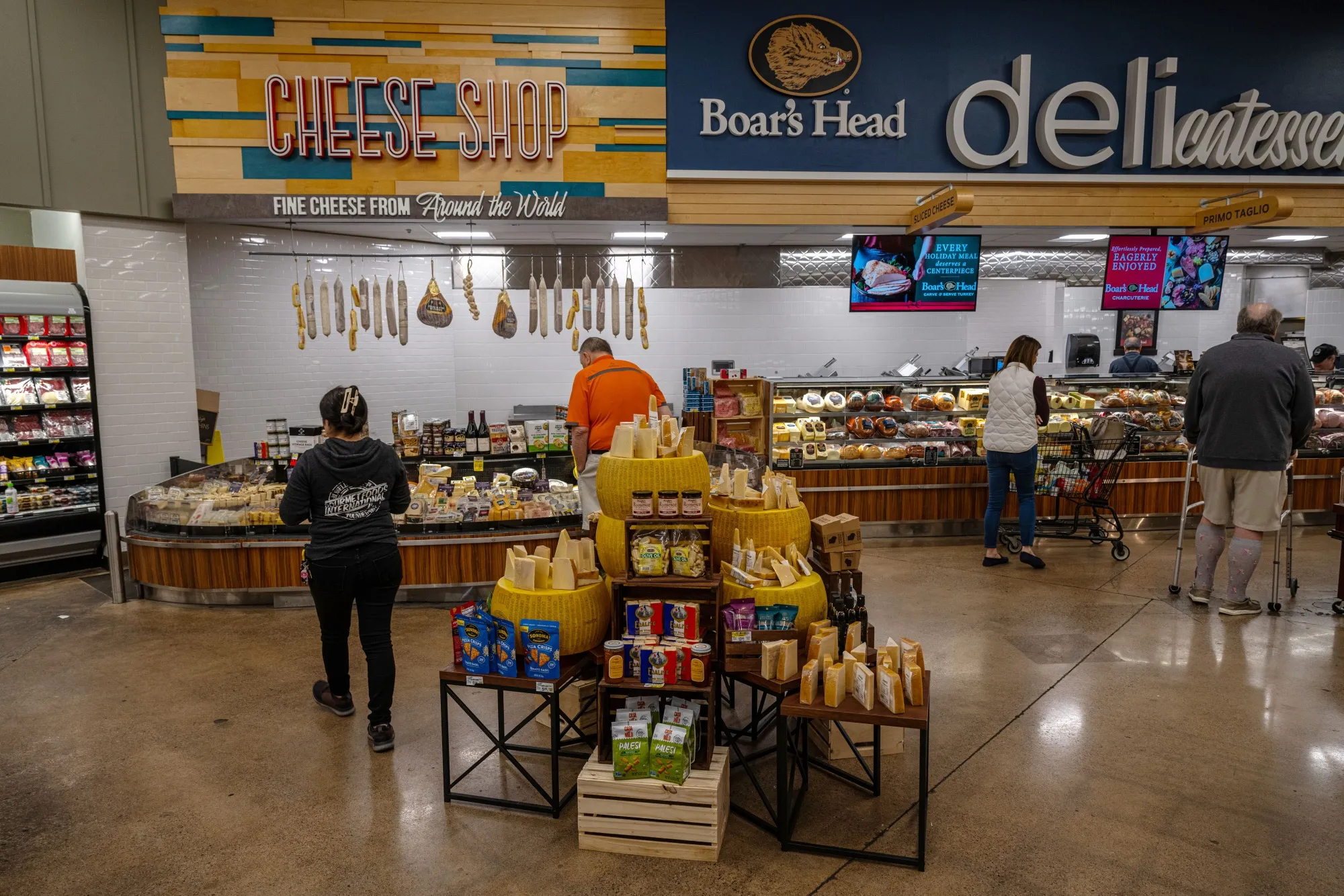
Albertsons' strategic response reveals critical O2O and retail partnership opportunities for sellers. The company is accelerating investments in digital commerce, expanding private-label offerings, and restructuring from 11 divisions into 4 regional units to centralize merchandising and pricing. This signals that Albertsons is actively seeking supplier partnerships for private-label products and digital-first fulfillment models. For cross-border sellers, this represents a direct channel opportunity: Albertsons' 2,240 stores across 34 U.S. states offer potential pop-up, showroom, and co-merchandising partnerships, particularly for value-oriented, private-label, and specialty food/beverage products. The company's emphasis on "improving customer experience and traffic through strategic investments" suggests openness to experiential retail formats and in-store digital integration.
Questions 7
When should sellers adjust pricing and promotional strategies based on this consumer pullback signal?
Albertsons' guidance cut on July 23, 2026 signals immediate consumer budget constraints. Sellers should implement pricing adjustments within 14-30 days: (1) reduce prices on discretionary categories by 5-10% to maintain conversion rates, (2) increase promotional frequency (weekly vs. bi-weekly) to drive traffic, and (3) emphasize value messaging in PPC campaigns and product listings. Albertsons' implementation of price reductions on hundreds of items suggests that aggressive pricing is now table-stakes. Monitor competitor pricing daily using tools like Keepa or CamelCamelCamel, and expect promotional intensity to increase 20-30% through Q4 2026. Sellers with strong unit economics at 10-15% lower price points will outperform premium-positioned competitors during this demand contraction period.
What does Albertsons' competitive pressure from Walmart and Aldi mean for marketplace sellers?
Albertsons explicitly cited intensifying competitive pressure from Walmart and discount grocers like Aldi, with Q1 identical sales declining 0.8%. This indicates that mass retailers and discount chains are capturing share from traditional supermarkets through aggressive pricing and value positioning. For marketplace sellers, this means: (1) Amazon and Walmart Marketplace will see increased competition from private-label and discount brands, (2) price-sensitive consumers will shift to Walmart.com and Amazon Fresh, creating opportunities for sellers with strong value-tier offerings, and (3) Aldi's expansion (currently 2,100+ U.S. stores) signals growing consumer preference for limited-SKU, high-velocity models. Sellers should optimize listings for price-comparison keywords and consider Walmart Marketplace as a secondary channel to capture value-seeking traffic.