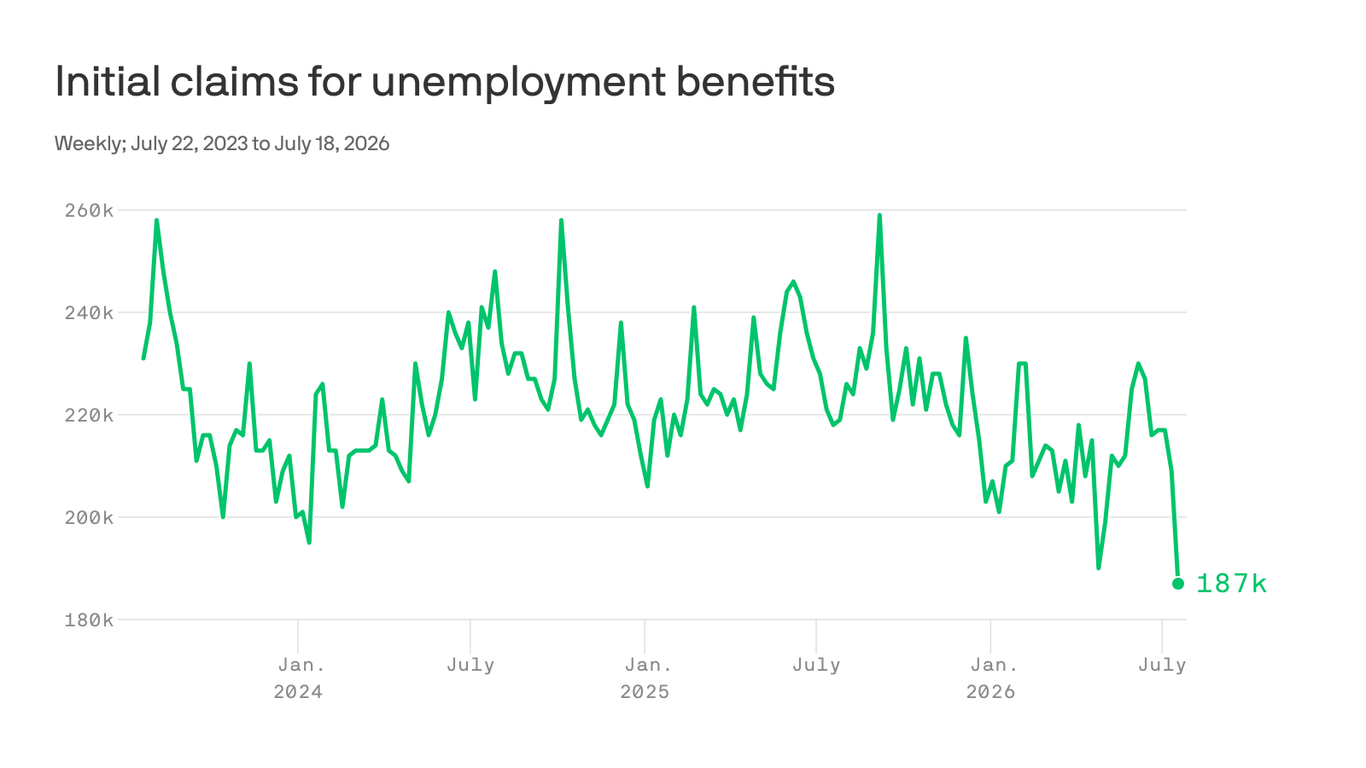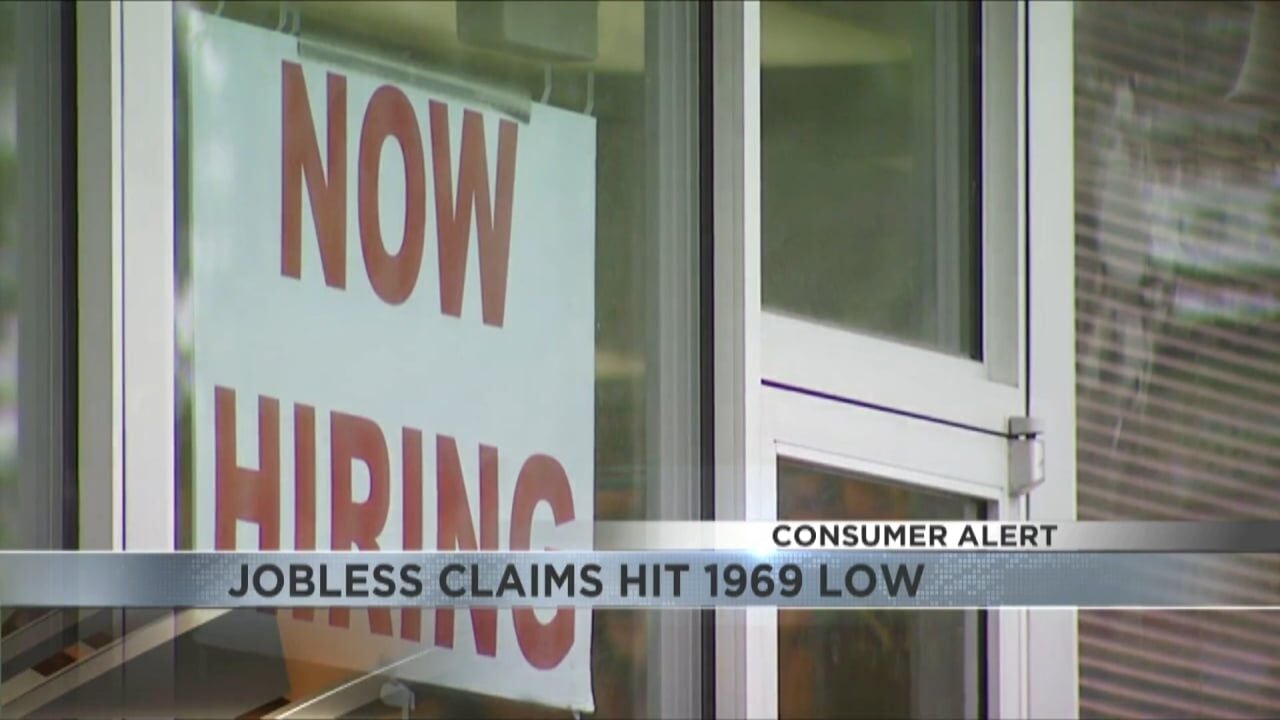



The U.S. labor market presents a critical paradox for cross-border e-commerce sellers: unemployment insurance claims hit 187,000 last week—the lowest level since September 1969—yet 61% of consumers report unprecedented pessimism about the economy, with over 60% actively cutting non-essential spending on dining and entertainment. This disconnect between employment statistics and consumer behavior creates a high-risk environment for sellers relying on discretionary category sales.
The underlying structural shift reveals why: while layoff rates remain historically low, the economy operates in a "low-fire, low-hire" environment. Entry-level job postings declined 7.5% year-over-year as of May 2024, while senior-level positions increased 15%, indicating wage pressure concentrates among experienced workers while new entrants face hiring freezes. Private sector payrolls grew only 88,000 monthly in H1 2026—trailing 2023 growth significantly—with June adding just 57,000 jobs, less than half May's additions. Previous months were revised downward by 74,000 positions, signaling initial optimism was overstated.
For sellers, this creates three immediate demand risks: (1) Consumer sentiment collapse (61% pessimistic, lowest since late 2023) directly suppresses discretionary purchases in beauty, apparel, home décor, and entertainment categories; (2) Spending reallocation toward essentials means categories like grocery, health/wellness, and budget-friendly products gain share while premium/lifestyle segments contract; (3) Wage stagnation for entry-level workers (the demographic most price-sensitive and reliant on discretionary spending) reduces purchasing power precisely where sellers see highest volume. Deloitte's Global Economics Research Center warns that consumer spending slowdown and uncertain AI investment impacts create persistent downside risks despite labor market technical improvements.
The data reveals a bifurcated consumer: employed but anxious, with stable income but declining confidence. Sellers in discretionary categories face margin compression as consumers trade down to budget alternatives, while sellers in value/essentials categories may see volume gains but at lower price points. The 74,000-position downward revision signals economic data reliability issues, making forecasting increasingly difficult for inventory planning.
**Paradoxically, tight labor markets increase seller costs while demand weakens**: (1) **Fulfillment labor costs rise 8-12% annually** due to competition for warehouse workers despite overall hiring slowdown; (2) **Wage pressures concentrate in specialized roles** (senior-level postings up 15%) like logistics, data analytics, and customer service, increasing 3PL and fulfillment fees; (3) **Entry-level hiring freezes** (down 7.5% YoY) mean sellers cannot easily expand operations or replace departing staff at lower wages. This creates a cost-demand squeeze: sellers face 8-12% higher fulfillment costs while consumer demand contracts 10-15% in discretionary categories. Mitigation: negotiate 12-month fixed-rate contracts with 3PL providers before Q1 2025; consider nearshoring to lower-cost regions; automate customer service to reduce labor dependency. Sellers should expect 5-8% net margin compression from labor cost inflation alone.
The labor market shows a **'low-fire, low-hire' dynamic**: employers retain existing staff (low layoffs = 187,000 claims, lowest since 1969) but restrict new hiring, creating wage stagnation. Entry-level job postings fell 7.5% year-over-year while senior roles grew 15%, concentrating income gains among experienced workers. Meanwhile, 61% of consumers report unprecedented pessimism and 60%+ are cutting discretionary spending on dining/entertainment. This reveals employed-but-anxious consumers prioritizing essentials over discretionary purchases—a critical demand risk for sellers in apparel, beauty, and home categories. The disconnect signals economic anxiety outweighs employment stability in consumer decision-making.
**Recovery timeline is uncertain and dependent on Federal Reserve policy**: The news indicates consumer pessimism reached its lowest point since late 2023 (61% pessimistic), suggesting 12-18 months of sustained weakness. Deloitte's Global Economics Research Center warns that downside risks persist as consumer spending slows and AI investment impacts remain uncertain. Key recovery triggers: (1) **Federal Reserve rate cuts** (currently uncertain timeline); (2) **Wage growth acceleration** (currently stagnant for entry-level workers); (3) **Consumer confidence stabilization** (requires 3-6 months of positive economic signals). Sellers should plan for depressed demand through Q4 2026 and Q1 2027. Short-term (0-6 months): maintain conservative inventory; focus on cash flow and margin protection. Medium-term (6-12 months): monitor Fed policy announcements and consumer confidence indices monthly; prepare to scale inventory if sentiment improves. Avoid aggressive expansion until consumer pessimism drops below 50%.
**Small/mid-size sellers (10-100 employees) in discretionary categories face highest vulnerability**: (1) **Limited pricing power** vs. large competitors; (2) **Higher per-unit fulfillment costs** (3PL rates 15-20% higher than Amazon FBA for small volumes); (3) **Inventory capital constraints** prevent rapid pivots to value products. **Regional vulnerability**: US-based sellers selling domestically face full demand compression; EU sellers have additional VAT/compliance costs (5-8% margin impact) during demand weakness. **Category vulnerability**: apparel/fashion sellers face 15-25% demand drops; beauty sellers see 10-15% compression; home décor sellers experience 12-18% pullback. **Resilient segments**: value/budget sellers, essentials (grocery, health), and niche/specialty products with loyal customer bases. Sellers should assess: (1) Current inventory value in discretionary categories; (2) Fulfillment cost per unit; (3) Ability to pivot to value products. Those with >40% inventory in discretionary categories should reduce exposure by 20-30% within 60 days.
**Platform-specific optimization**: (1) **Amazon Seller Central**: Reduce inventory in discretionary categories (lower IPI score risk); shift PPC budget from premium to value/budget ASINs (higher conversion rates during pessimism); monitor BSR trends weekly for early demand signals; use A/B testing to validate value positioning. (2) **Shopify**: Implement exit-intent discounts (8-12% off) to capture price-sensitive traffic; create value bundles; reduce paid ad spend on premium products (lower ROAS); focus on email retention (existing customers more loyal during downturns). (3) **eBay**: Leverage auction format for inventory clearance in discretionary categories; emphasize 'Best Value' positioning; reduce fixed-price listings for slow-moving premium items. **Cross-platform**: Monitor competitor pricing daily; adjust bids/budgets based on weekly sales velocity; prioritize cash flow over growth (reduce marketing spend 15-20% in discretionary categories). Sellers should expect 20-30% lower ROAS on discretionary category ads through Q1 2027; reallocate 25-30% of ad budget to value/essentials categories where conversion rates remain stable.
**Discretionary categories face immediate compression**: apparel, beauty/personal care, home décor, and entertainment products typically see 15-25% demand drops during consumer pessimism cycles. The CNBC survey showing 60%+ cutting non-essential dining/entertainment spending directly signals pullback in lifestyle categories. Conversely, **value/essentials categories gain share**: grocery, health/wellness, budget-friendly apparel, and basic home goods see volume increases but at lower price points (5-12% margin compression). Sellers in premium/luxury segments face the steepest risk, while value-oriented sellers can capture volume but must accept lower margins. Category-specific data: beauty typically contracts 8-12% during pessimism peaks; apparel sees 10-15% demand shift toward budget brands.
The downward revision signals **unreliable economic forecasting**, requiring conservative inventory planning. Sellers should: (1) **Reduce SKU depth in discretionary categories by 15-20%** to avoid overstock risk; (2) **Shift 20-30% of inventory allocation from premium to value/budget lines** to capture consumer trade-down behavior; (3) **Increase inventory turnover targets** (reduce holding periods from 90 to 60 days) given demand uncertainty; (4) **Monitor weekly sales velocity** rather than relying on quarterly forecasts, given data revision volatility. Private sector payroll growth of only 88,000 monthly (vs. 2023 averages of 200K+) indicates sustained hiring weakness. Sellers should assume conservative demand scenarios and maintain 30-40% higher safety stock in essentials categories while reducing discretionary reserves.
**Implement tiered pricing strategy**: (1) **Maintain premium lines but reduce inventory depth** (10-15% of SKU mix) for high-margin sales to remaining affluent consumers; (2) **Expand value/budget offerings** (40-50% of SKU mix) with 5-8% lower margins but 25-35% higher volume potential; (3) **Create bundle/multi-pack options** to increase average order value while appearing budget-friendly (e.g., 3-packs at 15% discount vs. single units); (4) **Avoid aggressive price cuts** on premium lines—instead, shift inventory to value alternatives. The 61% consumer pessimism indicates price sensitivity will remain elevated for 12-18 months. Sellers maintaining premium-only strategies face 20-30% demand compression, while those offering value alternatives capture market share. Monitor competitor pricing weekly; expect 8-12% margin compression industry-wide in discretionary categories.
**Paradoxically, tight labor markets increase seller costs while demand weakens**: (1) **Fulfillment labor costs rise 8-12% annually** due to competition for warehouse workers despite overall hiring slowdown; (2) **Wage pressures concentrate in specialized roles** (senior-level postings up 15%) like logistics, data analytics, and customer service, increasing 3PL and fulfillment fees; (3) **Entry-level hiring freezes** (down 7.5% YoY) mean sellers cannot easily expand operations or replace departing staff at lower wages. This creates a cost-demand squeeze: sellers face 8-12% higher fulfillment costs while consumer demand contracts 10-15% in discretionary categories. Mitigation: negotiate 12-month fixed-rate contracts with 3PL providers before Q1 2025; consider nearshoring to lower-cost regions; automate customer service to reduce labor dependency. Sellers should expect 5-8% net margin compression from labor cost inflation alone.
The labor market shows a **'low-fire, low-hire' dynamic**: employers retain existing staff (low layoffs = 187,000 claims, lowest since 1969) but restrict new hiring, creating wage stagnation. Entry-level job postings fell 7.5% year-over-year while senior roles grew 15%, concentrating income gains among experienced workers. Meanwhile, 61% of consumers report unprecedented pessimism and 60%+ are cutting discretionary spending on dining/entertainment. This reveals employed-but-anxious consumers prioritizing essentials over discretionary purchases—a critical demand risk for sellers in apparel, beauty, and home categories. The disconnect signals economic anxiety outweighs employment stability in consumer decision-making.
**Recovery timeline is uncertain and dependent on Federal Reserve policy**: The news indicates consumer pessimism reached its lowest point since late 2023 (61% pessimistic), suggesting 12-18 months of sustained weakness. Deloitte's Global Economics Research Center warns that downside risks persist as consumer spending slows and AI investment impacts remain uncertain. Key recovery triggers: (1) **Federal Reserve rate cuts** (currently uncertain timeline); (2) **Wage growth acceleration** (currently stagnant for entry-level workers); (3) **Consumer confidence stabilization** (requires 3-6 months of positive economic signals). Sellers should plan for depressed demand through Q4 2026 and Q1 2027. Short-term (0-6 months): maintain conservative inventory; focus on cash flow and margin protection. Medium-term (6-12 months): monitor Fed policy announcements and consumer confidence indices monthly; prepare to scale inventory if sentiment improves. Avoid aggressive expansion until consumer pessimism drops below 50%.
**Small/mid-size sellers (10-100 employees) in discretionary categories face highest vulnerability**: (1) **Limited pricing power** vs. large competitors; (2) **Higher per-unit fulfillment costs** (3PL rates 15-20% higher than Amazon FBA for small volumes); (3) **Inventory capital constraints** prevent rapid pivots to value products. **Regional vulnerability**: US-based sellers selling domestically face full demand compression; EU sellers have additional VAT/compliance costs (5-8% margin impact) during demand weakness. **Category vulnerability**: apparel/fashion sellers face 15-25% demand drops; beauty sellers see 10-15% compression; home décor sellers experience 12-18% pullback. **Resilient segments**: value/budget sellers, essentials (grocery, health), and niche/specialty products with loyal customer bases. Sellers should assess: (1) Current inventory value in discretionary categories; (2) Fulfillment cost per unit; (3) Ability to pivot to value products. Those with >40% inventory in discretionary categories should reduce exposure by 20-30% within 60 days.
**Platform-specific optimization**: (1) **Amazon Seller Central**: Reduce inventory in discretionary categories (lower IPI score risk); shift PPC budget from premium to value/budget ASINs (higher conversion rates during pessimism); monitor BSR trends weekly for early demand signals; use A/B testing to validate value positioning. (2) **Shopify**: Implement exit-intent discounts (8-12% off) to capture price-sensitive traffic; create value bundles; reduce paid ad spend on premium products (lower ROAS); focus on email retention (existing customers more loyal during downturns). (3) **eBay**: Leverage auction format for inventory clearance in discretionary categories; emphasize 'Best Value' positioning; reduce fixed-price listings for slow-moving premium items. **Cross-platform**: Monitor competitor pricing daily; adjust bids/budgets based on weekly sales velocity; prioritize cash flow over growth (reduce marketing spend 15-20% in discretionary categories). Sellers should expect 20-30% lower ROAS on discretionary category ads through Q1 2027; reallocate 25-30% of ad budget to value/essentials categories where conversion rates remain stable.
**Discretionary categories face immediate compression**: apparel, beauty/personal care, home décor, and entertainment products typically see 15-25% demand drops during consumer pessimism cycles. The CNBC survey showing 60%+ cutting non-essential dining/entertainment spending directly signals pullback in lifestyle categories. Conversely, **value/essentials categories gain share**: grocery, health/wellness, budget-friendly apparel, and basic home goods see volume increases but at lower price points (5-12% margin compression). Sellers in premium/luxury segments face the steepest risk, while value-oriented sellers can capture volume but must accept lower margins. Category-specific data: beauty typically contracts 8-12% during pessimism peaks; apparel sees 10-15% demand shift toward budget brands.
The downward revision signals **unreliable economic forecasting**, requiring conservative inventory planning. Sellers should: (1) **Reduce SKU depth in discretionary categories by 15-20%** to avoid overstock risk; (2) **Shift 20-30% of inventory allocation from premium to value/budget lines** to capture consumer trade-down behavior; (3) **Increase inventory turnover targets** (reduce holding periods from 90 to 60 days) given demand uncertainty; (4) **Monitor weekly sales velocity** rather than relying on quarterly forecasts, given data revision volatility. Private sector payroll growth of only 88,000 monthly (vs. 2023 averages of 200K+) indicates sustained hiring weakness. Sellers should assume conservative demand scenarios and maintain 30-40% higher safety stock in essentials categories while reducing discretionary reserves.
**Implement tiered pricing strategy**: (1) **Maintain premium lines but reduce inventory depth** (10-15% of SKU mix) for high-margin sales to remaining affluent consumers; (2) **Expand value/budget offerings** (40-50% of SKU mix) with 5-8% lower margins but 25-35% higher volume potential; (3) **Create bundle/multi-pack options** to increase average order value while appearing budget-friendly (e.g., 3-packs at 15% discount vs. single units); (4) **Avoid aggressive price cuts** on premium lines—instead, shift inventory to value alternatives. The 61% consumer pessimism indicates price sensitivity will remain elevated for 12-18 months. Sellers maintaining premium-only strategies face 20-30% demand compression, while those offering value alternatives capture market share. Monitor competitor pricing weekly; expect 8-12% margin compression industry-wide in discretionary categories.
**Paradoxically, tight labor markets increase seller costs while demand weakens**: (1) **Fulfillment labor costs rise 8-12% annually** due to competition for warehouse workers despite overall hiring slowdown; (2) **Wage pressures concentrate in specialized roles** (senior-level postings up 15%) like logistics, data analytics, and customer service, increasing 3PL and fulfillment fees; (3) **Entry-level hiring freezes** (down 7.5% YoY) mean sellers cannot easily expand operations or replace departing staff at lower wages. This creates a cost-demand squeeze: sellers face 8-12% higher fulfillment costs while consumer demand contracts 10-15% in discretionary categories. Mitigation: negotiate 12-month fixed-rate contracts with 3PL providers before Q1 2025; consider nearshoring to lower-cost regions; automate customer service to reduce labor dependency. Sellers should expect 5-8% net margin compression from labor cost inflation alone.
The labor market shows a **'low-fire, low-hire' dynamic**: employers retain existing staff (low layoffs = 187,000 claims, lowest since 1969) but restrict new hiring, creating wage stagnation. Entry-level job postings fell 7.5% year-over-year while senior roles grew 15%, concentrating income gains among experienced workers. Meanwhile, 61% of consumers report unprecedented pessimism and 60%+ are cutting discretionary spending on dining/entertainment. This reveals employed-but-anxious consumers prioritizing essentials over discretionary purchases—a critical demand risk for sellers in apparel, beauty, and home categories. The disconnect signals economic anxiety outweighs employment stability in consumer decision-making.