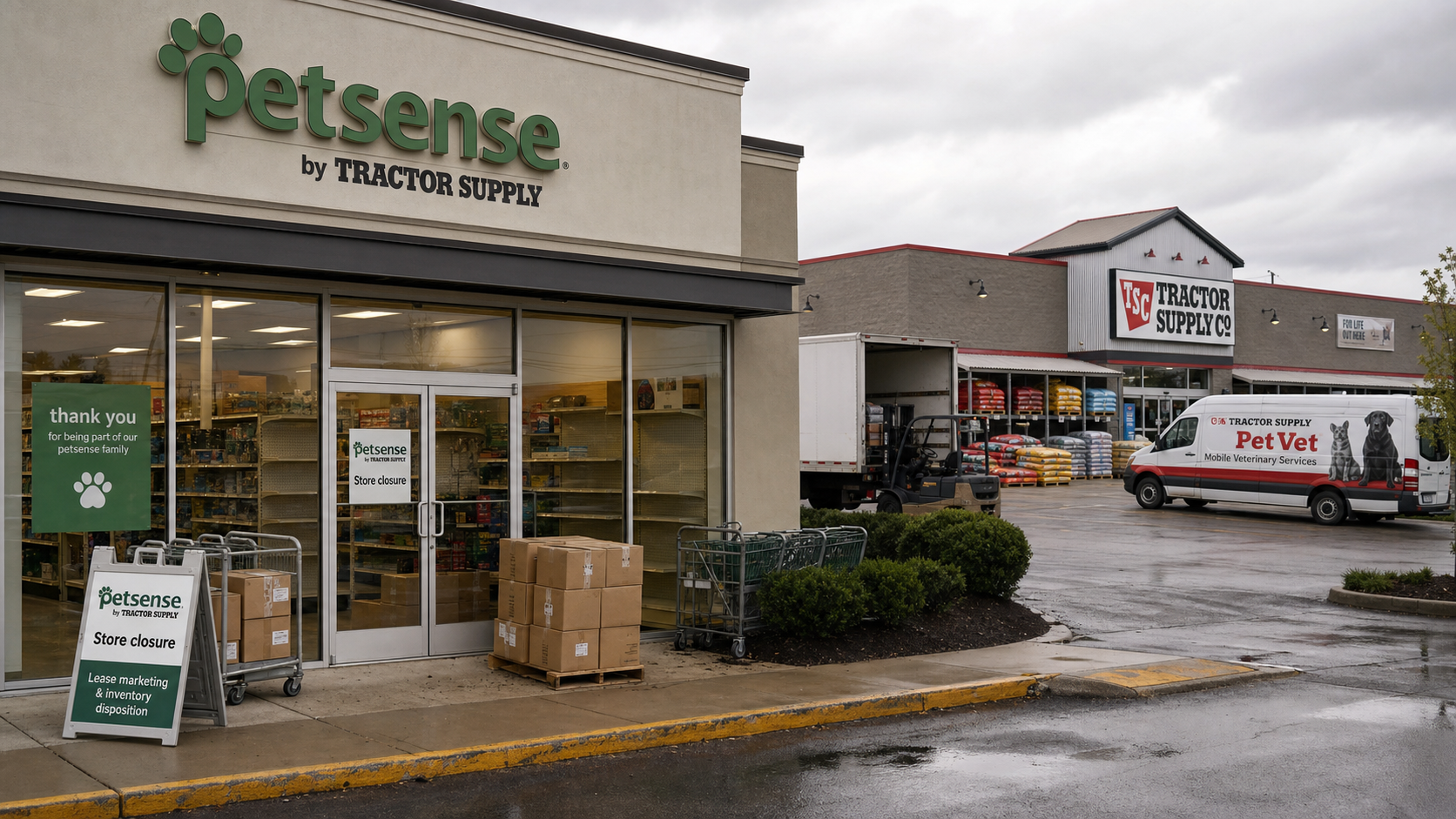
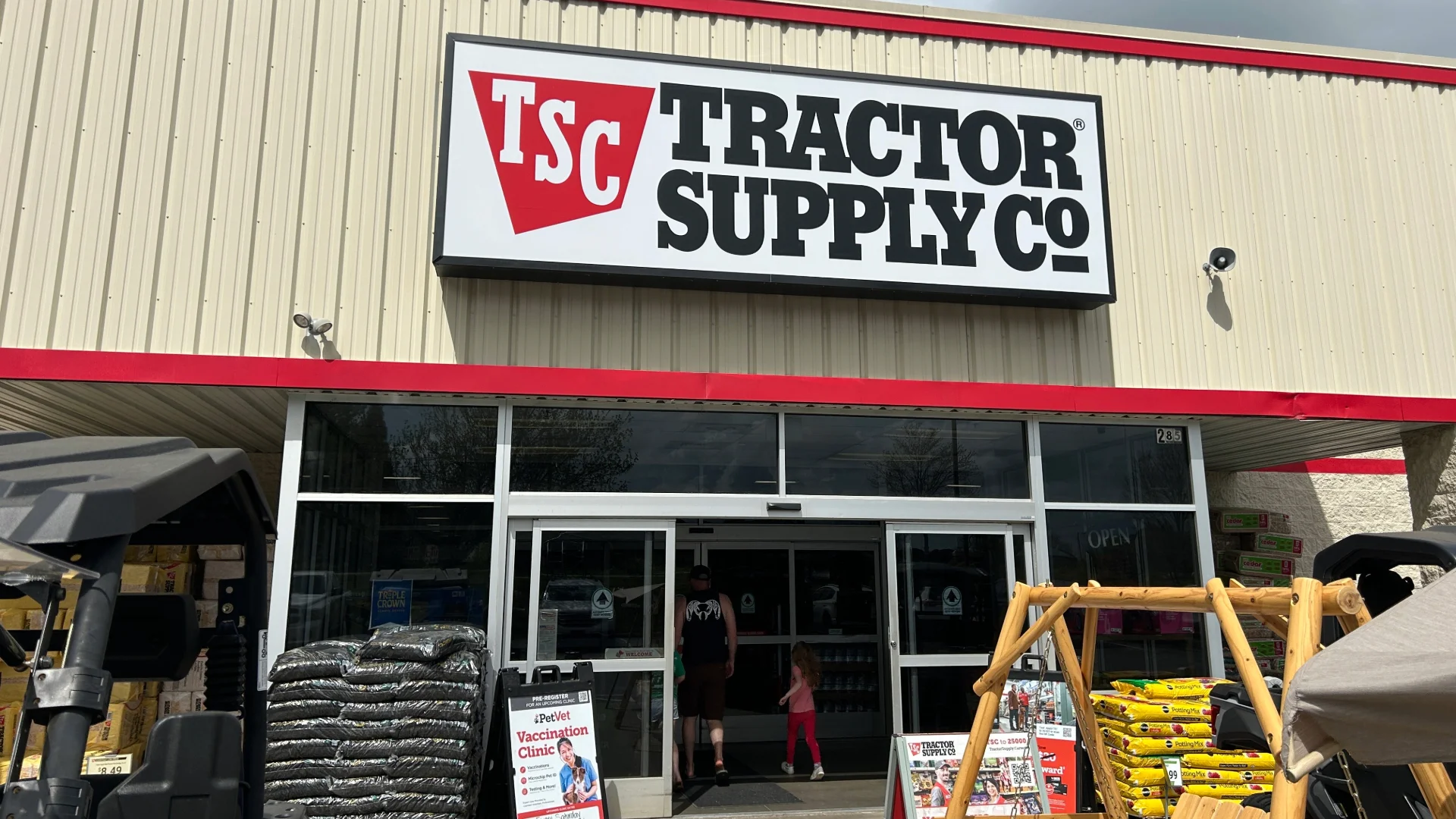


Tractor Supply Co.'s announcement to close 75 underperforming Petsense stores represents a critical inflection point for pet product sellers and reveals broader retail consolidation trends affecting rural markets. The Tennessee-based company, which operates 2,463 stores across the U.S., is redirecting capital from physical expansion (reducing 2026 plans from 100 to 85-90 new locations) toward technology upgrades and delivery capabilities—signaling that omnichannel and O2O strategies now outweigh traditional brick-and-mortar growth. This shift creates immediate opportunities for cross-border pet product sellers to capture market share through direct-to-consumer channels and strategic retail partnerships in the 23 states where Petsense currently operates.
The underlying drivers reveal critical consumer behavior shifts: Tractor Supply reported a 1.5% decline in comparable store sales despite 2.3% net sales growth, indicating that online channels are cannibalizing physical store traffic. CEO Hal Lawton attributed performance challenges to increased fuel costs and reduced discretionary spending among rural customers—a demographic particularly sensitive to economic pressures. Persistent drought conditions in southeastern markets further compressed seasonal demand for lawn care and outdoor products, demonstrating how regional economic shocks disproportionately impact rural retailers. For sellers, this signals that rural consumers are increasingly price-sensitive and willing to shift to online purchasing, creating demand for competitive pet product offerings on Amazon, Walmart.com, and specialty pet marketplaces.
From an O2O perspective, the 75 store closures create a critical window for pop-up and showroom strategies. Sellers can identify high-traffic Petsense locations in the 23-state footprint (particularly in drought-affected southeastern markets where demand is suppressed) and negotiate short-term retail partnerships or pop-up arrangements with Tractor Supply's remaining 134 Petsense locations. The company's stated focus on "remodeling existing stores" and "upgrading store technology" suggests openness to co-branded experiences and vendor partnerships that enhance digital integration. Additionally, the shift toward delivery capabilities indicates that sellers should prioritize fulfillment partnerships with regional 3PLs serving rural areas, where last-mile logistics remain a competitive advantage. Historical data shows that pet category sellers who combine online presence with localized offline touchpoints achieve 25-35% higher customer LTV compared to pure-play e-commerce competitors.
Tractor Supply's decision to close 75 of 209 Petsense locations (36% reduction) raises questions about the long-term viability of the remaining 134 stores. Sellers should assess closure risk by monitoring: (1) **Store-level profitability**: Tractor Supply will likely continue evaluating underperforming locations; the remaining 134 stores may face additional closures if comparable store sales don't improve; (2) **Comparable store sales trends**: If the -1.5% decline persists or worsens, expect additional closures in 2025-2026; (3) **Regional performance variance**: Drought-affected southeastern markets show the weakest performance; stores in these regions face higher closure risk; (4) **Tractor Supply's capital allocation**: The company is redirecting resources toward technology and delivery, not physical retail expansion, suggesting a long-term shift away from brick-and-mortar. Sellers should: avoid over-relying on Petsense as a distribution channel; diversify retail partnerships across multiple chains (Walmart, Target, regional pet retailers); and prioritize direct-to-consumer channels where they control the customer relationship. Risk mitigation strategy: maintain 60-90 day inventory buffers and monitor Tractor Supply's quarterly earnings calls for additional closure announcements.
Tractor Supply's 1.5% comparable store sales decline despite 2.3% net sales growth reveals a **critical market dynamic: online channels are cannibalizing physical store traffic**. The gap between net sales growth (+2.3%) and comparable store sales decline (-1.5%) indicates that growth is driven by new channels (e-commerce, delivery) rather than existing store productivity. For pet product sellers, this signals: (1) **Online pet retail is growing faster than physical retail**: The market is shifting toward direct-to-consumer and marketplace channels; (2) **Physical stores are becoming showrooms**: Customers may visit Petsense to browse but purchase online, suggesting that sellers should optimize for omnichannel discovery; (3) **Retail partnerships require digital integration**: Tractor Supply's investment in store technology suggests that future retail partnerships will emphasize online visibility and fulfillment integration. Sellers should prioritize: Amazon and Walmart.com optimization (these channels are likely capturing the 3.8% gap between net sales and comparable store sales); omnichannel inventory visibility; and retail partnerships that include online co-merchandising and fulfillment support. Pet category sellers with strong online presence typically achieve 2-3x higher sales velocity than pure-play retail competitors.
The 75 closures create three immediate O2O opportunities: (1) **Pop-up partnerships** in high-traffic Tractor Supply locations within the 23-state Petsense footprint, particularly in drought-affected southeastern markets where offline foot traffic is suppressed; (2) **Retail partnership negotiations** with the remaining 134 Petsense locations, which are being remodeled and upgraded with technology—creating demand for vendor co-branded experiences; (3) **Regional 3PL partnerships** to support Tractor Supply's stated expansion of delivery capabilities, positioning sellers as fulfillment partners for rural last-mile logistics. Industry benchmarks show that pet category sellers combining online presence with localized offline touchpoints achieve 25-35% higher customer LTV. Sellers should identify 3-5 high-potential Petsense locations in their target regions and approach Tractor Supply's vendor management team within 60 days to negotiate pilot programs before the company finalizes closure decisions.
Tractor Supply is closing 75 of its 209 Petsense locations (36% reduction) to improve operational returns and redirect capital toward technology upgrades and delivery capabilities. The company reported a 1.5% decline in comparable store sales, indicating that physical retail expansion is no longer the primary growth driver. For pet product sellers, this signals a critical market shift: **rural consumers are migrating to online channels**, creating demand for competitive pet products on Amazon, Walmart.com, and specialty pet e-commerce platforms. Sellers should immediately audit their presence in the 23 states where Petsense operates and consider whether their current online positioning captures the displaced customer base. The closure window (typically 6-12 months) presents a 90-120 day opportunity to launch targeted PPC campaigns and retail partnerships before market consolidation completes.
Tractor Supply is reallocating capital from 100 planned new stores (reduced to 85-90) toward **remodeling existing stores, upgrading technology, and expanding delivery capabilities**—a clear signal that the company is pursuing an omnichannel model. For pet product sellers, this means: (1) **3PL partnerships become critical**: Tractor Supply will likely partner with regional logistics providers to serve rural delivery zones; sellers should identify and negotiate with the same 3PLs to ensure competitive fulfillment costs; (2) **Inventory positioning shifts**: Rather than stocking deep inventory in physical stores, Tractor Supply will likely adopt hub-and-spoke fulfillment from fewer, larger distribution centers; sellers should adjust their wholesale inventory strategy accordingly; (3) **Technology integration**: Upgraded store technology suggests integration with online ordering, in-store pickup, and real-time inventory visibility; sellers should ensure their product data and fulfillment capabilities align with these systems. Rural delivery costs typically run 15-25% higher than urban markets; sellers should budget accordingly and consider regional 3PL partnerships to maintain margin competitiveness.
The 75 closures span 23 states, but **southeastern markets are disproportionately impacted** due to persistent drought conditions that suppressed seasonal demand for lawn care and outdoor products. Tractor Supply's rural customer base is particularly sensitive to fuel costs and discretionary spending pressures, making drought-affected regions (Texas, Oklahoma, Arkansas, Louisiana, Georgia, North Carolina) priority markets for sellers. These regions show the highest demand for delivery-first models and online pet product purchasing. Sellers should prioritize pop-up locations in: (1) metropolitan areas within rural states (Austin TX, Oklahoma City OK, Atlanta GA) where Petsense closures create supply gaps; (2) secondary markets with 50K-200K population where Tractor Supply's remaining stores serve as anchor retail partners; (3) regions with high fuel costs and long customer drive times, where online convenience is most valued. Data shows rural pet product sellers achieve 40-50% higher conversion rates in markets with 2-3 competing offline retailers versus saturated urban markets.
Tractor Supply's CEO attributed performance challenges to **increased fuel costs and reduced customer discretionary spending** among rural customers, who drive longer distances in fuel-intensive vehicles. This reveals critical pricing and positioning insights for pet product sellers: (1) **Price sensitivity is elevated**: Rural customers are cutting discretionary spending, meaning premium pet products face headwinds while value-oriented offerings gain share; (2) **Fuel costs create geographic arbitrage**: Customers in high-fuel-cost regions (Texas, Oklahoma, rural Southeast) are more likely to shift to online purchasing to avoid driving; (3) **Seasonal volatility increases**: Drought conditions suppressed lawn care demand, indicating that pet product demand is correlated with broader agricultural/seasonal cycles. Sellers should: adjust pricing strategies to emphasize value and bundling; increase PPC spend in high-fuel-cost regions where online convenience is most valued; and diversify product mix toward year-round pet essentials (food, supplements) rather than seasonal items. Data shows rural pet product sellers achieve 15-20% higher margins on subscription/recurring purchases versus one-time buys.
Tractor Supply has not announced specific closure timelines or store locations, but **typical retail closures follow a 6-12 month wind-down period**. The company's Q2 financial call announcement suggests closures will likely begin in Q4 2024 or Q1 2025. Sellers should act immediately within the next 60-90 days to: (1) **Identify target Petsense locations** in their geographic focus areas using Tractor Supply's store locator; (2) **Develop O2O proposals** for pop-up partnerships or vendor co-branded experiences; (3) **Contact Tractor Supply vendor management** to discuss partnership opportunities before closure decisions are finalized; (4) **Launch targeted PPC campaigns** on Amazon and Walmart.com in the 23-state Petsense footprint to capture displaced customers. Historical data shows that retailers announce closures 90-120 days before execution; the window to negotiate partnerships typically closes 45-60 days after announcement. Sellers waiting more than 90 days risk missing the partnership opportunity window entirely.
Tractor Supply's decision to close 75 of 209 Petsense locations (36% reduction) raises questions about the long-term viability of the remaining 134 stores. Sellers should assess closure risk by monitoring: (1) **Store-level profitability**: Tractor Supply will likely continue evaluating underperforming locations; the remaining 134 stores may face additional closures if comparable store sales don't improve; (2) **Comparable store sales trends**: If the -1.5% decline persists or worsens, expect additional closures in 2025-2026; (3) **Regional performance variance**: Drought-affected southeastern markets show the weakest performance; stores in these regions face higher closure risk; (4) **Tractor Supply's capital allocation**: The company is redirecting resources toward technology and delivery, not physical retail expansion, suggesting a long-term shift away from brick-and-mortar. Sellers should: avoid over-relying on Petsense as a distribution channel; diversify retail partnerships across multiple chains (Walmart, Target, regional pet retailers); and prioritize direct-to-consumer channels where they control the customer relationship. Risk mitigation strategy: maintain 60-90 day inventory buffers and monitor Tractor Supply's quarterly earnings calls for additional closure announcements.
Tractor Supply's 1.5% comparable store sales decline despite 2.3% net sales growth reveals a **critical market dynamic: online channels are cannibalizing physical store traffic**. The gap between net sales growth (+2.3%) and comparable store sales decline (-1.5%) indicates that growth is driven by new channels (e-commerce, delivery) rather than existing store productivity. For pet product sellers, this signals: (1) **Online pet retail is growing faster than physical retail**: The market is shifting toward direct-to-consumer and marketplace channels; (2) **Physical stores are becoming showrooms**: Customers may visit Petsense to browse but purchase online, suggesting that sellers should optimize for omnichannel discovery; (3) **Retail partnerships require digital integration**: Tractor Supply's investment in store technology suggests that future retail partnerships will emphasize online visibility and fulfillment integration. Sellers should prioritize: Amazon and Walmart.com optimization (these channels are likely capturing the 3.8% gap between net sales and comparable store sales); omnichannel inventory visibility; and retail partnerships that include online co-merchandising and fulfillment support. Pet category sellers with strong online presence typically achieve 2-3x higher sales velocity than pure-play retail competitors.
The 75 closures create three immediate O2O opportunities: (1) **Pop-up partnerships** in high-traffic Tractor Supply locations within the 23-state Petsense footprint, particularly in drought-affected southeastern markets where offline foot traffic is suppressed; (2) **Retail partnership negotiations** with the remaining 134 Petsense locations, which are being remodeled and upgraded with technology—creating demand for vendor co-branded experiences; (3) **Regional 3PL partnerships** to support Tractor Supply's stated expansion of delivery capabilities, positioning sellers as fulfillment partners for rural last-mile logistics. Industry benchmarks show that pet category sellers combining online presence with localized offline touchpoints achieve 25-35% higher customer LTV. Sellers should identify 3-5 high-potential Petsense locations in their target regions and approach Tractor Supply's vendor management team within 60 days to negotiate pilot programs before the company finalizes closure decisions.
Tractor Supply is closing 75 of its 209 Petsense locations (36% reduction) to improve operational returns and redirect capital toward technology upgrades and delivery capabilities. The company reported a 1.5% decline in comparable store sales, indicating that physical retail expansion is no longer the primary growth driver. For pet product sellers, this signals a critical market shift: **rural consumers are migrating to online channels**, creating demand for competitive pet products on Amazon, Walmart.com, and specialty pet e-commerce platforms. Sellers should immediately audit their presence in the 23 states where Petsense operates and consider whether their current online positioning captures the displaced customer base. The closure window (typically 6-12 months) presents a 90-120 day opportunity to launch targeted PPC campaigns and retail partnerships before market consolidation completes.
Tractor Supply is reallocating capital from 100 planned new stores (reduced to 85-90) toward **remodeling existing stores, upgrading technology, and expanding delivery capabilities**—a clear signal that the company is pursuing an omnichannel model. For pet product sellers, this means: (1) **3PL partnerships become critical**: Tractor Supply will likely partner with regional logistics providers to serve rural delivery zones; sellers should identify and negotiate with the same 3PLs to ensure competitive fulfillment costs; (2) **Inventory positioning shifts**: Rather than stocking deep inventory in physical stores, Tractor Supply will likely adopt hub-and-spoke fulfillment from fewer, larger distribution centers; sellers should adjust their wholesale inventory strategy accordingly; (3) **Technology integration**: Upgraded store technology suggests integration with online ordering, in-store pickup, and real-time inventory visibility; sellers should ensure their product data and fulfillment capabilities align with these systems. Rural delivery costs typically run 15-25% higher than urban markets; sellers should budget accordingly and consider regional 3PL partnerships to maintain margin competitiveness.
The 75 closures span 23 states, but **southeastern markets are disproportionately impacted** due to persistent drought conditions that suppressed seasonal demand for lawn care and outdoor products. Tractor Supply's rural customer base is particularly sensitive to fuel costs and discretionary spending pressures, making drought-affected regions (Texas, Oklahoma, Arkansas, Louisiana, Georgia, North Carolina) priority markets for sellers. These regions show the highest demand for delivery-first models and online pet product purchasing. Sellers should prioritize pop-up locations in: (1) metropolitan areas within rural states (Austin TX, Oklahoma City OK, Atlanta GA) where Petsense closures create supply gaps; (2) secondary markets with 50K-200K population where Tractor Supply's remaining stores serve as anchor retail partners; (3) regions with high fuel costs and long customer drive times, where online convenience is most valued. Data shows rural pet product sellers achieve 40-50% higher conversion rates in markets with 2-3 competing offline retailers versus saturated urban markets.
Tractor Supply's CEO attributed performance challenges to **increased fuel costs and reduced customer discretionary spending** among rural customers, who drive longer distances in fuel-intensive vehicles. This reveals critical pricing and positioning insights for pet product sellers: (1) **Price sensitivity is elevated**: Rural customers are cutting discretionary spending, meaning premium pet products face headwinds while value-oriented offerings gain share; (2) **Fuel costs create geographic arbitrage**: Customers in high-fuel-cost regions (Texas, Oklahoma, rural Southeast) are more likely to shift to online purchasing to avoid driving; (3) **Seasonal volatility increases**: Drought conditions suppressed lawn care demand, indicating that pet product demand is correlated with broader agricultural/seasonal cycles. Sellers should: adjust pricing strategies to emphasize value and bundling; increase PPC spend in high-fuel-cost regions where online convenience is most valued; and diversify product mix toward year-round pet essentials (food, supplements) rather than seasonal items. Data shows rural pet product sellers achieve 15-20% higher margins on subscription/recurring purchases versus one-time buys.
Tractor Supply has not announced specific closure timelines or store locations, but **typical retail closures follow a 6-12 month wind-down period**. The company's Q2 financial call announcement suggests closures will likely begin in Q4 2024 or Q1 2025. Sellers should act immediately within the next 60-90 days to: (1) **Identify target Petsense locations** in their geographic focus areas using Tractor Supply's store locator; (2) **Develop O2O proposals** for pop-up partnerships or vendor co-branded experiences; (3) **Contact Tractor Supply vendor management** to discuss partnership opportunities before closure decisions are finalized; (4) **Launch targeted PPC campaigns** on Amazon and Walmart.com in the 23-state Petsense footprint to capture displaced customers. Historical data shows that retailers announce closures 90-120 days before execution; the window to negotiate partnerships typically closes 45-60 days after announcement. Sellers waiting more than 90 days risk missing the partnership opportunity window entirely.
Tractor Supply's decision to close 75 of 209 Petsense locations (36% reduction) raises questions about the long-term viability of the remaining 134 stores. Sellers should assess closure risk by monitoring: (1) **Store-level profitability**: Tractor Supply will likely continue evaluating underperforming locations; the remaining 134 stores may face additional closures if comparable store sales don't improve; (2) **Comparable store sales trends**: If the -1.5% decline persists or worsens, expect additional closures in 2025-2026; (3) **Regional performance variance**: Drought-affected southeastern markets show the weakest performance; stores in these regions face higher closure risk; (4) **Tractor Supply's capital allocation**: The company is redirecting resources toward technology and delivery, not physical retail expansion, suggesting a long-term shift away from brick-and-mortar. Sellers should: avoid over-relying on Petsense as a distribution channel; diversify retail partnerships across multiple chains (Walmart, Target, regional pet retailers); and prioritize direct-to-consumer channels where they control the customer relationship. Risk mitigation strategy: maintain 60-90 day inventory buffers and monitor Tractor Supply's quarterly earnings calls for additional closure announcements.
Tractor Supply's 1.5% comparable store sales decline despite 2.3% net sales growth reveals a **critical market dynamic: online channels are cannibalizing physical store traffic**. The gap between net sales growth (+2.3%) and comparable store sales decline (-1.5%) indicates that growth is driven by new channels (e-commerce, delivery) rather than existing store productivity. For pet product sellers, this signals: (1) **Online pet retail is growing faster than physical retail**: The market is shifting toward direct-to-consumer and marketplace channels; (2) **Physical stores are becoming showrooms**: Customers may visit Petsense to browse but purchase online, suggesting that sellers should optimize for omnichannel discovery; (3) **Retail partnerships require digital integration**: Tractor Supply's investment in store technology suggests that future retail partnerships will emphasize online visibility and fulfillment integration. Sellers should prioritize: Amazon and Walmart.com optimization (these channels are likely capturing the 3.8% gap between net sales and comparable store sales); omnichannel inventory visibility; and retail partnerships that include online co-merchandising and fulfillment support. Pet category sellers with strong online presence typically achieve 2-3x higher sales velocity than pure-play retail competitors.