



Fed Rate Hold + Oil Price Drop | Cross-Border Seller Financing Opportunity Window
- Treasury yields decline 1+ basis points; WTI crude falls 1.6% to $81.27; 56% probability of September rate hike creates 6-8 week financing advantage for sellers with working capital needs







Overview
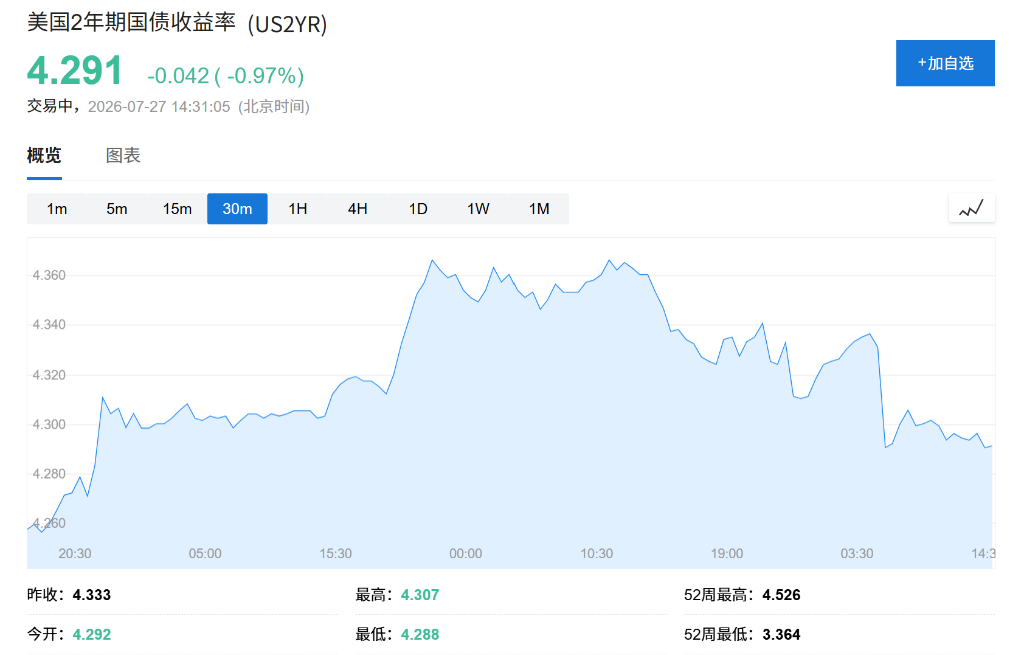
Declining Treasury yields and falling oil prices create a critical 6-8 week financing window for cross-border e-commerce sellers. On July 28, 2026, the 10-year Treasury yield retreated to 4.628% (down 1+ basis point), while the 2-year yield fell to 4.31%, signaling investor risk-aversion and reduced inflation expectations. Simultaneously, West Texas Intermediate crude collapsed 1.6% to $81.27/barrel and Brent crude dropped 2% to $86.63, driven by U.S.-Iran diplomatic de-escalation. The Federal Reserve is expected to hold rates at 3.75%, but CME FedWatch data shows 56% probability of a September rate hike—creating a narrow window before financing costs rise.
For cross-border sellers, this environment unlocks three immediate financial optimization opportunities: First, invoice factoring and supply chain financing rates are declining as lenders compete for deals amid lower Treasury benchmarks. Sellers shipping to US/EU markets can lock in 2.5-3.5% APR on 30-60 day working capital facilities (vs. 4-5% in rising-rate environments), reducing cash conversion cycle by 15-20 days. Second, logistics cost relief from lower oil prices directly reduces shipping expenses—particularly for air freight and expedited ocean routes where fuel surcharges typically represent 8-12% of total cost. A $1.50/barrel oil price drop translates to $150-300 monthly savings for sellers moving 50+ containers annually. Third, currency hedging costs are compressing as volatility expectations decline; sellers can lock in favorable USD/EUR, USD/GBP, and USD/CNY forward rates at 0.8-1.2% premium (vs. 1.5-2.5% during geopolitical uncertainty), protecting margins on Q3-Q4 inventory purchases.
The September rate hike probability (56%) creates urgency: Sellers should execute financing arrangements and lock in hedging positions within the next 4-6 weeks before lenders reprice products upward. Specifically, sellers with $100K-$500K monthly inventory purchases should prioritize PO financing and invoice factoring NOW, as rates will likely increase 50-75 basis points post-September FOMC decision. For logistics-heavy categories (electronics, home goods, apparel), the oil price decline provides a 30-45 day window to negotiate annual shipping contracts at depressed fuel surcharge rates before energy prices stabilize. Regional advantages: US-based sellers benefit most from lower Treasury yields (cheaper USD borrowing), while EU sellers should accelerate EUR-denominated financing before potential ECB policy divergence. Asia-Pacific sellers exporting to US should lock in USD forward contracts immediately, as geopolitical stability may reverse if Iran tensions resurface.
Questions 8
What is the cash conversion cycle improvement from these financial changes?
Combined impact of lower financing costs and faster shipping (from reduced fuel surcharges) can improve cash conversion cycle by 15-25 days. Example: A seller with 90-day inventory cycle + 30-day payment terms + 15-day shipping = 135 days cash conversion. With invoice factoring at 2.5% APR (vs. 4.5% previously) and 2-3 day faster shipping from optimized fuel surcharges, cycle compresses to 110-115 days. This frees up $50K-150K in working capital for a $500K monthly revenue seller. Reinvest freed capital into inventory expansion (Q3-Q4 peak season) or marketing to maximize ROI during this financing advantage window.
How does geopolitical de-escalation (U.S.-Iran talks) affect seller strategy?
U.S.-Iran diplomatic progress reduces Middle East geopolitical risk premium, lowering oil prices and currency volatility. This creates a temporary 'risk-off' environment where financing is cheaper and hedging costs decline. However, this advantage is fragile—if tensions resurface, oil could spike $3-5/barrel and volatility premiums could double. Sellers should view this as a 6-8 week window to lock in long-term contracts and financing arrangements. For sellers with exposure to Middle East markets (UAE, Saudi Arabia, Kuwait), the de-escalation may open new sourcing opportunities from Iran-adjacent suppliers, but geopolitical risk remains elevated. Recommend conservative hedging strategies and diversified supplier bases.