



Nvidia Nemotron 3.5 Lightning Cuts AI Costs 67% | E-Commerce Automation Breakthrough
- Open-source model delivers 4x faster agentic AI with 30% task speedup; NeMo Switchyard reduces costs to 1/3 of Opus 4.8; sellers can now automate customer service, product research, pricing at enterprise scale without licensing fees















Overview
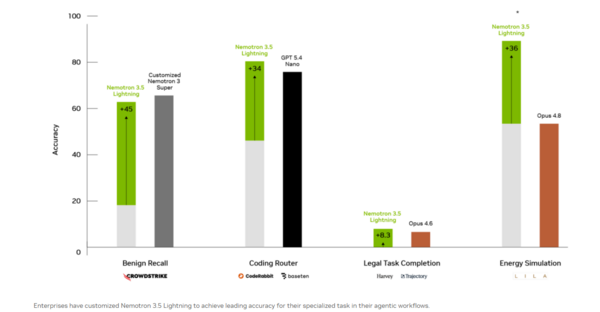
Nvidia's August 2026 release of Nemotron 3.5 Lightning (30B parameters) and NeMo Switchyard represents a watershed moment for e-commerce automation economics. The 30-billion-parameter mixture-of-experts model delivers 4x faster output speed and 30% faster agentic task completion versus competing models while maintaining frontier-level accuracy. More critically for sellers: NeMo Switchyard reduces task completion costs to approximately one-third of Claude Opus 4.8, with early partners reporting 21-74% cost reductions and 21-33% runtime improvements. This is not incremental—it's a structural shift in AI affordability that directly impacts seller operations.
For e-commerce sellers, the immediate automation opportunities are substantial. Nemotron 3.5 Lightning runs on single GPUs on laptops/desktops (NVIDIA RTX PCs, DGX Spark, Jetson devices) and is freely available via HuggingFace, ModelScope, and build.nvidia.com without licensing fees. This eliminates the $500-2,000/month proprietary AI costs that previously deterred mid-market sellers from automation. Sellers can now deploy custom-trained models for: (1) Product research automation—parsing competitor listings, extracting specifications, identifying category trends at 4x faster speed; (2) Dynamic pricing agents—monitoring competitor prices, calculating optimal margins, executing repricing decisions autonomously; (3) Customer service automation—handling routine inquiries, processing returns, managing reviews at 30% faster completion rates; (4) Inventory optimization—forecasting demand, flagging slow-moving SKUs, recommending reorder quantities. The model's customizability via NVIDIA NeMo means sellers can post-train on their own domain data (historical sales, customer behavior, category-specific terminology) to improve accuracy for specialized tasks—critical for niche categories where generic models underperform.
The competitive moat created by early adoption is significant. Sellers who deploy Nemotron 3.5 Lightning by Q4 2026 gain 6-12 months of operational advantage before competitors catch up. The cost structure ($0 licensing + minimal GPU infrastructure) means sellers with 500+ SKUs can achieve ROI within 30-60 days through labor savings alone. A mid-market seller automating 20 hours/week of pricing research (at $25/hour = $500/week) recovers GPU infrastructure costs ($200-400/month) within 2-3 weeks. NeMo Switchyard's intelligent routing further amplifies ROI by automatically selecting the most cost-effective model for each task—using Nemotron 3.5 Lightning for routine tasks (customer inquiries, basic pricing) while routing complex decisions to frontier models only when necessary, reducing overall AI spend by 50-67%. This hybrid approach is unavailable from proprietary vendors like OpenAI or Anthropic, creating a structural advantage for sellers willing to implement open-source infrastructure.
The broader ecosystem shift signals accelerating AI democratization. Nvidia's simultaneous development of Nemotron 4 (1+ trillion parameters, late-fall 2026 availability) indicates sustained commitment to open-source competition with OpenAI/Anthropic. Meta's same-day release of Muse Spark (coding model) and Nvidia's AI safety consortium with Microsoft demonstrate industry-wide momentum toward open-weight models. For sellers, this means: (1) Declining AI costs over 12-24 months—as more open models compete, proprietary pricing pressure increases; (2) Increased tool ecosystem—platforms like LangChain, LiteLLM, Kong, and Ramp have already integrated NeMo Switchyard, meaning sellers can access these capabilities through existing e-commerce tools without custom development; (3) Reduced vendor lock-in—sellers can switch between models without application rewrites, enabling negotiation leverage with platform providers. However, open-source models lack built-in cybersecurity safeguards (acknowledged in news), requiring sellers to implement additional security layers for customer data handling—a compliance cost of $5-15K for mid-market operations.
Questions 7
What security risks should sellers consider when deploying open-source Nemotron models?
Open-source models lack built-in cybersecurity safeguards, creating potential risks for malicious applications—a concern highlighted by recent autonomous AI agent exploits mentioned in industry reports. Sellers deploying Nemotron 3.5 Lightning must implement additional security layers for customer data handling, including: (1) input validation to prevent prompt injection attacks; (2) output filtering to prevent data leakage; (3) access controls limiting model access to authorized systems; (4) audit logging for compliance. These security implementations cost $5-15K for mid-market operations. Sellers should also monitor Nvidia's AI safety consortium with Microsoft (focusing on open-source software for cybersecurity applications) for emerging best practices. The tradeoff is clear: 67% cost savings versus proprietary models requires accepting security implementation responsibility that vendors like OpenAI handle internally.
When will Nemotron 4 (1+ trillion parameters) be available and how will it affect seller strategy?
Nemotron 4 is expected in late-fall 2026 pending final training completion, according to The Information's August 11, 2026 report. The largest model will feature at least 1 trillion parameters, positioning it competitively against leading open-source models, though it's anticipated to lag behind frontier models from OpenAI and Anthropic. For sellers, Nemotron 4's availability signals: (1) Sustained open-source competition will continue driving down proprietary AI costs; (2) Sellers should plan infrastructure investments now to support larger models by Q4 2026; (3) NeMo Switchyard's intelligent routing will become more valuable as model options expand—sellers can route complex tasks to Nemotron 4 while using Nemotron 3.5 Lightning for routine operations. Sellers should adopt Nemotron 3.5 Lightning immediately to establish operational baselines and gain 6-12 months of competitive advantage before Nemotron 4 commoditizes larger-model capabilities.