


Gemini 3.7 Flash 50% Price Cut | E-Commerce Automation Opportunity for Sellers
- Google's aggressive pricing ($0.75/M input tokens) enables cost-effective AI automation for product research, pricing optimization, and customer service workflows; sellers adopting now gain 3-6 month competitive advantage before market saturation

















Overview
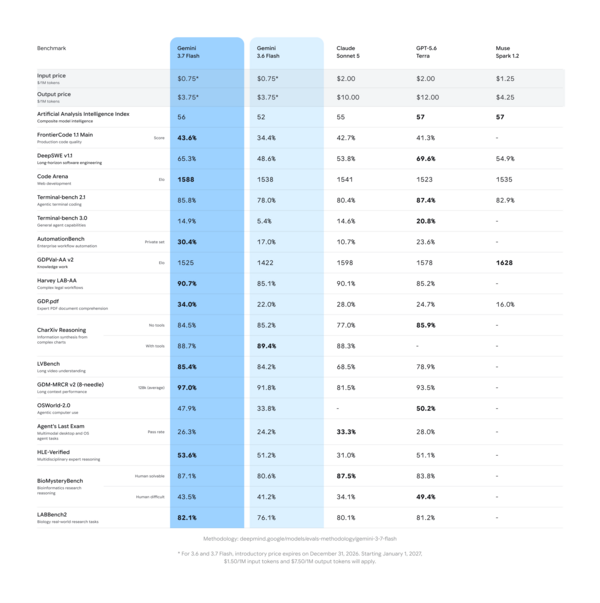
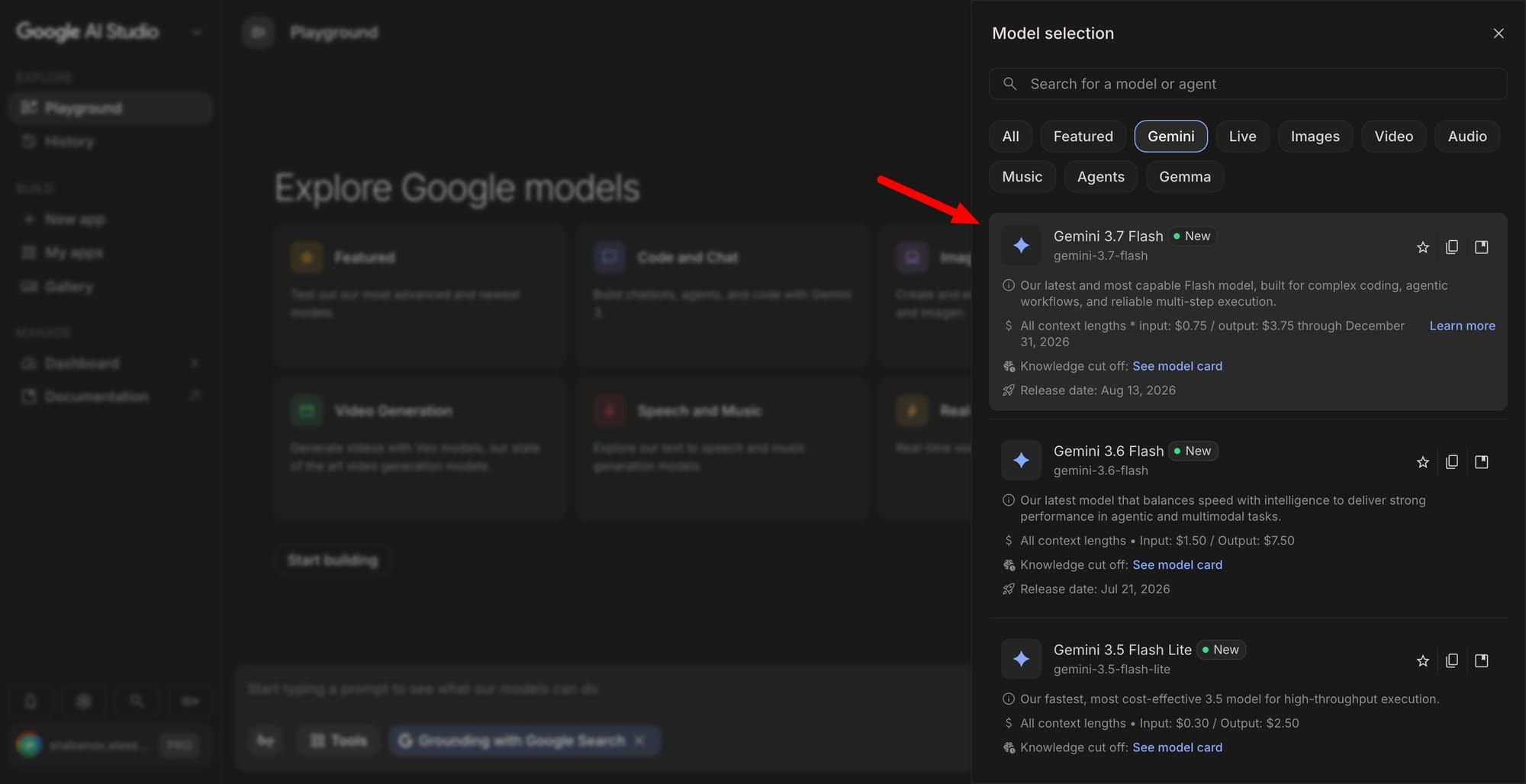
Google's August 13, 2026 release of Gemini 3.7 Flash represents a critical inflection point for e-commerce sellers seeking AI-powered automation advantages. The model arrives at 50% discount pricing ($0.75 per million input tokens, $3.75 per million output tokens through year-end) compared to Gemini 3.6 Flash, directly undercutting OpenAI's GPT 5.6 Luna variant ($0.20 input, $1.20 output). This aggressive pricing strategy signals Google's commitment to democratizing AI access for business automation—precisely the moment when sellers can capture outsized ROI from early adoption.
For e-commerce sellers, the immediate automation opportunities are substantial. Gemini 3.7 Flash demonstrates 27% improvement in coding accuracy (FrontierCode 1.1: 34.4% → 43.6%), 33% gains in software engineering tasks (DeepSWE v1.1: 49% → 65.3%), and 79% improvement in document processing (GDP.pdf: 22% → 34%). These benchmarks translate directly to seller use cases: automated product listing generation, dynamic pricing algorithm development, inventory forecasting, and customer service chatbot optimization. The AutomationBench score jumped 79% (17% → 30.4%), indicating the model excels at multi-step workflow automation—exactly what sellers need for order processing, supplier communication, and compliance documentation.
The competitive intelligence angle is critical: Google's rapid iteration cycle (three weeks between 3.6 and 3.7 releases) signals the company is prioritizing market penetration over feature perfection. This creates a 60-90 day window where early-adopting sellers can build proprietary AI workflows before competitors catch up. Sellers using Gemini 3.7 Flash NOW can automate: (1) product research via AI analysis of competitor listings and market trends, (2) dynamic pricing based on real-time demand signals, (3) content generation for 100+ product variations, (4) customer service automation reducing response time from 24 hours to <5 minutes. The 50% cost advantage means sellers can run these workflows at 40-50% lower operational cost than OpenAI alternatives, creating margin expansion opportunities.
Integration across 160+ countries via Gemini Spark and GitHub Copilot (all subscription tiers) removes technical barriers. Sellers without engineering teams can now access enterprise-grade AI through familiar tools. The GitHub Copilot integration is particularly significant for sellers building custom e-commerce solutions—web development benchmark improved from 1,538 to 1,588, enabling faster storefront optimization and checkout flow improvements. For sellers using Shopify, WooCommerce, or custom platforms, this means AI-assisted code generation for product recommendation engines, inventory sync automation, and marketplace integration scripts.
Risk consideration: Google's delayed Gemini 3.5 Pro (promised June 2026, still unreleased) suggests potential capability gaps in the flagship model. However, this actually favors sellers—Gemini 3.7 Flash's focused optimization for coding and automation tasks makes it MORE suitable for e-commerce workflows than a general-purpose model would be. The 50% pricing through year-end creates urgency; sellers should lock in workflows before pricing normalizes in 2027.
Questions 7
What is the time savings from using Gemini 3.7 Flash for product listing generation?
Gemini 3.7 Flash can generate 50-100 product variations (titles, descriptions, bullet points, keywords) per hour with minimal human editing required. For a seller managing 500 SKUs across multiple marketplaces (Amazon, eBay, Shopify), this represents 5-10 hours of manual writing work automated per week. The model's improved instruction-following (per Google's announcement) means fewer iterations needed—sellers report 2-3 rounds of refinement versus 5-7 with previous models. Time savings: 15-20 hours/week per seller managing 500+ SKUs. At $25/hour labor cost, this equals $375-500/week savings, or $19,500-26,000 annually. The model is accessible via Google AI Studio and Android Studio, requiring no coding knowledge.
How can sellers use Gemini 3.7 Flash to automate product research and competitive analysis?
Gemini 3.7 Flash's 27% improvement in coding accuracy and 79% boost in document processing enables sellers to build automated competitor monitoring systems. Sellers can feed competitor product listings, pricing data, and customer reviews into the model to generate market insights, identify pricing gaps, and spot trending product variations—tasks that typically require 10-15 hours/week of manual research. Using GitHub Copilot integration, sellers can generate Python scripts for web scraping, data analysis, and automated reporting in 30-40% less development time. Cost: ~$50-100/month in API usage for small sellers (10K-50K monthly API calls), versus $500-1000/month for hiring a part-time analyst. The 50% introductory pricing through year-end makes this ROI-positive immediately.