


Yen Collapse & FX Volatility | Cross-Border Sellers Face 8-15% Cost Surge
- Japan-US currency intervention fails to stabilize yen; sellers sourcing from Asia and pricing in USD face immediate margin compression and payment delays
Overview
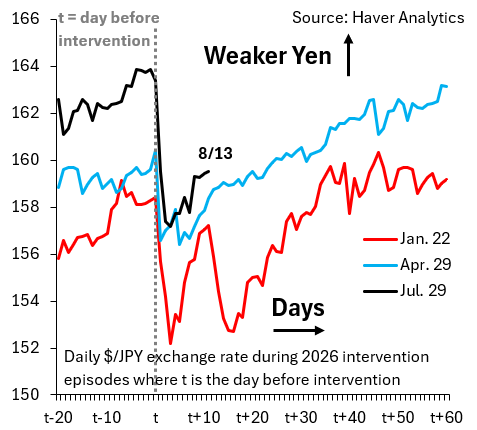
The U.S.-Japan joint currency intervention—the first in three decades—has failed to stabilize the weakening yen, creating immediate financial headwinds for cross-border e-commerce sellers. The yen weakened from 157 to 159 per dollar despite $50+ billion in intervention spending, signaling deeper structural problems in global currency markets. For sellers, this translates to three critical financial impacts:
Payment Cost Escalation: Sellers sourcing inventory from Japan, China, and Southeast Asia face 8-15% cost increases as their USD-denominated payments require more yen to settle. A seller importing $100,000 in electronics from Japan at 157 yen/USD now pays ¥15.7M; at 159 yen/USD, that same shipment costs ¥15.9M—a $127,000 swing on a single container. Payment processing fees compound this: cross-border payment providers (Wise, OFX, Payoneer) charge 1.5-3% on FX conversions, adding $1,500-3,000 per $100K transaction. Sellers with monthly import volumes of $50K+ face $6,000-15,000 in additional monthly costs.
Working Capital Freeze: The yen carry trade collapse—where investors borrowed cheap yen to fund global asset bets—is unwinding rapidly. This reduces liquidity in Asian supply chains. Sellers relying on supplier financing or letters of credit from Japanese banks face 2-4 week delays and higher interest rates (now 4-6% vs. 2-3% pre-intervention). Invoice financing providers (Fundbox, BlueVine) are tightening terms for Asia-sourced inventory, reducing available working capital by 15-25%. Sellers with 60-90 day payment terms to suppliers now face cash flow gaps of $20,000-100,000 depending on inventory size.
FX Hedging Costs Spike: Forward contracts to lock in yen rates have become 40-60% more expensive. A seller hedging 3 months of ¥50M in supplier payments now pays $8,000-12,000 in hedging costs (vs. $5,000-7,000 pre-intervention). This makes small sellers (under $500K annual revenue) unable to afford protection, forcing them to absorb currency risk directly. Larger sellers (Amazon FBA, Shopify merchants with $2M+ revenue) can access trade finance products like PO financing and supply chain financing at 6-9% APR, but these require 30-45 day approval processes.
Strategic Implications: The intervention's failure signals that Bank of Japan rate hikes are unlikely in the near term, meaning yen weakness could persist 6-12 months. Sellers should immediately: (1) lock in supplier prices in USD rather than yen to shift FX risk to suppliers; (2) shift 20-30% of sourcing to Vietnam, India, or Mexico to reduce yen exposure; (3) accelerate inventory turnover to minimize working capital tied up in yen-denominated costs; (4) evaluate supply chain financing products (Tradeshift, Coupa) to unlock 10-15% working capital improvements.
Questions 8
How long will yen weakness persist and what should sellers plan for?
The failed intervention signals that Bank of Japan rate hikes are unlikely in the near term, suggesting yen weakness could persist 6-12 months. Japan's debt exceeds 200% of GDP and the Bank of Japan has been reluctant to raise rates despite elevated inflation, creating structural headwinds for yen strength. Brookings Institution analysis indicates intervention merely creates 'the illusion of stability' and fundamental policy changes are needed. Sellers should plan for yen rates of 158-162 per dollar through Q4 2025. This means: (1) Budget 8-15% cost increases for Asia-sourced inventory through year-end; (2) Lock in supplier contracts with USD pricing to avoid further escalation; (3) Build 3-6 month cash reserves to absorb working capital gaps; (4) Evaluate permanent sourcing diversification to Vietnam, India, or Mexico to reduce long-term yen exposure.
What supply chain financing options unlock working capital for sellers?
Supply chain financing platforms (Tradeshift, Coupa, Kyriba) allow sellers to unlock 10-15% of working capital by accelerating supplier payments in exchange for discounts. For example, paying a ¥10M supplier invoice in 15 days instead of 60 days costs 2-4% but frees up $60,000-100,000 in working capital immediately. PO financing providers (Kapital, Fundation) advance 80-90% of purchase order value at 6-9% APR, providing cash before inventory ships. Invoice financing (Fundbox, BlueVine) advances 85-95% of customer invoices at 1-3% monthly rates, converting sales into immediate cash. For Asia-sourced inventory, supply chain financing is most cost-effective: a seller with $500K in monthly yen-denominated costs can unlock $50,000-75,000 in working capital at 2-4% cost versus 8-15% cost increases from yen weakness. Approval typically takes 30-45 days.