





AI Bubble Rotation Cycle | Sellers Must Adapt to Volatile Tech Valuations & Supply Shocks
- Rolling market corrections in semiconductors, SaaS, and data center components create 3-6 month windows for sellers to capitalize on price volatility and supply chain disruptions through 2027




















)





Overview
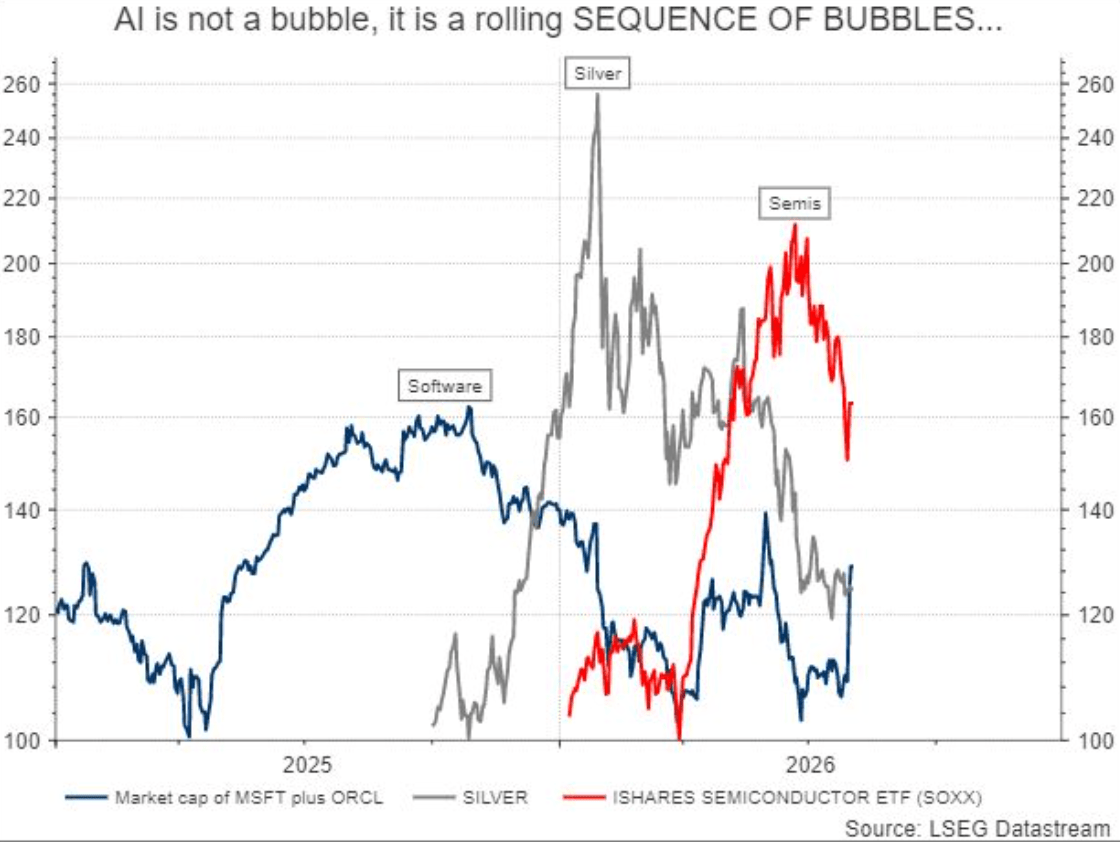
Strategist Dhaval Joshi's "rolling sequence of bubbles" framework reveals a critical market dynamic for e-commerce sellers: rather than a single AI crash, investors are rapidly repricing different AI-related asset classes in succession, creating predictable boom-bust cycles across distinct sectors. This pattern directly impacts seller operations through three mechanisms: (1) SaaS subscription model disruption as AI agents threaten recurring revenue models, (2) semiconductor and component price volatility affecting hardware sellers and electronics categories, and (3) data center infrastructure demand spikes driving 600% surges in DDR3 RAM and conductor materials within 12-month windows.
The news identifies specific market corrections already underway: SaaS stocks crashed as investors recognized AI agents could replace subscription services; silver prices nearly tripled on data center conductor demand before correcting; semiconductor stocks surged on perceived unlimited pricing power, now unwinding as investors recognize chipmakers lack sustainable profit moats. For sellers, this creates actionable intelligence: Joshi predicts AI capital expenditure will peak in late 2026 or early 2027, with three critical risks—sharp interest rate increases, rapid capex cycle unwinding, or recession—that will trigger the next rotation cycle.
Immediate seller implications: Electronics and hardware sellers should monitor DDR3 RAM, semiconductor components, and data center-related products (cooling systems, power supplies, networking equipment) as leading indicators of bubble rotation. The 600% DDR3 RAM surge in under one year demonstrates the amplitude of these cycles. Sellers can use AI-powered price monitoring tools to detect when these components enter bubble phases, then execute dynamic pricing strategies to capture margin expansion before corrections occur. SaaS sellers must prepare for margin compression as AI agents commoditize subscription models—shifting toward usage-based pricing or AI-augmented services creates defensible moats. The fundamental question Joshi raises—"which entity captures AI's value: corporations with moats, individual superusers, or consumers through price competition"—directly determines whether sellers can maintain margins or face commoditization.
Strategic window: With capex projected to peak in late 2026/early 2027, sellers have 18-24 months to position inventory in high-volatility categories (semiconductors, memory, data center components) and establish pricing algorithms that capitalize on the 4-8 week correction cycles Joshi identifies. Amazon, Meta, Microsoft, Alphabet, and Oracle's capex consuming free cash flow by 2027 signals sustained demand for infrastructure products, but with declining pricing power—sellers must shift from margin expansion to volume optimization before the correction hits.
Questions 8
What are the three critical risks that could accelerate the AI bubble correction timeline?
Joshi identifies three critical risks that could trigger earlier corrections than the predicted late 2026/early 2027 peak: (1) **Sharp increases in real interest rates** (above 3-4% real rates) would reduce hyperscaler capex ROI calculations, accelerating budget cuts and demand destruction for semiconductors and infrastructure products, (2) **Rapid capex cycle unwinding** if hyperscalers simultaneously reduce capex guidance (e.g., all five major companies cutting capex 20%+ in same quarter), and (3) **Non-mild recession** that reduces enterprise AI spending and delays infrastructure buildouts. For sellers, these risks mean the 18-24 month window could compress to 12-18 months if any risk materializes. Immediate monitoring actions: (1) Track 10-year Treasury yields and real rate forecasts—if real rates spike above 3%, accelerate inventory liquidation plans, (2) Monitor hyperscaler earnings calls for capex guidance changes—if three or more companies cut capex guidance simultaneously, the correction is likely imminent, and (3) Watch recession probability indicators (yield curve, unemployment, PMI)—if recession probability exceeds 40%, reduce inventory exposure in bubble categories by 30-40%. The amplitude and rapidity of corrections—fortunes made and lost in weeks—means sellers must act decisively when these risk signals appear.
What AI tools should sellers use to detect and capitalize on bubble rotation cycles?
Sellers need three AI-powered capabilities: (1) **Price monitoring and anomaly detection** tools that track semiconductor, memory, and data center component prices across suppliers and marketplaces, alerting when 50%+ spikes occur within 4-week windows (indicating bubble entry), (2) **Dynamic pricing engines** that automatically adjust seller margins based on bubble phase detection—expanding margins 20-30% during bubble phases, contracting 10-15% during corrections, and (3) **Demand forecasting models** that predict which categories will enter bubble phases next by analyzing capex announcements from Amazon, Microsoft, Meta, Alphabet, and Oracle. Specific tools: Use Keepa or CamelCamelCamel for Amazon price history analysis, implement Prisync or Competera for dynamic pricing, and subscribe to earnings call transcripts from hyperscalers to detect capex trend shifts. The ROI is substantial—sellers using dynamic pricing in volatile categories typically see 15-25% margin improvement during bubble phases, with 3-6 month payback periods on tool investments.