
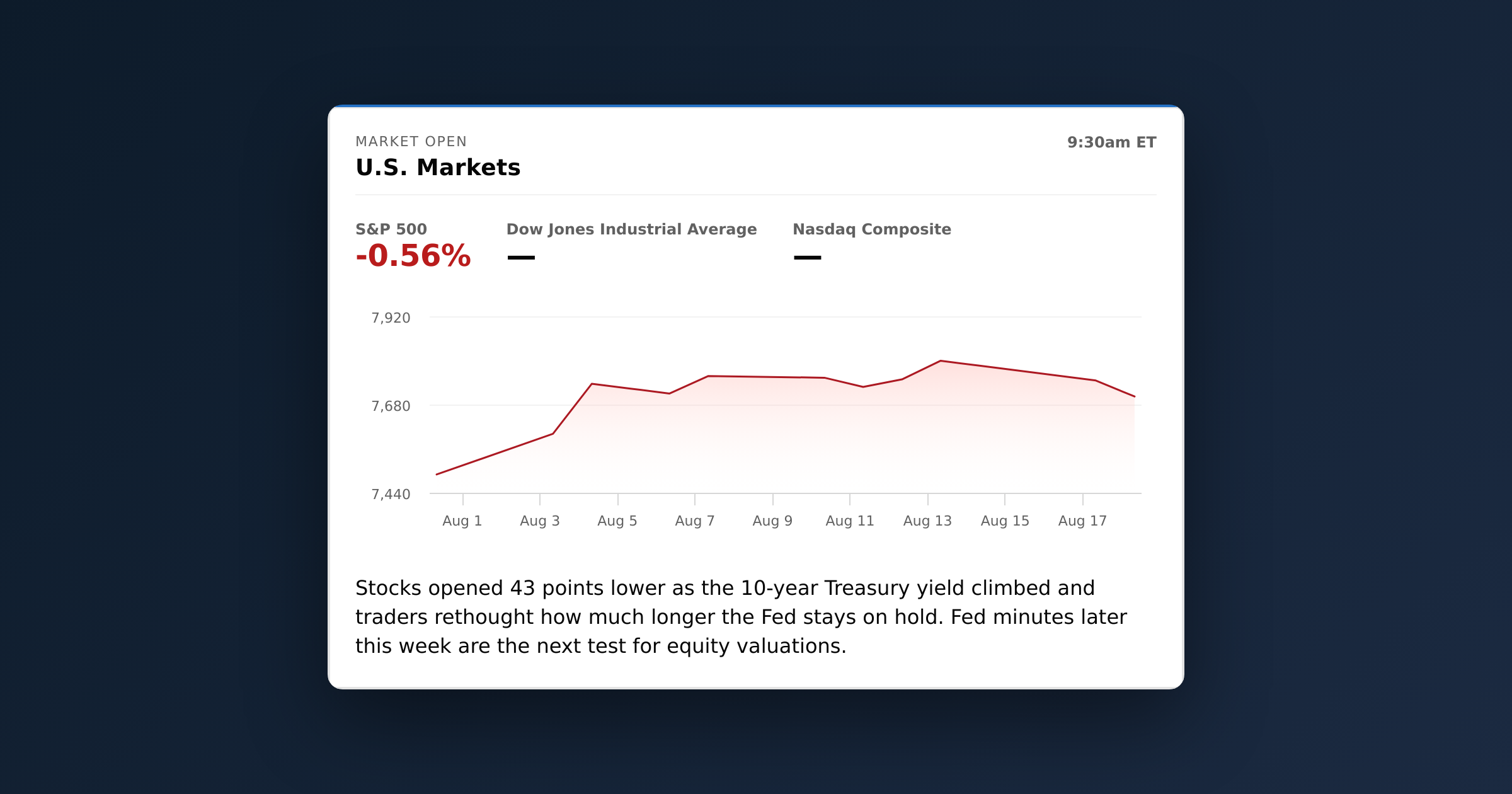




Treasury Yields Hit 19-Year High | Cross-Border Sellers Face Financing Costs & Currency Volatility Crisis
- 30-year Treasury yield reaches 5.33% (August 2026), triggering $432.3B monthly fiscal deficit and Strait of Hormuz closure risks; sellers face 8-15% working capital financing cost increases and 12-18% shipping cost inflation from oil price spikes
















Overview
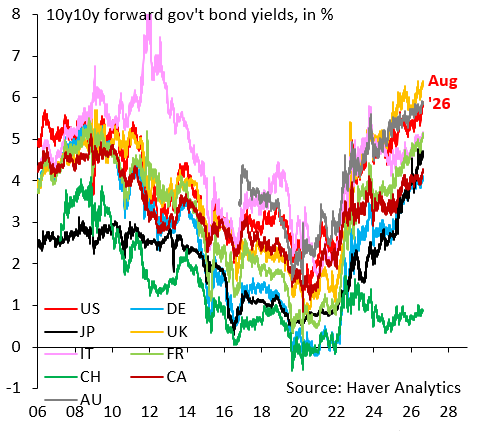
The U.S. 30-year Treasury yield has surged to 5.33% on August 18, 2026—a 19-year high—driven by a $432.3 billion monthly fiscal deficit (highest since March 2021) and persistent inflation above the Federal Reserve's 2% target. This represents a critical financial inflection point for cross-border e-commerce sellers. The 10-year Treasury note, which benchmarks consumer credit and mortgage rates, settled at 4.72%, while the 2-year yield hit 4.175%. Simultaneously, the expired U.S.-Iran 60-day peace negotiation deadline has triggered oil price spikes and investor pricing of extended Strait of Hormuz closures—a critical chokepoint for 21% of global seaborne oil trade. Global borrowing costs have hit multidecade highs: Japan's 10-year bond reached a 30-year high, Germany's 30-year yield hit its highest since 2011, and France's 30-year government bond climbed to post-2008 highs.
For cross-border sellers, this creates a three-layer financial crisis: First, working capital financing costs are escalating dramatically. With the 10-year Treasury at 4.72%, traditional inventory financing (PO financing, invoice factoring, inventory loans) will see APR rates increase 150-250 basis points. Sellers using supply chain finance platforms like Trusst, Fundbox, or Shopify Capital can expect rates rising from 8-12% APR to 10-15% APR—directly compressing margins on inventory turns. A seller financing $500K in inventory at 12% APR now faces $60K annual costs; at 15% APR, that jumps to $75K, a $15K margin hit. Second, shipping costs are spiking due to geopolitical risk. Oil prices have risen sharply as markets price in Strait of Hormuz disruption scenarios. Shipping costs from Asia to North America typically increase $200-400 per 40-foot container for every $10/barrel oil price increase. A seller shipping 100 containers monthly from China faces an additional $20K-40K monthly logistics burden—equivalent to 3-5% margin compression on electronics or apparel categories. Third, currency volatility is creating FX headwinds. The strong dollar (driven by higher Treasury yields attracting capital inflows) is creating 2-4% monthly FX swings against EUR, GBP, CNY, and INR. Sellers with unhedged exposure to these currencies face immediate margin erosion on cross-border transactions.
Immediate payment and financing optimization becomes critical. Sellers should immediately evaluate alternative payment corridors: ACH transfers to China (0.5-1% fees) versus wire transfers (0.1-0.3% but slower settlement), or exploring emerging fintech providers like Wise (formerly TransferWise) for 1.5-2% all-in costs on major currency pairs. For inventory financing, sellers should lock in rates NOW before further Treasury yield increases: a 50 basis point yield increase typically translates to 75-100 basis point APR increases in supply chain finance products. Sellers with $200K+ inventory should evaluate trade finance products (letters of credit, supply chain financing through banks like JPMorgan, HSBC, or DBS) which may offer 6-9% rates for creditworthy sellers—200-400 basis points cheaper than fintech alternatives. For FX risk, sellers should implement immediate hedging: forward contracts on EUR/USD, GBP/USD, and CNY/USD for 30-90 day windows cost 0.3-0.8% but lock in rates and eliminate volatility. Sellers with $1M+ annual cross-border revenue should establish multi-currency accounts in Singapore, Hong Kong, or UK to capture 0.5-1.5% arbitrage on currency conversion spreads and reduce exposure to dollar strength.
Questions 8
How will higher interest rates impact consumer demand for my products?
The 10-year Treasury at 4.72% (benchmark for mortgages and consumer credit) will reduce consumer purchasing power. Mortgage rates will rise to 7-7.5%, reducing home buyer demand and impacting home goods, furniture, and appliance categories. Credit card rates will climb to 20-22%, reducing discretionary spending on luxury goods, fashion, and non-essential electronics. U.S. import prices declined 0.4% in July (deflationary signal), suggesting demand weakness in specific sectors. Action: (1) Shift inventory toward essential categories (home basics, electronics, apparel); (2) Reduce exposure to luxury goods and non-essential categories; (3) Increase marketing spend on value-oriented messaging; (4) Prepare for 5-10% demand reduction in discretionary categories over next 2-3 quarters.
Which payment methods offer the lowest fees for cross-border transfers right now?
ACH transfers to China cost 0.5-1% and offer 3-5 day settlement, while wire transfers cost 0.1-0.3% but settle in 1-2 days. Fintech providers like Wise charge 1.5-2% all-in for major currency pairs with real-time rates. For high-volume sellers ($500K+ monthly), negotiate bank rates: HSBC, DBS, and JPMorgan offer 0.3-0.6% rates on $100K+ transfers with 1-2 day settlement. Avoid PayPal (2.2-3%) and Stripe (1.5-2.9%) for cross-border B2B payments. Evaluate emerging corridors: India (INR) transfers via Wise cost 1.8-2.2% vs. traditional banks at 2.5-3.5%.