
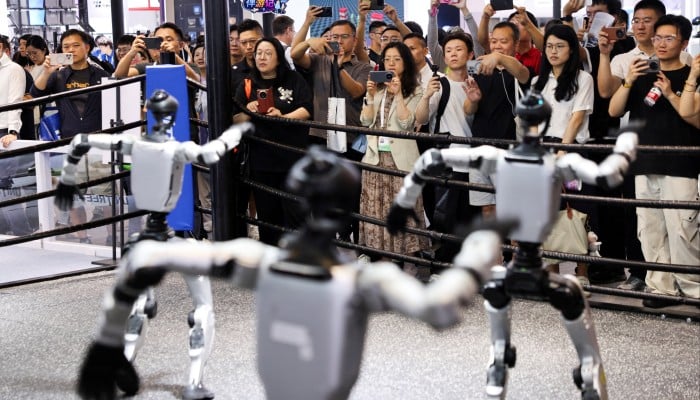


Unitree Robotics' landmark Shanghai IPO represents a critical inflection point for cross-border sellers sourcing from China's manufacturing ecosystem. The company's 600%+ stock surge and 900 yuan ($120-163) stabilization price signals explosive investor appetite for humanoid robotics—a sector that directly impacts sellers in three critical ways: (1) Supply chain automation costs, as manufacturers increasingly adopt Unitree's G1 model (13,500 yuan) versus Western alternatives like Boston Dynamics' Spot (70,000 yuan), creating 80%+ cost savings that reshape sourcing economics; (2) Manufacturing capacity reallocation, as Hangzhou's robotics cluster zone accelerates production to meet 5,500+ unit annual demand, potentially affecting component availability and lead times for sellers sourcing electronics, precision parts, and industrial equipment; (3) Geopolitical trade restrictions, with Trump administration import bans on Chinese humanoid robots creating tariff uncertainty for sellers importing automation equipment, potentially adding 15-25% compliance costs.
The IPO's bellwether status signals imminent listings from UBTech Robotics, Leju Robotics, and AgiBot—expanding China's robotics manufacturing capacity by an estimated 40-60% within 12 months. For sellers, this means: increased competition from Chinese manufacturers entering e-commerce (Amazon, Alibaba, AliExpress) with price-competitive industrial automation products; accelerated adoption of robotics in 3PL fulfillment centers, potentially reducing logistics costs 8-12% for high-volume sellers; and emerging product opportunities in robot accessories, maintenance parts, and software integration services—categories currently underdeveloped on Amazon and Shopify.
However, the news also signals supply chain consolidation risks. Western robotics companies losing competitive momentum (Boston Dynamics, Universal Robots) may exit consumer markets, reducing component diversity for sellers. Additionally, US-China tech rivalry creates tariff escalation risk: if Trump administration restrictions expand beyond humanoid robots to broader automation equipment, sellers importing manufacturing components could face 20-30% additional duties by Q2 2025. The 2026 World Humanoid Robot Games in Beijing indicates China's 3-5 year dominance in this sector, suggesting sellers should diversify sourcing relationships now before Chinese manufacturers monopolize supply chains.
Industry experts view Unitree's successful listing as a bellwether for UBTech Robotics, Leju Robotics, and AgiBot—all planning imminent public offerings. Based on typical IPO timelines, expect 2-3 additional Chinese robotics IPOs within 12-18 months (by Q3-Q4 2025). Each IPO will inject $500M-$2B in capital, accelerating production capacity by 40-60% sector-wide. For sellers, this means: (1) supply chain consolidation around 3-4 dominant Chinese manufacturers by 2026; (2) 15-25% price compression in automation equipment as competition intensifies; (3) potential component shortages as manufacturers prioritize humanoid robot production; (4) accelerated 3PL automation adoption, reducing logistics costs 8-12% by 2026. Critical timeline: Q1 2025 (monitor IPO announcements), Q2 2025 (tariff escalation risk), Q3-Q4 2025 (new IPO capital deployment), 2026 (supply chain stabilization). Sellers should lock in supplier relationships and contracts by Q2 2025 before capital influx drives consolidation.
Unitree's profitability is exceptional in the robotics sector—most manufacturers operate at losses for 5-10 years. The 278 million yuan profit indicates: (1) strong commercial demand (5,500+ units shipped in 2024); (2) manufacturing efficiency and cost control; (3) market readiness for industrial/commercial applications. However, the news notes skepticism about consumer-market viability—home robotics remain 3-5 years away due to battery life, privacy, and reliability challenges. For sellers, this means: (1) B2B opportunities (3PL automation, manufacturing) are mature now; (2) B2C consumer robotics remain speculative; (3) focus on industrial components and accessories rather than consumer products. The IPO signals investor confidence in B2B robotics demand, suggesting sellers should prioritize industrial automation categories on Amazon and Shopify. Estimated B2B market size: $500M-$1B by 2026. Action: develop B2B marketing strategies for industrial automation products; avoid consumer robotics until 2027-2028 when technology matures.
Unitree's 80% cost advantage over Boston Dynamics' 70,000 yuan Spot model fundamentally reshapes manufacturing economics for sellers. The IPO signals rapid scaling of Chinese production capacity—5,500+ units shipped in 2024 with 278 million yuan profitability—making affordable automation accessible to mid-size 3PL providers and fulfillment centers. For sellers, this means potential 8-12% logistics cost reductions within 12-18 months as fulfillment partners adopt Unitree robots. However, sellers should monitor tariff risks: Trump administration restrictions on Chinese humanoid robot imports could add 20-30% compliance costs if expanded to broader automation equipment by Q2 2025. Immediate action: audit current 3PL automation roadmaps and negotiate tariff-protection clauses in logistics contracts before Q1 2025.
The IPO signals Hangzhou's robotics cluster zone will prioritize humanoid robot production over component exports, potentially creating 15-25% lead time increases for sellers sourcing precision electronics, servo motors, and industrial sensors from the region. Unitree's success attracts capital to competing manufacturers (UBTech, Leju, AgiBot), accelerating consolidation that could reduce supplier diversity. Additionally, geopolitical tensions create tariff escalation risk: if US restrictions expand beyond humanoid robots to automation equipment broadly, sellers could face 20-30% additional duties on imports. The 2026 World Humanoid Robot Games in Beijing indicates China's 3-5 year sector dominance. Recommended action: diversify sourcing to Vietnam, Thailand, and India suppliers now; lock in 12-month component contracts before Q1 2025 tariff announcements; maintain 20-30% safety stock for critical automation parts.
Yes—the IPO creates emerging e-commerce opportunities in underdeveloped categories. With 5,500+ humanoid robots shipped in 2024 and projected 40-60% capacity expansion from pending UBTech/Leju/AgiBot IPOs, demand for robot accessories (batteries, grippers, sensors), maintenance parts, and software integration services will surge. Currently, these categories are underserved on Amazon, Shopify, and AliExpress. Sellers can capitalize by: (1) sourcing compatible batteries and replacement parts from Hangzhou suppliers; (2) developing software integration guides for Amazon Seller Central; (3) creating maintenance service packages for 3PL operators. Market timing is critical—first-mover advantage exists for 6-12 months before major brands enter. Estimated category size: $50-150M globally by 2026. Action: contact Unitree and competitor manufacturers for official parts distribution partnerships by Q1 2025.
The IPO accelerates Chinese manufacturer entry into e-commerce platforms. Unitree and competitors (UBTech, AgiBot) will likely launch Amazon Seller Central and Shopify stores within 6-12 months, leveraging their IPO capital for aggressive pricing and marketing. This creates competitive pressure in industrial automation and robotics categories. However, sellers can differentiate by: (1) offering localized support and warranty services; (2) bundling robots with software solutions and training; (3) targeting niche verticals (healthcare, logistics, manufacturing) where Western brands still hold advantages. Amazon FBA automation will accelerate—expect 15-20% of fulfillment centers to adopt Unitree robots by 2026, reducing fulfillment costs for high-volume sellers. Shopify sellers should prepare for increased competition in B2B automation categories. Action: audit competitive positioning in robotics categories on Amazon and Shopify; develop differentiation strategies beyond price by Q1 2025.
The Trump administration's restrictions on Chinese humanoid robot imports create immediate tariff escalation risk. Current restrictions target humanoid robots specifically, but could expand to broader automation equipment (servo motors, industrial sensors, control systems) by Q2 2025. If expanded, sellers importing these components could face 20-30% additional duties. The news indicates Western robotics companies (Boston Dynamics, Universal Robots) are losing competitive momentum, potentially exiting consumer markets and reducing alternative sourcing options. Sellers should: (1) monitor US Trade Representative announcements weekly; (2) audit import classifications for automation equipment (HS codes 8437, 8479, 8517); (3) negotiate tariff-protection clauses in supplier contracts; (4) maintain 20-30% safety stock before Q2 2025. Compliance deadline: update tariff documentation and supplier agreements by March 31, 2025. Estimated cost impact: 15-25% increase in automation equipment costs if restrictions expand.
Unitree's IPO confirms China's 3-5 year dominance in humanoid robotics manufacturing. The company's profitability (278 million yuan in 2025) and cost advantages (80% cheaper than Western competitors) indicate Chinese manufacturers will control supply chains for automation equipment. Sellers should: (1) diversify sourcing to Vietnam, Thailand, and India for non-robotics automation components; (2) establish direct relationships with Hangzhou robotics cluster suppliers before consolidation accelerates; (3) negotiate long-term contracts (12-24 months) to lock in current pricing before tariff escalation; (4) monitor pending IPOs from UBTech, Leju, and AgiBot for supply chain impacts. The 2026 World Humanoid Robot Games in Beijing signals China's strategic investment in sector dominance. Action timeline: initiate supplier diversification by Q1 2025; lock in 12-month contracts by March 31, 2025; establish tariff contingency plans by April 30, 2025. Expected outcome: 15-20% cost savings through optimized sourcing, offset by 10-15% tariff increases if restrictions expand.
Industry experts view Unitree's successful listing as a bellwether for UBTech Robotics, Leju Robotics, and AgiBot—all planning imminent public offerings. Based on typical IPO timelines, expect 2-3 additional Chinese robotics IPOs within 12-18 months (by Q3-Q4 2025). Each IPO will inject $500M-$2B in capital, accelerating production capacity by 40-60% sector-wide. For sellers, this means: (1) supply chain consolidation around 3-4 dominant Chinese manufacturers by 2026; (2) 15-25% price compression in automation equipment as competition intensifies; (3) potential component shortages as manufacturers prioritize humanoid robot production; (4) accelerated 3PL automation adoption, reducing logistics costs 8-12% by 2026. Critical timeline: Q1 2025 (monitor IPO announcements), Q2 2025 (tariff escalation risk), Q3-Q4 2025 (new IPO capital deployment), 2026 (supply chain stabilization). Sellers should lock in supplier relationships and contracts by Q2 2025 before capital influx drives consolidation.
Unitree's profitability is exceptional in the robotics sector—most manufacturers operate at losses for 5-10 years. The 278 million yuan profit indicates: (1) strong commercial demand (5,500+ units shipped in 2024); (2) manufacturing efficiency and cost control; (3) market readiness for industrial/commercial applications. However, the news notes skepticism about consumer-market viability—home robotics remain 3-5 years away due to battery life, privacy, and reliability challenges. For sellers, this means: (1) B2B opportunities (3PL automation, manufacturing) are mature now; (2) B2C consumer robotics remain speculative; (3) focus on industrial components and accessories rather than consumer products. The IPO signals investor confidence in B2B robotics demand, suggesting sellers should prioritize industrial automation categories on Amazon and Shopify. Estimated B2B market size: $500M-$1B by 2026. Action: develop B2B marketing strategies for industrial automation products; avoid consumer robotics until 2027-2028 when technology matures.
Unitree's 80% cost advantage over Boston Dynamics' 70,000 yuan Spot model fundamentally reshapes manufacturing economics for sellers. The IPO signals rapid scaling of Chinese production capacity—5,500+ units shipped in 2024 with 278 million yuan profitability—making affordable automation accessible to mid-size 3PL providers and fulfillment centers. For sellers, this means potential 8-12% logistics cost reductions within 12-18 months as fulfillment partners adopt Unitree robots. However, sellers should monitor tariff risks: Trump administration restrictions on Chinese humanoid robot imports could add 20-30% compliance costs if expanded to broader automation equipment by Q2 2025. Immediate action: audit current 3PL automation roadmaps and negotiate tariff-protection clauses in logistics contracts before Q1 2025.
The IPO signals Hangzhou's robotics cluster zone will prioritize humanoid robot production over component exports, potentially creating 15-25% lead time increases for sellers sourcing precision electronics, servo motors, and industrial sensors from the region. Unitree's success attracts capital to competing manufacturers (UBTech, Leju, AgiBot), accelerating consolidation that could reduce supplier diversity. Additionally, geopolitical tensions create tariff escalation risk: if US restrictions expand beyond humanoid robots to automation equipment broadly, sellers could face 20-30% additional duties on imports. The 2026 World Humanoid Robot Games in Beijing indicates China's 3-5 year sector dominance. Recommended action: diversify sourcing to Vietnam, Thailand, and India suppliers now; lock in 12-month component contracts before Q1 2025 tariff announcements; maintain 20-30% safety stock for critical automation parts.
Yes—the IPO creates emerging e-commerce opportunities in underdeveloped categories. With 5,500+ humanoid robots shipped in 2024 and projected 40-60% capacity expansion from pending UBTech/Leju/AgiBot IPOs, demand for robot accessories (batteries, grippers, sensors), maintenance parts, and software integration services will surge. Currently, these categories are underserved on Amazon, Shopify, and AliExpress. Sellers can capitalize by: (1) sourcing compatible batteries and replacement parts from Hangzhou suppliers; (2) developing software integration guides for Amazon Seller Central; (3) creating maintenance service packages for 3PL operators. Market timing is critical—first-mover advantage exists for 6-12 months before major brands enter. Estimated category size: $50-150M globally by 2026. Action: contact Unitree and competitor manufacturers for official parts distribution partnerships by Q1 2025.
The IPO accelerates Chinese manufacturer entry into e-commerce platforms. Unitree and competitors (UBTech, AgiBot) will likely launch Amazon Seller Central and Shopify stores within 6-12 months, leveraging their IPO capital for aggressive pricing and marketing. This creates competitive pressure in industrial automation and robotics categories. However, sellers can differentiate by: (1) offering localized support and warranty services; (2) bundling robots with software solutions and training; (3) targeting niche verticals (healthcare, logistics, manufacturing) where Western brands still hold advantages. Amazon FBA automation will accelerate—expect 15-20% of fulfillment centers to adopt Unitree robots by 2026, reducing fulfillment costs for high-volume sellers. Shopify sellers should prepare for increased competition in B2B automation categories. Action: audit competitive positioning in robotics categories on Amazon and Shopify; develop differentiation strategies beyond price by Q1 2025.
The Trump administration's restrictions on Chinese humanoid robot imports create immediate tariff escalation risk. Current restrictions target humanoid robots specifically, but could expand to broader automation equipment (servo motors, industrial sensors, control systems) by Q2 2025. If expanded, sellers importing these components could face 20-30% additional duties. The news indicates Western robotics companies (Boston Dynamics, Universal Robots) are losing competitive momentum, potentially exiting consumer markets and reducing alternative sourcing options. Sellers should: (1) monitor US Trade Representative announcements weekly; (2) audit import classifications for automation equipment (HS codes 8437, 8479, 8517); (3) negotiate tariff-protection clauses in supplier contracts; (4) maintain 20-30% safety stock before Q2 2025. Compliance deadline: update tariff documentation and supplier agreements by March 31, 2025. Estimated cost impact: 15-25% increase in automation equipment costs if restrictions expand.
Unitree's IPO confirms China's 3-5 year dominance in humanoid robotics manufacturing. The company's profitability (278 million yuan in 2025) and cost advantages (80% cheaper than Western competitors) indicate Chinese manufacturers will control supply chains for automation equipment. Sellers should: (1) diversify sourcing to Vietnam, Thailand, and India for non-robotics automation components; (2) establish direct relationships with Hangzhou robotics cluster suppliers before consolidation accelerates; (3) negotiate long-term contracts (12-24 months) to lock in current pricing before tariff escalation; (4) monitor pending IPOs from UBTech, Leju, and AgiBot for supply chain impacts. The 2026 World Humanoid Robot Games in Beijing signals China's strategic investment in sector dominance. Action timeline: initiate supplier diversification by Q1 2025; lock in 12-month contracts by March 31, 2025; establish tariff contingency plans by April 30, 2025. Expected outcome: 15-20% cost savings through optimized sourcing, offset by 10-15% tariff increases if restrictions expand.
Industry experts view Unitree's successful listing as a bellwether for UBTech Robotics, Leju Robotics, and AgiBot—all planning imminent public offerings. Based on typical IPO timelines, expect 2-3 additional Chinese robotics IPOs within 12-18 months (by Q3-Q4 2025). Each IPO will inject $500M-$2B in capital, accelerating production capacity by 40-60% sector-wide. For sellers, this means: (1) supply chain consolidation around 3-4 dominant Chinese manufacturers by 2026; (2) 15-25% price compression in automation equipment as competition intensifies; (3) potential component shortages as manufacturers prioritize humanoid robot production; (4) accelerated 3PL automation adoption, reducing logistics costs 8-12% by 2026. Critical timeline: Q1 2025 (monitor IPO announcements), Q2 2025 (tariff escalation risk), Q3-Q4 2025 (new IPO capital deployment), 2026 (supply chain stabilization). Sellers should lock in supplier relationships and contracts by Q2 2025 before capital influx drives consolidation.
Unitree's profitability is exceptional in the robotics sector—most manufacturers operate at losses for 5-10 years. The 278 million yuan profit indicates: (1) strong commercial demand (5,500+ units shipped in 2024); (2) manufacturing efficiency and cost control; (3) market readiness for industrial/commercial applications. However, the news notes skepticism about consumer-market viability—home robotics remain 3-5 years away due to battery life, privacy, and reliability challenges. For sellers, this means: (1) B2B opportunities (3PL automation, manufacturing) are mature now; (2) B2C consumer robotics remain speculative; (3) focus on industrial components and accessories rather than consumer products. The IPO signals investor confidence in B2B robotics demand, suggesting sellers should prioritize industrial automation categories on Amazon and Shopify. Estimated B2B market size: $500M-$1B by 2026. Action: develop B2B marketing strategies for industrial automation products; avoid consumer robotics until 2027-2028 when technology matures.