


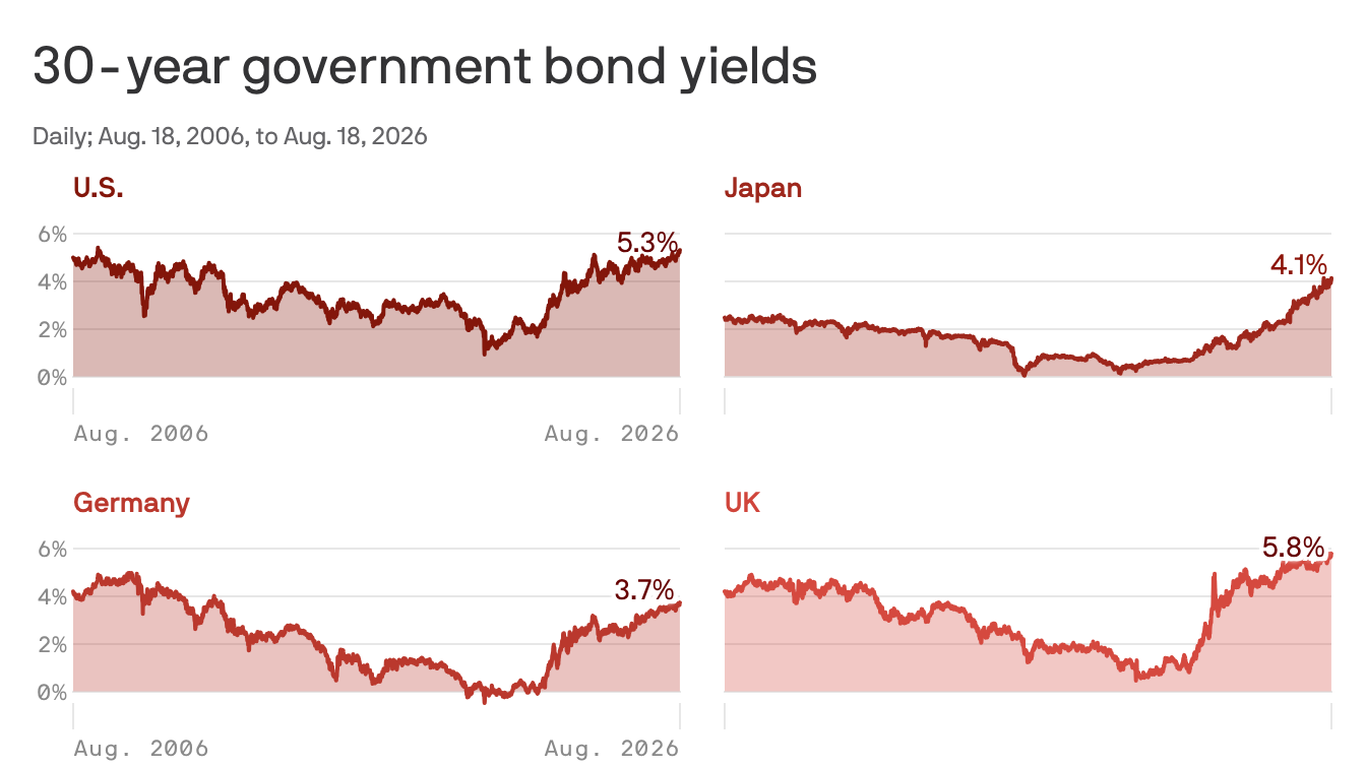


Global Bond Selloff Triggers FX Volatility | Cross-Border Sellers Face Working Capital Squeeze
- Rising borrowing costs (US 30-year yields at 5.34%) compress seller financing access; JPY/USD approaching 160 creates immediate hedging urgency for Asia-Pacific exporters






Overview
The August 19, 2024 bond market selloff represents a critical inflection point for cross-border e-commerce sellers, particularly those reliant on trade financing and multi-currency operations. U.S. 30-year bond yields surged to 5.3371%—the highest in nearly 20 years—while European bunds hit 2011 highs and Japanese 10-year yields approached 3%. This synchronized global rate shock directly impacts seller working capital through three financial channels: (1) Financing Cost Escalation: Rising bond yields increase borrowing costs for inventory financing, PO financing, and invoice factoring. Sellers using supply chain finance products will face 50-150 basis point increases in APR rates as lenders reprice risk. (2) FX Volatility Amplification: The yen trading near 159.44 per dollar—approaching the 160 level that could trigger BOJ intervention—creates immediate hedging opportunities and risks. Asia-Pacific sellers shipping to US/EU markets face 2-3% daily currency swings, directly compressing margins on unhedged inventory. Canadian sellers benefit from the 50% tariff pause, but this 3-day reprieve creates timing pressure for payment optimization. (3) Equity Market Contagion: Asia-Pacific shares fell 1.7% (ex-Japan) and Nikkei dropped 2.6%, signaling reduced consumer spending. Retail earnings from Home Depot, Lowe's, Target, and TJX showed softer-than-expected sales, indicating demand contraction in home goods and apparel categories—critical for cross-border sellers. The $16 billion US Treasury debt sale and Alphabet's A$5 billion AUD bond issuance signal capital markets are pricing in extended high-rate environments. For sellers, this means: (a) Immediate payment optimization: Shift from 60-90 day payment terms to 30-day or faster settlement to reduce exposure to further rate increases. (b) FX hedging acceleration: Lock in JPY/USD rates below 160 before potential BOJ intervention; consider forward contracts for 90-180 day inventory cycles. (c) Financing product migration: Evaluate invoice factoring (faster cash conversion, 2-4% fees) versus traditional bank loans (now 8-12% APR) for working capital needs. Sellers with $500K+ monthly revenue should immediately review financing options before rates stabilize at higher levels.
Questions 8
What's the impact of Alphabet's A$5 billion AUD bond sale on Australian sellers?
Alphabet's large AUD bond issuance signals capital markets are pricing in extended high-rate environments globally, including Australia. This increases borrowing costs for Australian sellers accessing trade finance or inventory loans. AUD/USD rates may face pressure as global capital flows shift. Australian sellers should evaluate financing in AUD (local rates) versus USD (potentially cheaper despite higher global rates). The bond issuance also indicates tech sector confidence, suggesting continued demand for electronics and tech accessories—a positive signal for sellers in those categories.
Should I hedge my Canadian dollar exposure given the tariff pause?
The 50% tariff pause on Canadian goods is temporary (3 days as of August 19), creating a timing window but not a long-term solution. Canadian sellers shipping to US markets should lock in USD/CAD rates immediately before the pause expires. The Canadian dollar gained slightly on the pause announcement, but this is likely to reverse. For sellers with $50K+ monthly USD revenue, forward contracts locking in 1.35-1.37 USD/CAD rates for 90-180 days provide certainty. Avoid holding CAD cash; convert to USD immediately or use multi-currency accounts to capture any rate improvements.