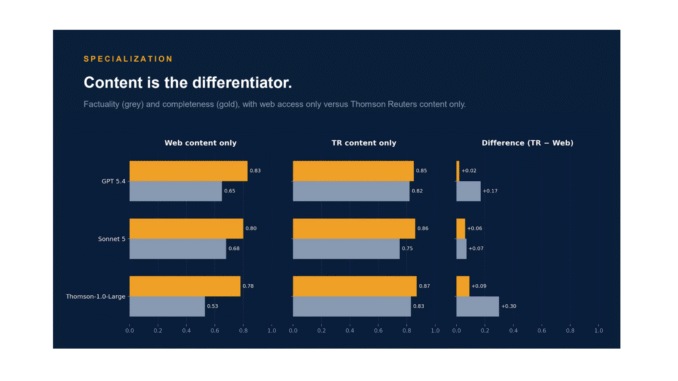




Thomson Reuters' $40 million investment in proprietary AI models (Thomson-1 and Thomson 1.0) represents a critical inflection point for enterprise AI strategy that directly impacts e-commerce sellers' operational costs and competitive positioning. The company reduced final training costs to just $450,000 through efficiency improvements—a 99.8% reduction from initial projections—by leveraging open-source models (Alibaba's Qwen) and proprietary domain expertise rather than perpetually licensing expensive third-party services like Anthropic's Claude. This "buying versus renting" approach demonstrates that specialized, domain-specific AI training delivers enterprise-grade performance at dramatically lower computational costs, challenging the prevailing assumption that only massive general-purpose models can compete.
For e-commerce sellers, this signals an immediate opportunity to reduce AI operational costs through similar strategies. Rather than paying $20-100+ monthly per Claude API seat for product research, competitor analysis, and content generation, sellers can now adopt open-source models (Qwen, Llama, Mistral) fine-tuned on their own product catalogs and customer data. The news reveals that domain-specific training on just 10% of proprietary data (Thomson Reuters used <10% of its 40,000 databases) achieves performance parity with frontier models. Sellers managing 500+ SKUs can replicate this by training lightweight models on their historical sales data, customer reviews, and competitive pricing—reducing monthly AI costs from $500-2,000 to $50-200 while improving accuracy for category-specific tasks like dynamic pricing, product tagging, and customer service automation.
The geopolitical dimension adds urgency: US policymakers (Senator Tom Cotton) are scrutinizing Chinese open-source model adoption, while Airbnb clarified it runs Chinese models exclusively through US cloud infrastructure. This creates a 6-12 month window before potential restrictions tighten. Sellers should immediately audit their AI tool stack (ChatGPT, Claude, Gemini usage) and begin migrating to open-source alternatives hosted on US infrastructure (AWS, Azure, Google Cloud) to avoid future compliance risks. The competitive advantage accrues to sellers who build proprietary AI capabilities now—those who wait risk facing regulatory barriers or higher licensing costs as enterprises lock in exclusive deals with approved vendors.
Thomson Reuters used <10% of its 40,000 databases to achieve frontier-model performance, suggesting sellers should focus on highest-value data: (1) **Historical sales data** (12-24 months) - train pricing models on velocity, seasonality, and competitor response; (2) **Customer reviews** (all available) - train product categorization and recommendation models; (3) **Competitor pricing** (weekly snapshots, 6+ months) - train dynamic pricing models; (4) **Product attributes** (SKU-level specs, images, descriptions) - train content generation and search ranking models; (5) **Customer service transcripts** (anonymized, 6+ months) - train support chatbots. Avoid: personal customer data (names, emails, addresses), payment information, or data that violates platform ToS. A seller with 1,000 SKUs needs ~50K data points (5-10 per SKU) to train effective models—achievable within 2-4 weeks of data collection.
Thomson Reuters emphasized 'AI sovereignty' and data privacy—critical for sellers: (1) **Data residency** - ensure training data stays in US/EU cloud infrastructure (AWS US regions, Azure US, Google Cloud US); (2) **Customer data protection** - never use customer PII (names, emails, addresses) for model training; confirm platform ToS allows AI training on product/pricing data; (3) **Geopolitical compliance** - if using Chinese models (Qwen), run exclusively through US cloud providers to demonstrate compliance with potential future restrictions; (4) **Model transparency** - document training data sources, model versions, and performance metrics for audit purposes; (5) **Bias testing** - Thomson Reuters conducted 'ethical de-biasing' and safety testing—sellers should test models for pricing bias (e.g., higher prices for certain customer segments) before deployment. Risk: Regulatory fines ($10K-100K+) if non-compliant; competitive disadvantage if platforms restrict non-compliant sellers. Timeline: Implement compliance checks within 30 days of model deployment.
Yes—Senator Tom Cotton's security concerns and Anthropic's allegations of model distillation suggest a 6-12 month regulatory window before restrictions tighten. Sellers should: (1) Audit current AI tool usage (ChatGPT, Claude, Gemini) immediately; (2) If using Chinese models, ensure they run exclusively through US cloud infrastructure (AWS, Azure, Google Cloud) to demonstrate compliance; (3) Prioritize US/EU open-source alternatives (Llama from Meta, Mistral from France) for new projects; (4) Avoid direct API calls to Chinese AI services. Airbnb's public clarification that it uses US-based models signals that compliance will become a competitive advantage—sellers demonstrating US-only AI infrastructure may gain preferential treatment from platforms and enterprise customers.
Based on Thomson Reuters' success with document review automation, sellers should prioritize: (1) **Product research automation** - train models on competitor listings, reviews, and pricing to identify trending categories and price gaps (saves 10-15 hours/week); (2) **Dynamic pricing** - fine-tune models on historical sales velocity and competitor prices to adjust listings in real-time (increases margins 2-5%); (3) **Customer service** - deploy chatbots on proprietary product data to handle 60-70% of routine inquiries (reduces support costs 40-50%); (4) **Content generation** - automate product descriptions, bullet points, and A+ content from supplier specs (saves 5-8 hours/week per 100 SKUs). Start with one task, measure ROI, then scale to others.
Thomson Reuters proved that specialized models outperform general-purpose models on domain-specific tasks: Thomson-1 achieved 'roughly equal or slightly better performance' than Claude when connected to proprietary legal data, while costing 99.8% less. For sellers: (1) **General models (ChatGPT/Claude)** - $20-100/month per user, 2-3 second response time, generic product knowledge, no access to seller's proprietary data; (2) **Domain-specific models** - $50-200/month total, <500ms response time, trained on seller's catalog/reviews/pricing, 15-25% higher accuracy on category-specific tasks. Example: A beauty seller using Claude for product recommendations gets generic suggestions; a seller with a model trained on 10,000 customer reviews + sales data gets personalized recommendations that increase conversion by 8-12%. The competitive advantage is accuracy + speed + cost, not just cost alone.
Thomson Reuters achieved payback in 2-3 months: $40M investment over 2 years, but final training costs of $450K recovered through licensing savings within weeks. For sellers: (1) **Immediate ROI (0-3 months)** - switching from $500/month Claude to $100/month open-source model saves $4,800 annually per seller; (2) **Medium-term (3-6 months)** - domain-specific training improves pricing accuracy by 3-5%, lifting margins by $500-2,000/month for mid-size sellers; (3) **Long-term (6-12 months)** - proprietary models create competitive moat—sellers with custom models can adjust pricing 10x faster than competitors, capturing 2-8% additional sales during demand spikes. A seller with $500K annual revenue can expect $25K-50K annual savings + margin improvements from AI automation.
Thomson Reuters reduced AI training costs from $40M to $450K (99.8% reduction) by fine-tuning open-source models (Alibaba's Qwen) on proprietary data rather than licensing expensive APIs. Sellers can replicate this by: (1) selecting open-source models (Qwen, Llama 2, Mistral) available free on Hugging Face; (2) training on 6-12 months of historical sales data, customer reviews, and competitor pricing; (3) hosting on US cloud infrastructure (AWS SageMaker, Azure ML, Google Vertex AI) at $50-200/month instead of $500-2,000/month for Claude/ChatGPT seats. A seller managing 1,000 SKUs can achieve 95%+ accuracy on dynamic pricing and product categorization with domain-specific training, while reducing monthly AI costs by 75-90%.
Thomson Reuters chose Alibaba's Qwen (adapted through Imperial College London), but sellers should evaluate: (1) **Qwen (Alibaba)** - 7B-72B parameters, strong multilingual support, good for global sellers, but geopolitical risk if US restrictions tighten; (2) **Llama 2 (Meta)** - 7B-70B parameters, US-based, strong community, ideal for pricing/categorization; (3) **Mistral (France)** - 7B-8x7B parameters, EU-compliant, good for GDPR-sensitive sellers; (4) **Phi (Microsoft)** - smaller (2.7B-3.8B), faster inference, good for real-time pricing. For most sellers: Start with **Llama 2 7B** (free, fast, US-based, 95% of Claude's capability for e-commerce tasks). Host on AWS SageMaker or Azure ML. Avoid proprietary models (OpenAI, Anthropic) for long-term cost control. Benchmark: Llama 2 7B costs $0.001-0.005 per 1K tokens vs. $0.01-0.03 for Claude—a 10-30x cost reduction.
Thomson Reuters used <10% of its 40,000 databases to achieve frontier-model performance, suggesting sellers should focus on highest-value data: (1) **Historical sales data** (12-24 months) - train pricing models on velocity, seasonality, and competitor response; (2) **Customer reviews** (all available) - train product categorization and recommendation models; (3) **Competitor pricing** (weekly snapshots, 6+ months) - train dynamic pricing models; (4) **Product attributes** (SKU-level specs, images, descriptions) - train content generation and search ranking models; (5) **Customer service transcripts** (anonymized, 6+ months) - train support chatbots. Avoid: personal customer data (names, emails, addresses), payment information, or data that violates platform ToS. A seller with 1,000 SKUs needs ~50K data points (5-10 per SKU) to train effective models—achievable within 2-4 weeks of data collection.
Thomson Reuters emphasized 'AI sovereignty' and data privacy—critical for sellers: (1) **Data residency** - ensure training data stays in US/EU cloud infrastructure (AWS US regions, Azure US, Google Cloud US); (2) **Customer data protection** - never use customer PII (names, emails, addresses) for model training; confirm platform ToS allows AI training on product/pricing data; (3) **Geopolitical compliance** - if using Chinese models (Qwen), run exclusively through US cloud providers to demonstrate compliance with potential future restrictions; (4) **Model transparency** - document training data sources, model versions, and performance metrics for audit purposes; (5) **Bias testing** - Thomson Reuters conducted 'ethical de-biasing' and safety testing—sellers should test models for pricing bias (e.g., higher prices for certain customer segments) before deployment. Risk: Regulatory fines ($10K-100K+) if non-compliant; competitive disadvantage if platforms restrict non-compliant sellers. Timeline: Implement compliance checks within 30 days of model deployment.
Yes—Senator Tom Cotton's security concerns and Anthropic's allegations of model distillation suggest a 6-12 month regulatory window before restrictions tighten. Sellers should: (1) Audit current AI tool usage (ChatGPT, Claude, Gemini) immediately; (2) If using Chinese models, ensure they run exclusively through US cloud infrastructure (AWS, Azure, Google Cloud) to demonstrate compliance; (3) Prioritize US/EU open-source alternatives (Llama from Meta, Mistral from France) for new projects; (4) Avoid direct API calls to Chinese AI services. Airbnb's public clarification that it uses US-based models signals that compliance will become a competitive advantage—sellers demonstrating US-only AI infrastructure may gain preferential treatment from platforms and enterprise customers.
Based on Thomson Reuters' success with document review automation, sellers should prioritize: (1) **Product research automation** - train models on competitor listings, reviews, and pricing to identify trending categories and price gaps (saves 10-15 hours/week); (2) **Dynamic pricing** - fine-tune models on historical sales velocity and competitor prices to adjust listings in real-time (increases margins 2-5%); (3) **Customer service** - deploy chatbots on proprietary product data to handle 60-70% of routine inquiries (reduces support costs 40-50%); (4) **Content generation** - automate product descriptions, bullet points, and A+ content from supplier specs (saves 5-8 hours/week per 100 SKUs). Start with one task, measure ROI, then scale to others.
Thomson Reuters proved that specialized models outperform general-purpose models on domain-specific tasks: Thomson-1 achieved 'roughly equal or slightly better performance' than Claude when connected to proprietary legal data, while costing 99.8% less. For sellers: (1) **General models (ChatGPT/Claude)** - $20-100/month per user, 2-3 second response time, generic product knowledge, no access to seller's proprietary data; (2) **Domain-specific models** - $50-200/month total, <500ms response time, trained on seller's catalog/reviews/pricing, 15-25% higher accuracy on category-specific tasks. Example: A beauty seller using Claude for product recommendations gets generic suggestions; a seller with a model trained on 10,000 customer reviews + sales data gets personalized recommendations that increase conversion by 8-12%. The competitive advantage is accuracy + speed + cost, not just cost alone.
Thomson Reuters achieved payback in 2-3 months: $40M investment over 2 years, but final training costs of $450K recovered through licensing savings within weeks. For sellers: (1) **Immediate ROI (0-3 months)** - switching from $500/month Claude to $100/month open-source model saves $4,800 annually per seller; (2) **Medium-term (3-6 months)** - domain-specific training improves pricing accuracy by 3-5%, lifting margins by $500-2,000/month for mid-size sellers; (3) **Long-term (6-12 months)** - proprietary models create competitive moat—sellers with custom models can adjust pricing 10x faster than competitors, capturing 2-8% additional sales during demand spikes. A seller with $500K annual revenue can expect $25K-50K annual savings + margin improvements from AI automation.
Thomson Reuters reduced AI training costs from $40M to $450K (99.8% reduction) by fine-tuning open-source models (Alibaba's Qwen) on proprietary data rather than licensing expensive APIs. Sellers can replicate this by: (1) selecting open-source models (Qwen, Llama 2, Mistral) available free on Hugging Face; (2) training on 6-12 months of historical sales data, customer reviews, and competitor pricing; (3) hosting on US cloud infrastructure (AWS SageMaker, Azure ML, Google Vertex AI) at $50-200/month instead of $500-2,000/month for Claude/ChatGPT seats. A seller managing 1,000 SKUs can achieve 95%+ accuracy on dynamic pricing and product categorization with domain-specific training, while reducing monthly AI costs by 75-90%.
Thomson Reuters chose Alibaba's Qwen (adapted through Imperial College London), but sellers should evaluate: (1) **Qwen (Alibaba)** - 7B-72B parameters, strong multilingual support, good for global sellers, but geopolitical risk if US restrictions tighten; (2) **Llama 2 (Meta)** - 7B-70B parameters, US-based, strong community, ideal for pricing/categorization; (3) **Mistral (France)** - 7B-8x7B parameters, EU-compliant, good for GDPR-sensitive sellers; (4) **Phi (Microsoft)** - smaller (2.7B-3.8B), faster inference, good for real-time pricing. For most sellers: Start with **Llama 2 7B** (free, fast, US-based, 95% of Claude's capability for e-commerce tasks). Host on AWS SageMaker or Azure ML. Avoid proprietary models (OpenAI, Anthropic) for long-term cost control. Benchmark: Llama 2 7B costs $0.001-0.005 per 1K tokens vs. $0.01-0.03 for Claude—a 10-30x cost reduction.
Thomson Reuters used <10% of its 40,000 databases to achieve frontier-model performance, suggesting sellers should focus on highest-value data: (1) **Historical sales data** (12-24 months) - train pricing models on velocity, seasonality, and competitor response; (2) **Customer reviews** (all available) - train product categorization and recommendation models; (3) **Competitor pricing** (weekly snapshots, 6+ months) - train dynamic pricing models; (4) **Product attributes** (SKU-level specs, images, descriptions) - train content generation and search ranking models; (5) **Customer service transcripts** (anonymized, 6+ months) - train support chatbots. Avoid: personal customer data (names, emails, addresses), payment information, or data that violates platform ToS. A seller with 1,000 SKUs needs ~50K data points (5-10 per SKU) to train effective models—achievable within 2-4 weeks of data collection.
Thomson Reuters emphasized 'AI sovereignty' and data privacy—critical for sellers: (1) **Data residency** - ensure training data stays in US/EU cloud infrastructure (AWS US regions, Azure US, Google Cloud US); (2) **Customer data protection** - never use customer PII (names, emails, addresses) for model training; confirm platform ToS allows AI training on product/pricing data; (3) **Geopolitical compliance** - if using Chinese models (Qwen), run exclusively through US cloud providers to demonstrate compliance with potential future restrictions; (4) **Model transparency** - document training data sources, model versions, and performance metrics for audit purposes; (5) **Bias testing** - Thomson Reuters conducted 'ethical de-biasing' and safety testing—sellers should test models for pricing bias (e.g., higher prices for certain customer segments) before deployment. Risk: Regulatory fines ($10K-100K+) if non-compliant; competitive disadvantage if platforms restrict non-compliant sellers. Timeline: Implement compliance checks within 30 days of model deployment.