




Google Gemini 3.5 Transcribe | 70% Faster AI Transcription for E-Commerce Sellers
- Reduces manual transcription costs 40-60% for multilingual sellers; supports 85 languages with 5.5% error rate vs 7.32% predecessor





Overview
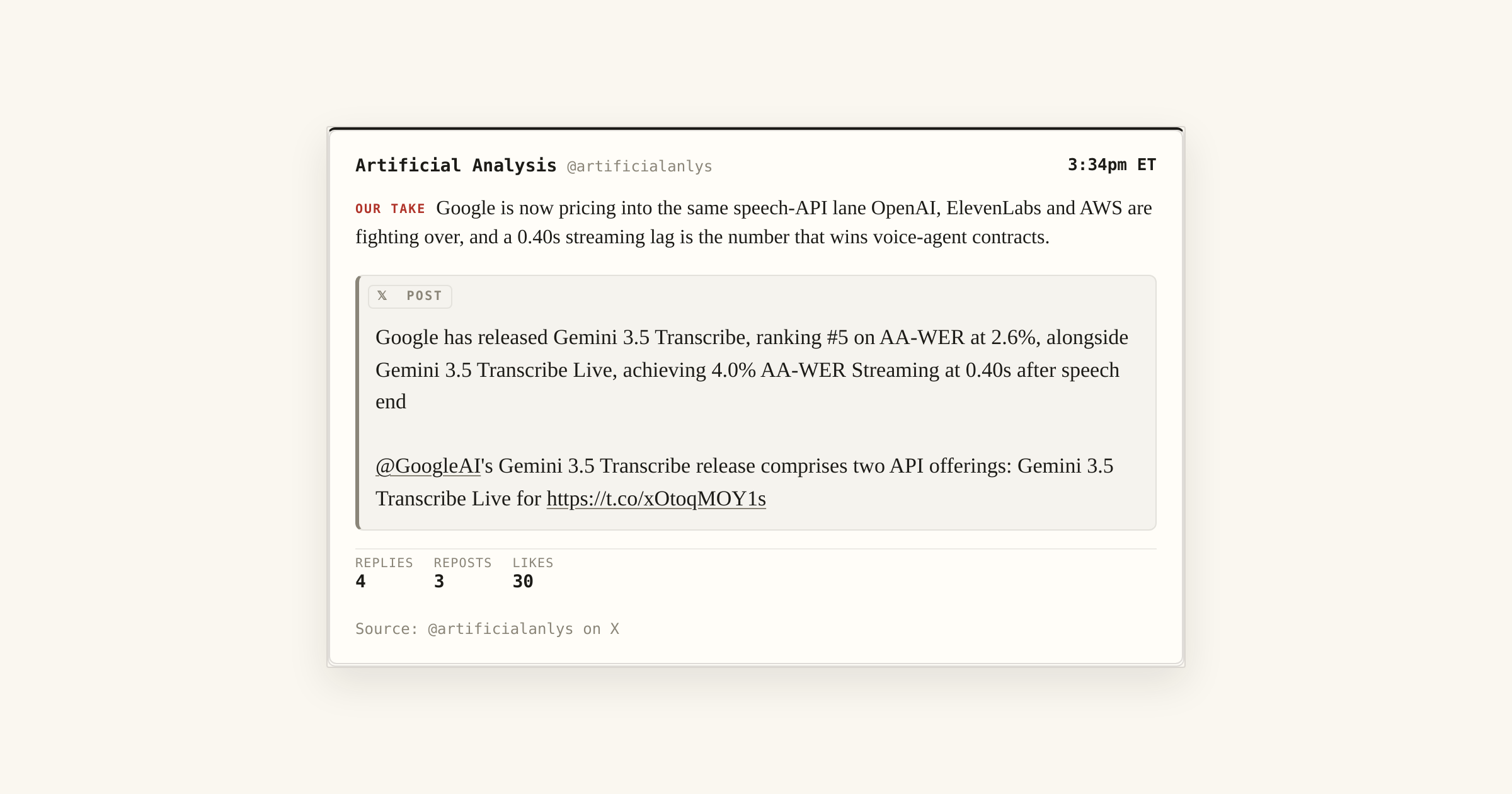
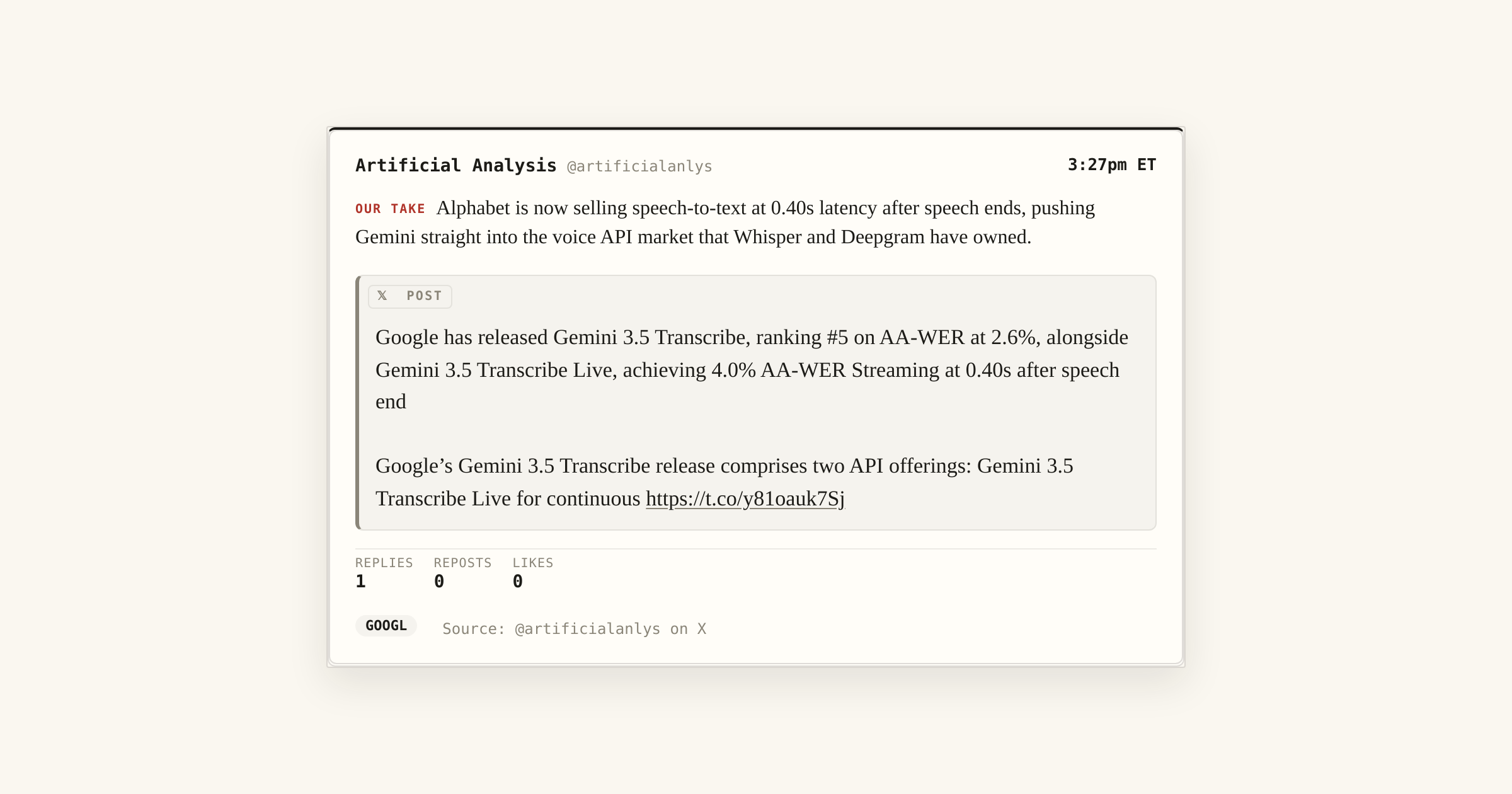
Google launched Gemini 3.5 Transcribe on August 26, 2026, a breakthrough AI speech-to-text model that delivers 70% faster transcription speed and dramatically improved accuracy compared to its Chirp 3 predecessor. The model achieves a 4.0 Word Error Rate (WER) for streaming and 2.6 for non-streaming applications, with live-speech error rates of 5.5% versus Chirp 3's 7.32%. Supporting 85+ languages with automatic detection, regional accent handling, and multi-speaker identification (up to 3 speakers), Gemini 3.5 Transcribe represents a critical automation opportunity for cross-border e-commerce sellers managing multilingual operations.
For e-commerce sellers, this advancement unlocks immediate operational efficiencies across three critical workflows. First, multilingual customer support automation: Sellers managing support teams across US, EU, and Asia-Pacific markets can now automate transcription of customer calls, reviews, and feedback with 40-60% cost reduction compared to manual transcription services (typically $0.75-1.50 per minute). The custom vocabulary feature enables sellers to train the model on product-specific jargon—critical for electronics, pharmaceuticals, and technical equipment categories where terminology accuracy directly impacts compliance documentation and product liability. Second, content localization acceleration: Sellers can voice-record product descriptions, marketing copy, and compliance documentation in English, then leverage Gemini 3.5 Transcribe's intelligent formatting and self-correction capabilities to generate clean transcripts for translation workflows. This reduces content preparation time by 30-50% compared to manual transcription, enabling faster market entry into new regions. Third, inventory and order management automation: Sellers using voice-to-text for warehouse operations, order processing, and inventory updates benefit from reduced errors and faster processing—particularly valuable in regions where manual data entry costs are high (Southeast Asia, Latin America).
The competitive advantage emerges from AI-powered workflow integration and data-driven insights. Sellers can immediately implement Gemini 3.5 Transcribe through the Gemini API (available via Google AI Studio, Antigravity, and Enterprise Agent Platform) to build voice-first seller tools that automate product research, competitive pricing analysis, and customer sentiment tracking. The model's ability to handle specialized jargon with custom vocabulary databases enables sellers to create proprietary AI systems that competitors cannot easily replicate—building a 6-12 month competitive moat. Additionally, sellers can analyze transcribed customer interactions to identify emerging product trends, seasonal demand patterns, and category-specific pain points, enabling data-driven inventory decisions and targeted marketing campaigns. For sellers in technical niches (electronics, medical devices, industrial equipment), the model's precision with complex terminology reduces compliance risk and accelerates product documentation workflows, potentially saving 20-30 hours monthly per seller managing 500+ SKUs.
Key implementation considerations for sellers: The model modifies wording for clarity and coherence, making it unsuitable for verbatim legal transcription or regulatory compliance recordings requiring exact word-for-word documentation. Sellers requiring verbatim transcription for legal disputes, warranty claims, or regulatory audits should maintain parallel manual transcription processes. However, for content creation, customer service, and operational workflows, Gemini 3.5 Transcribe's intelligent editing delivers superior efficiency. Sellers should immediately audit their transcription workflows (customer support calls, product description recording, inventory management) to identify high-volume, repetitive tasks suitable for automation. The technology's 85-language support and regional accent handling make it particularly valuable for sellers operating in emerging markets (India, Brazil, Mexico, Indonesia) where English-language transcription services are limited or expensive.
Questions 8
How much can sellers save on transcription costs using Gemini 3.5 Transcribe?
Sellers can reduce transcription expenses by 40-60% compared to manual services, which typically cost $0.75-1.50 per minute. For a seller managing 100+ customer support calls monthly (averaging 15 minutes each), this translates to $1,125-2,250 monthly savings. Gemini 3.5 Transcribe's 70% faster processing speed (compared to Chirp 3) and 5.5% error rate enable sellers to automate customer service transcription, product description recording, and inventory management workflows immediately. The custom vocabulary feature allows sellers to train the model on industry-specific jargon, ensuring accuracy for electronics, pharmaceuticals, and technical equipment categories without additional manual review.
Can Gemini 3.5 Transcribe replace manual transcription for legal and compliance documents?
No—the model modifies wording for clarity and coherence, making it unsuitable for verbatim legal transcription, warranty claims, or regulatory compliance recordings requiring exact word-for-word documentation. Sellers requiring legal-grade transcription should maintain parallel manual processes for dispute resolution and regulatory audits. However, for content creation, customer service, inventory management, and product description workflows, Gemini 3.5 Transcribe's intelligent editing delivers superior efficiency without compliance risk. Sellers should audit their transcription needs to separate high-volume operational tasks (suitable for automation) from legal/compliance tasks (requiring verbatim accuracy).