


Google Gemini 3.8 Live Extended Thinking | AI Voice Agents Transform E-Commerce Customer Service
- Sellers can automate 40-60% of customer support tasks with voice AI; 97-language support enables global marketplace expansion; Gemini 3.8 Live Extended Thinking ranks #1 (82.6 score) vs competitors; $0.005-0.018/min pricing enables cost-effective deployment for mid-market sellers














Overview
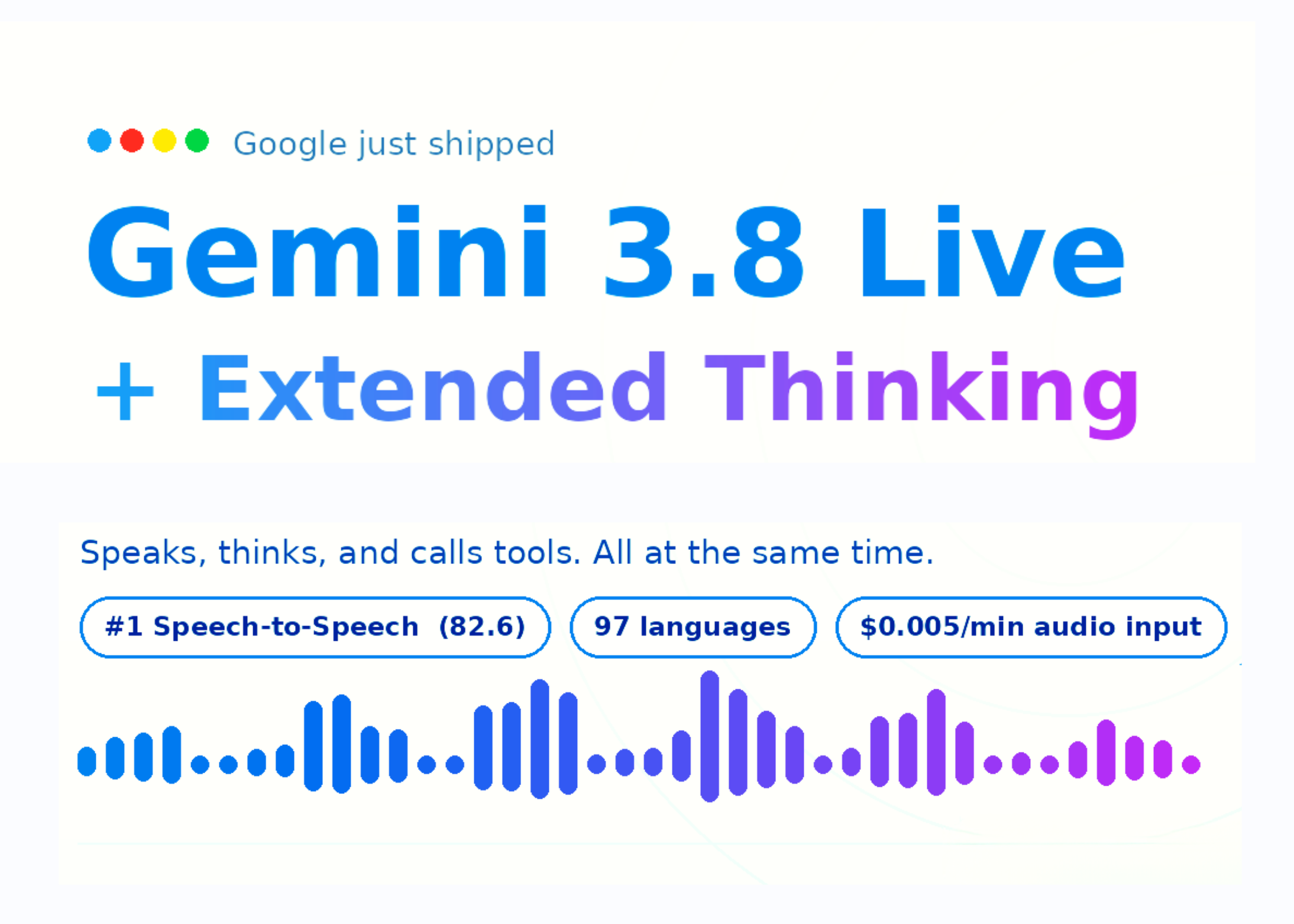
Google's September 15, 2026 release of Gemini 3.8 Live and 3.8 Live Extended Thinking models represents a critical inflection point for e-commerce sellers seeking to automate customer service, product discovery, and conversational commerce at scale. The Extended Thinking variant achieved a 82.6 score on the Artificial Analysis Speech-to-Speech Quality Index, outperforming OpenAI's GPT-Live-1 Astra (81.5) and SpaceXAI's Grok Voice Think Fast 2.0 (81.3), establishing Google as the performance leader in production-ready voice AI. Gemini 3.5 Transcribe delivers industry-leading accuracy with 2.6 Word Error Rate (WER) for non-streaming and 4.0 WER for streaming transcription, supporting 97 languages with accent consistency and alphanumeric parsing for order confirmations and claim numbers. Pricing at $0.005/minute for audio input and $0.018/minute for audio output makes voice automation economically viable for sellers processing 1,000+ customer interactions monthly.
For e-commerce sellers, the immediate automation opportunity centers on three high-ROI use cases: (1) Customer Service Automation: Gemini 3.8 Live Extended Thinking's simultaneous reasoning and speech capabilities enable sellers to deploy voice agents handling order status inquiries, returns processing, and product recommendations without human intervention. A seller processing 500 daily support tickets at $2-3 per ticket (outsourced) can reduce costs to $0.15-0.30 per interaction using Gemini's voice API, yielding $750-1,350 monthly savings at scale. (2) Multilingual Product Discovery: The 97-language support with automatic code-switching enables sellers to build voice-activated shopping experiences for global markets. Sellers can implement "voice search" features across Amazon, Shopify, and independent storefronts, capturing voice commerce demand projected to reach $40B by 2027. (3) Real-Time Order Processing: Gemini 3.5 Transcribe's ability to accurately parse confirmation codes, tracking numbers, and claim details enables voice-first order management, reducing manual data entry by 60-70% for sellers managing 3PL fulfillment across multiple regions.
The competitive advantage window is 3-6 months before mainstream adoption. Google's partnership ecosystem with Salesforce, Genspark, and Lumeris signals rapid integration into enterprise CRM platforms that sellers use for customer management. Early adopters implementing voice agents via Gemini API (through partners like LangChain, Pipecat, and Vercel) can establish customer experience differentiation before competitors. The background thinking feature in Gemini 3.8 Live enables complex reasoning for dynamic pricing analysis, competitive intelligence gathering, and inventory optimization—tasks currently requiring manual analyst time. Sellers relying on Gemini for product description generation, pricing strategy development, and market analysis can now leverage extended reasoning to improve content quality and strategic decision-making without displaying intermediate steps to customers, streamlining the user experience while maintaining analytical rigor.
Risk mitigation requires immediate platform evaluation. Sellers should audit current customer service infrastructure (chatbots, outsourced support, in-house teams) to identify high-volume, repetitive interactions suitable for voice automation. The integration pathways through Salesforce (via Genspark partnership) and Google Workspace suggest that sellers using these platforms will gain native voice capabilities within 2-3 months. Sellers NOT integrated into these ecosystems should evaluate direct Gemini API implementation through LangChain or Pipecat to avoid competitive disadvantage. The 97-language support creates urgency for sellers targeting Southeast Asia, Latin America, and European markets where voice commerce adoption is accelerating—delaying implementation risks losing market share to early-moving competitors.
Questions 8
How can sellers use Gemini 3.8 Live Extended Thinking to reduce customer service costs?
Sellers can deploy voice agents handling 40-60% of routine inquiries (order status, returns, product questions) at $0.15-0.30 per interaction using Gemini's API, compared to $2-3 per ticket for outsourced support. A seller processing 500 daily support tickets can save $750-1,350 monthly. The Extended Thinking variant's simultaneous reasoning and speech capabilities enable complex multi-step tasks like returns authorization and refund processing without human intervention. Integration through Salesforce (via Genspark partnership) or direct API implementation via LangChain enables deployment within 2-4 weeks.
What is the competitive advantage of Gemini 3.8 Live's 97-language support for cross-border sellers?
Gemini 3.8 Live's 97-language support with automatic code-switching enables sellers to build voice-activated shopping experiences across global markets without developing separate systems per region. The model maintains accent consistency and accurately parses alphanumeric data (order confirmations, tracking numbers), critical for international fulfillment. Sellers targeting Southeast Asia, Latin America, and Europe can implement voice commerce features 3-6 months ahead of competitors, capturing early-mover advantage in markets where voice shopping adoption is accelerating. The $0.005/minute input pricing makes multilingual deployment economically viable even for mid-market sellers.