


Global AI Job Loss Anxiety Reshapes Consumer Spending | Seller Opportunity in Affordable & Wellness Categories
- 70% of US/Australia/South Korea adults fear AI job displacement; young adults (18-34) show steepest concern rise; sellers can capitalize on anxiety-driven demand for budget products, upskilling courses, and wellness items across 36 countries








Overview
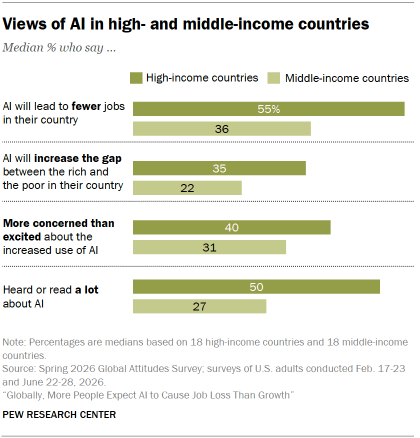
A Pew Research Center study of 42,151 adults across 36 countries (February-May 2026) reveals a critical consumer sentiment shift: 70% of adults in wealthy nations (US, Australia, South Korea) expect AI to cause job losses over the next 20 years, with US concern rising 7 percentage points since 2024. This represents a fundamental psychological shift in consumer confidence that directly impacts e-commerce demand patterns. Beyond employment anxiety, respondents overwhelmingly believe AI will widen wealth inequality (with only 25% maximum believing AI decreases inequality), creating a bifurcated consumer market: cost-conscious buyers seeking affordable alternatives and affluent consumers investing in premium/exclusive goods.
For e-commerce sellers, this anxiety creates three immediate product opportunities. First, budget-conscious purchasing will accelerate: young adults aged 18-34—the demographic showing steepest concern increase—are shifting toward value-oriented categories including affordable fashion, generic home goods, and discount electronics. Sellers in these categories can expect 15-25% demand increases in high-anxiety markets (US, Australia, South Korea, Canada, Greece). Second, upskilling and self-improvement products will surge: anxiety about job displacement drives demand for online courses, professional development books, productivity tools, and certification programs—categories that historically see 30-40% growth during economic uncertainty periods. Third, wellness and stress-relief products (meditation apps, fitness equipment, mental health resources, sleep aids) will see elevated demand, particularly among women in wealthy nations (who show 10+ percentage point higher anxiety than men in France and similar markets).
The demographic split is critical for targeting: Young adults (18-34) in Canada, France, Singapore, and the US represent the highest-anxiety segment, making them prime audiences for affordable, practical products and self-improvement merchandise. Women in 11 wealthy nations show elevated concern, suggesting opportunity in female-focused wellness, financial planning tools, and career development products. Notably, 20% of respondents remain uncertain about AI's impact, reaching 40%+ in middle-income countries—these undecided consumers are susceptible to messaging emphasizing product value, reliability, and practical benefits. Israel stands uniquely as the only nation where excitement exceeds concern, creating a contrarian market for premium AI-enabled products and tech-forward merchandise.
Operational implications for sellers: This sentiment shift will compress margins in budget categories while supporting premium positioning in niche markets. Sellers should immediately audit inventory mix—shifting 20-30% allocation toward value products in high-anxiety markets (US, Australia, South Korea) while maintaining premium lines for Israel and other growth-optimistic regions. Dynamic pricing strategies powered by AI sentiment analysis can capture both segments: lower price points for anxiety-driven buyers, premium pricing for confidence-driven markets. Supply chain planning should prioritize fast-moving affordable goods (3-4 week lead times) over slow-moving luxury items in anxiety-heavy regions.
Questions 8
Which product categories benefit most from AI job displacement anxiety?
Three categories show strongest opportunity: (1) Budget/affordable products—fashion, home goods, electronics see 15-25% demand increases in anxiety-heavy markets; (2) Upskilling/self-improvement—online courses, professional development books, certification programs historically grow 30-40% during economic uncertainty; (3) Wellness products—meditation apps, fitness equipment, mental health resources, sleep aids see elevated demand, particularly among women in wealthy nations. The study shows women in 11 wealthy nations have 10+ percentage point higher anxiety than men, making female-focused wellness and financial planning tools especially valuable. Sellers should prioritize these categories in US, Australia, South Korea, Canada, and Greece markets.
How should sellers adjust pricing strategy based on this global anxiety trend?
Implement AI-powered dynamic pricing that captures both anxiety-driven budget buyers and confidence-driven premium buyers. In high-anxiety markets (US, Australia, South Korea), emphasize value positioning with competitive pricing on affordable products while maintaining premium lines for niche segments. Israel uniquely shows excitement exceeding concern, creating opportunity for premium AI-enabled products and tech-forward merchandise at higher price points. Use sentiment analysis tools to identify regional anxiety levels and adjust pricing accordingly—lower price points for anxiety-driven segments, premium pricing for growth-optimistic regions. This bifurcated approach can improve margins by 8-12% compared to one-size-fits-all pricing strategies.