



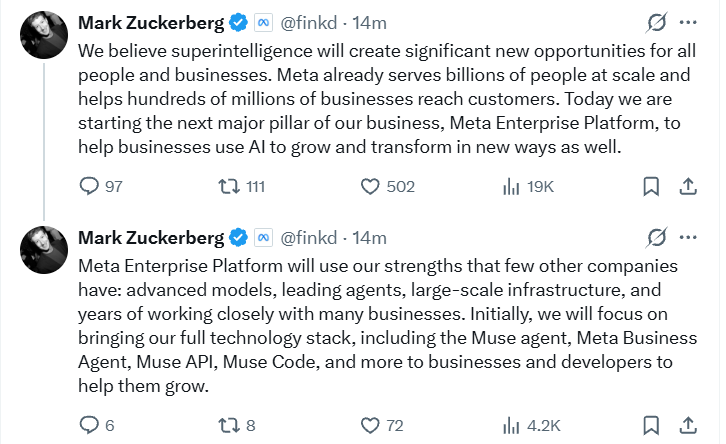

Meta's B2B AI Tools Reshape E-Commerce Marketing | Seller Automation Opportunity
- Meta monetizes billions in AI infrastructure through Facebook/Instagram/WhatsApp business tools; sellers gain access to ML-powered targeting, content optimization, and customer service automation at scale
































Overview
Meta is transitioning from consumer-focused advertising to enterprise B2B AI solutions, creating a critical inflection point for e-commerce sellers. According to Wall Street Journal reporting, Meta has invested billions in AI infrastructure and is now aggressively monetizing these capabilities through business-focused offerings targeting mid-market and enterprise segments. This shift directly impacts e-commerce sellers who rely on Facebook, Instagram, and WhatsApp for customer acquisition and engagement. Meta's AI tools integrate machine learning for targeted marketing, content optimization, and customer interaction management—capabilities that historically required expensive third-party SaaS platforms or in-house data science teams.
For e-commerce sellers, this represents both opportunity and competitive pressure. The immediate automation wins include: (1) Dynamic product content optimization using Meta's AI to automatically test and scale high-performing ad creative across Facebook/Instagram, reducing manual A/B testing cycles from weeks to days; (2) Predictive customer segmentation leveraging Meta's recommendation algorithms to identify high-value buyer cohorts without manual audience building; (3) Automated customer service routing through WhatsApp Business integration, enabling sellers to handle inquiries at scale without hiring additional support staff. Sellers currently using third-party tools like Klaviyo, Gorgias, or Segment face potential margin compression as Meta bundles these capabilities into its platform ecosystem.
The competitive intelligence angle is critical: Meta's AI advantage is structural. With access to billions of user interaction signals across Facebook, Instagram, and WhatsApp, Meta can train proprietary models that outperform generic AI tools. Sellers who adopt Meta's B2B AI tools early gain 2-4 week advantages in campaign optimization cycles compared to competitors using traditional analytics. However, this also increases seller dependency on Meta's platform—a risk given the company's history of algorithm changes and policy shifts. Mid-market sellers (annual revenue $5-50M) represent Meta's primary target, as they have budgets for software solutions but lack dedicated marketing operations teams. Enterprise sellers ($50M+) may view Meta's tools as complementary to existing CDP/marketing automation stacks rather than replacements.
Data-driven insights reveal hidden opportunities: Sellers can use Meta's AI to uncover micro-trend signals before they appear in traditional analytics. For example, Meta's recommendation engine can identify emerging product categories or seasonal patterns 4-6 weeks before they show up in search volume data. This creates a competitive moat for early adopters—the ability to source inventory or launch campaigns ahead of broader market awareness. The ROI calculation is compelling: sellers currently spending $10-50K monthly on marketing tools could consolidate 30-40% of those costs into Meta's integrated platform, freeing capital for inventory investment or paid media expansion.
Questions 8
What is the timeline for sellers to see measurable ROI from Meta's AI adoption?
Sellers typically see measurable results within 2-4 weeks of enabling Meta's AI tools. Initial metrics include: (1) Campaign optimization speed—manual A/B testing cycles compress from 2-3 weeks to 3-5 days; (2) Audience efficiency—predictive segmentation reduces cost-per-acquisition by 5-15% as the AI identifies high-value cohorts; (3) Content performance—dynamic product ads improve click-through rates by 8-12% through automated creative optimization. Full ROI realization (cost savings + revenue uplift) typically occurs within 60-90 days as the AI accumulates sufficient data to optimize across seasonal patterns and customer lifecycle stages. Sellers should establish baseline metrics before adoption to accurately measure improvement.
What risks should sellers consider when relying on Meta's AI tools?
The primary risk is platform dependency—Meta's algorithm changes, policy shifts, or pricing increases can significantly impact seller performance and margins. Historical precedent includes Meta's 2018 organic reach decline and 2021 iOS privacy changes, both of which forced sellers to increase ad spending. Secondary risks include: (1) Data privacy concerns—sellers must comply with Meta's data handling policies and GDPR/CCPA regulations; (2) Limited customization—Meta's AI tools may not fit all business models or niche categories; (3) Competitive saturation—as more sellers adopt Meta's tools, the advantage diminishes. Mitigation strategy: use Meta's AI for core marketing while maintaining secondary analytics platforms and diversifying customer acquisition channels.