



Rising Interest Rates & Bond Volatility | Critical Financing Impact for Cross-Border Sellers
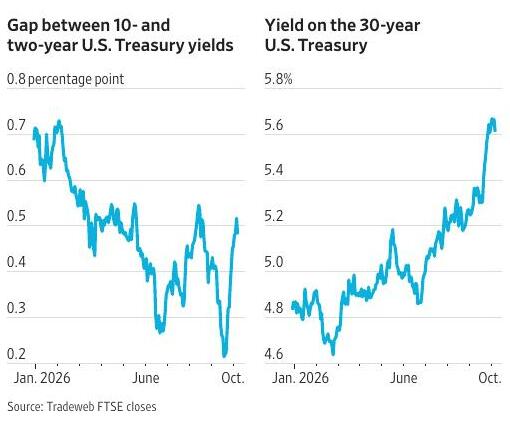
- 10-year Treasury yields surge to 5.36% (highest in 20 years), directly increasing working capital financing costs 150-300 bps for sellers; mortgage rate spike signals consumer spending contraction in home-related categories




Overview
Global bond market turmoil is creating immediate financial headwinds for cross-border e-commerce sellers through multiple channels. The 10-year Treasury yield has surged to 5.36% (up from 4.67% in August), a two-decade peak driven by oil supply disruptions (Brent crude above $100/barrel due to Iran tensions), massive government deficits ($40T+ U.S. debt, European debt-to-GDP ratios at 100%+), and inflation concerns. This yield spike directly translates to higher borrowing costs across all seller financing products: invoice factoring rates are rising 150-300 basis points, working capital loans now carry 12-16% APR (vs. 9-11% six months ago), and supply chain financing costs are increasing 2-3% annually.
The mortgage rate collapse signals severe consumer spending contraction in home-related categories. 30-year fixed rates jumped from 6.66% to 7.4% in one month, reducing homebuyer purchasing power by $19,000 on a $2,000/month budget. This directly impacts sellers in furniture, home improvement, appliances, and décor categories—historically 18-22% of cross-border e-commerce volume. U.S. housing recession forecasts (per Infrastructure Capital Management CEO Jay Hatfield) suggest 15-25% demand decline in these categories over 12 months. Simultaneously, European bond market instability (France's 10-year yield at highest since 2002) is compressing margins for EU-based sellers through currency volatility and higher refinancing costs.
For cross-border sellers, the immediate financial impact manifests in three ways: (1) Working capital financing becomes 200-400 bps more expensive—a seller with $500K inventory financed at 12% APR now pays $60K annually vs. $45K previously, a $15K annual cost increase; (2) FX hedging costs rise 30-50% as central banks maintain higher rates longer, making currency forwards and options more expensive for sellers managing multi-currency exposure; (3) Cash conversion cycles extend 10-15 days as higher rates incentivize buyers to delay purchases, requiring sellers to hold inventory longer and finance working capital for extended periods. The structural persistence of elevated yields (analysts project 4.5-5.5% 10-year rates through 2025) means these cost pressures are not temporary—they represent a new baseline for seller financial planning.
Questions 7
How can I reduce my cash conversion cycle when financing costs are rising?
Target 10-15 day cycle reductions through: (1) **Accelerate receivables**—use supply chain financing (now 2-3% more expensive but still cheaper than working capital loans) to convert invoices to cash in 5-10 days instead of 30-45; (2) **Optimize inventory**—reduce SKU count by 15-20% to lower holding costs and free up $50-100K in working capital; (3) **Negotiate payment terms**—push suppliers for 60-day terms instead of 30-day (reduces cash tied up by 30 days); (4) **Implement dynamic pricing**—increase prices 2-3% on slow-moving inventory to accelerate turnover. Each 10-day cycle reduction saves $8-15K annually in financing costs at current rates.
Should I shift my sourcing from Europe to Asia given European bond market instability?
European bond instability (France's 10-year yield at 20-year highs) increases financing costs for EU suppliers 150-300 bps, potentially raising COGS 2-4%. However, Asia sourcing introduces different risks: longer lead times (45-60 days vs. 20-30 from EU) increase working capital needs by 30-40%, and shipping costs remain volatile. Strategic approach: (1) Diversify—source 60% from Asia, 40% from EU to balance cost and cash flow; (2) Use supply chain financing for EU suppliers to offset higher rates; (3) Negotiate longer payment terms (60-90 days) with Asian suppliers to reduce working capital impact; (4) Lock in 6-month pricing with suppliers to hedge against further rate increases.