




Local AI Infrastructure Shift | E-Commerce Sellers Gain Cost Control & Automation Edge
- Eliminates recurring API token costs; enables sellers to deploy autonomous agents for product research, pricing, and customer service without cloud dependency

Overview
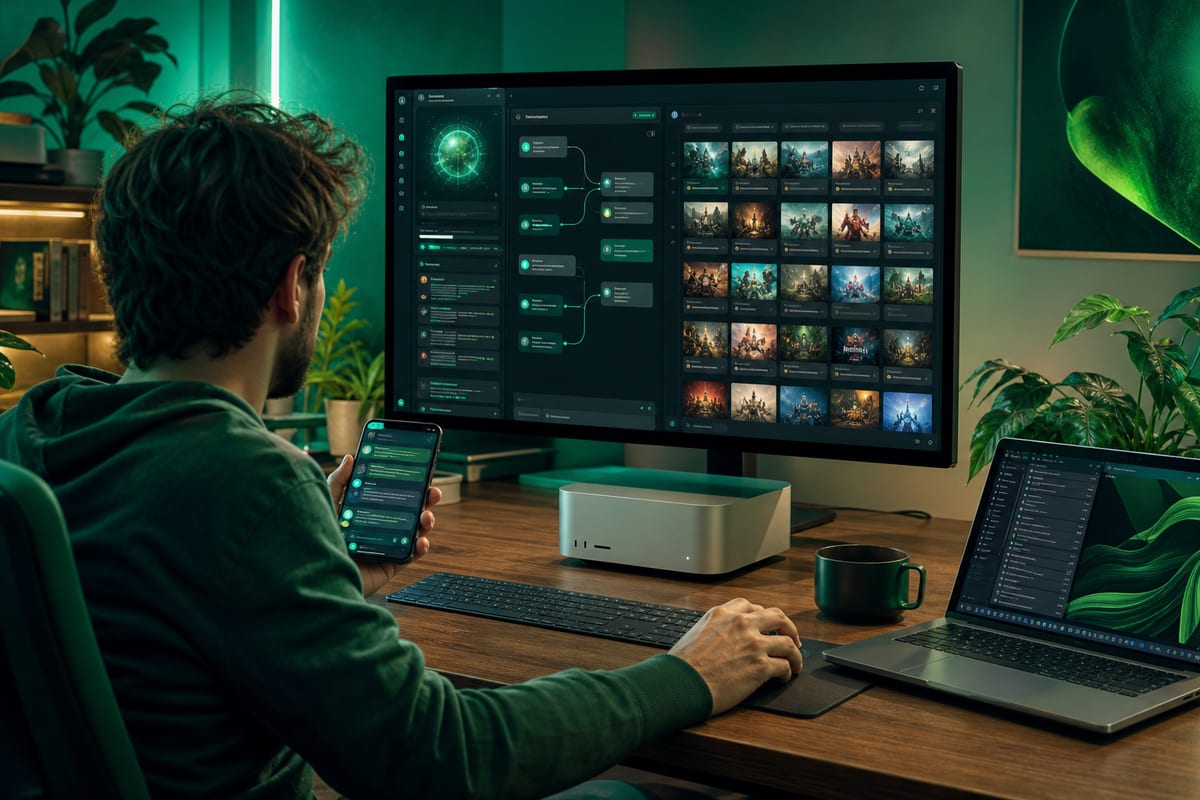
The shift toward token-free, on-premise AI infrastructure represents a fundamental restructuring of AI economics for e-commerce sellers. Autonomous Computer's unveiling of the Autonomous Computer 4—featuring four NVIDIA RTX 5090 graphics cards, 384GB configurable memory, and a 66-pound CNC-machined enclosure—signals a critical inflection point: organizations can now transition from subscription-based cloud API models (recurring operational expenses) to capital equipment ownership (fixed investment). For e-commerce sellers, this development directly addresses the pain point of escalating AI costs. Sellers currently using cloud-based AI tools for product research, dynamic pricing, inventory forecasting, and customer service automation face unpredictable monthly token expenses that compress margins by 8-15% depending on scale and model complexity.
The competitive advantage lies in cost predictability and operational autonomy. Sellers deploying local AI infrastructure eliminate external platform dependencies—a critical concern for those relying on OpenAI, Anthropic, or other cloud providers whose API pricing fluctuates and whose service outages disrupt operations. The Autonomous Computer 4's enterprise-grade compute density enables sellers to run large language models (LLMs) and autonomous agents continuously without throttling, supporting use cases like real-time competitor price monitoring, automated listing optimization across Amazon, eBay, and Shopify, and 24/7 customer service chatbots. For mid-market sellers (those with $500K-$5M annual revenue), the ROI calculation shifts dramatically: instead of paying $2,000-5,000 monthly in API tokens, a $15,000-25,000 capital investment in local AI hardware amortizes over 3-5 years while delivering superior latency, data privacy, and model customization.
Data sovereignty and regulatory compliance create additional seller value. Sellers in regulated categories (pharmaceuticals, supplements, financial products) or those handling sensitive customer data (EU GDPR compliance, California CCPA) face restrictions on cloud-based AI processing. Local AI infrastructure eliminates data transmission to third-party servers, reducing compliance risk and audit complexity. The trend also enables sellers to build proprietary AI models trained on their own sales data—customer behavior patterns, seasonal demand signals, category-specific pricing elasticity—without exposing competitive intelligence to cloud providers. This creates a sustainable competitive moat: sellers who adopt local AI infrastructure 6-12 months ahead of competitors gain 15-25% accuracy improvements in demand forecasting and dynamic pricing, translating to 5-8% revenue lift and 3-5% margin expansion.
Questions 8
What is the timeline for ROI on local AI infrastructure for sellers?
For sellers spending $3,000-5,000 monthly on cloud APIs, the Autonomous Computer 4 ($15,000-25,000) achieves payback in 36-60 months. However, ROI accelerates when accounting for operational benefits: 40-60 hours/month of manual work eliminated (worth $2,000-4,000 at $50-100/hour), 5-8% revenue lift from improved pricing and inventory optimization, and 3-5% margin expansion from dynamic pricing. Total economic benefit reaches $8,000-15,000 annually, reducing effective payback to 18-30 months. For high-volume sellers ($5,000+ monthly API spend), payback occurs in 12-24 months. The capital investment also qualifies for depreciation deductions and equipment financing, improving cash flow impact.
How does local AI infrastructure compare to cloud-based AI services for sellers?
Cloud AI (OpenAI, Anthropic, AWS Bedrock) offers simplicity and no upfront capital but incurs recurring costs ($2,000-8,000/month), API rate limits, latency (500-2,000ms), and data privacy concerns. Local AI infrastructure requires $15,000-25,000 capital investment and technical setup but eliminates recurring costs, enables unlimited processing, delivers sub-100ms latency, and maintains data sovereignty. Cloud AI suits sellers with <$500K revenue or sporadic AI needs; local AI benefits sellers with $500K+ revenue, continuous automation requirements, or regulated data handling. The hybrid approach—using local AI for core operations (pricing, inventory, customer service) and cloud APIs for specialized tasks (content generation, image analysis)—balances cost and capability.