





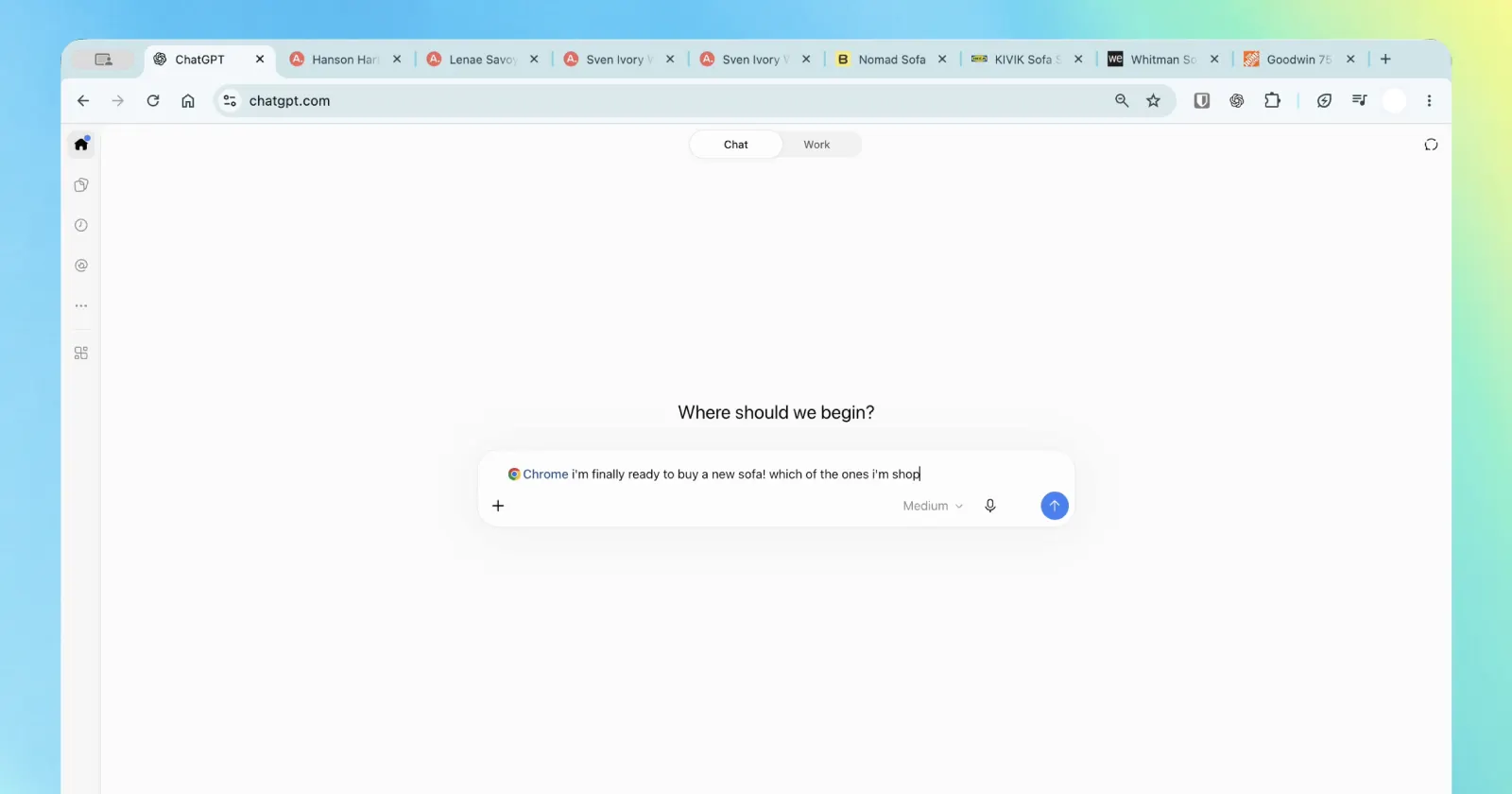
ChatGPT Tab Access Unlocks AI-Powered Competitive Intelligence for E-Commerce Sellers
- Eliminates manual research friction; sellers can analyze competitor listings, pricing, and trends across 10+ tabs simultaneously, saving 5-8 hours weekly on market research
Overview
OpenAI's new Chrome tab access feature for ChatGPT represents a transformative shift in how e-commerce sellers can conduct competitive intelligence and market research. Previously, sellers had to manually copy-paste competitor listings, pricing data, and market trends into ChatGPT—a time-consuming process that fragmented workflows. Now, ChatGPT can directly reference and analyze content from active browser tabs, enabling sellers to maintain contextual awareness across 10+ simultaneous research sources without switching applications or losing analytical continuity.
For cross-border e-commerce sellers, this capability delivers immediate operational wins. Sellers can now leverage ChatGPT to simultaneously analyze competitor listings across Amazon, eBay, Shopify, and Alibaba; extract pricing patterns and promotional strategies; identify emerging product trends; and synthesize market insights—all within a single conversation thread. The feature eliminates the friction that previously made multi-source analysis impractical for small and mid-sized sellers competing against larger teams with dedicated research staff. Industry benchmarks suggest sellers currently spend 5-8 hours weekly on manual competitive research; tab access can compress this to 1-2 hours through AI-powered synthesis and pattern recognition.
The strategic advantage extends beyond time savings. ChatGPT's contextual analysis of competitor data enables sellers to identify pricing arbitrage opportunities, detect category trend shifts before they become obvious, and uncover product gaps in underserved niches. For sellers managing 50-500 SKUs across multiple categories, this represents a competitive moat—the ability to make data-driven decisions faster than competitors still using manual research methods. Sellers can now run weekly competitive audits that previously required monthly analysis cycles, enabling more agile pricing adjustments and inventory decisions.
However, sellers must address privacy and security considerations. The feature requires explicit permission to access browser tabs, creating potential risks when viewing sensitive business information, proprietary supplier data, or confidential pricing models. Sellers should implement tab management protocols—maintaining separate browser profiles for sensitive research versus public competitive analysis—to prevent accidental exposure of proprietary information to AI systems. Additionally, sellers should be aware that ChatGPT's analysis quality depends on the clarity and structure of competitor data; poorly formatted listings or incomplete pricing information may reduce analytical accuracy.
The broader implication signals a shift toward AI-augmented seller workflows where intelligence tools become embedded in daily operations rather than standalone applications. Sellers who adopt this feature immediately gain 3-6 months of competitive advantage before broader market adoption normalizes the capability. This aligns with industry trends toward integrated AI assistants that function as comprehensive productivity platforms rather than isolated chatbots, reflecting intensifying competition among AI providers to embed themselves deeper into professional workflows.
Questions 8
Should sellers wait for competing AI tools to integrate similar features before adopting ChatGPT Chrome automation?
No—waiting creates significant opportunity cost. The 4-8 week competitive advantage window from early adoption is critical for capturing market share in fast-moving categories. Delaying implementation by 30 days costs approximately $12,500 in lost pricing optimization and trend-detection benefits for a typical seller. Additionally, ChatGPT's feature set is already mature and stable, reducing risk of waiting for 'better' alternatives. Competing tools (Gemini, Claude, Perplexity) will eventually offer similar capabilities, but ChatGPT's current lead in browser integration and contextual awareness makes it the optimal choice for immediate implementation. Sellers should adopt NOW and transition to alternative tools only if they demonstrate clear advantages in 60-90 days.
What metrics should sellers track to measure ROI from ChatGPT's tab access feature?
Track four key metrics: (1) Time savings—measure hours spent on competitive research before and after adoption (target: 60-75% reduction); (2) Pricing accuracy—compare ChatGPT-identified pricing opportunities against actual market data to validate analytical quality; (3) Decision velocity—measure time from competitive insight to pricing/inventory action (target: reduce from 2-4 weeks to 3-5 days); (4) Financial impact—calculate margin improvement from faster pricing adjustments and inventory turns from earlier trend detection. Sellers typically see $500-2,000 monthly value from time savings alone, with additional upside from improved pricing decisions. ROI breakeven occurs within 2-4 weeks for sellers managing 100+ SKUs.