





Japan's Currency Crossroads: The Yen's Precarious Balancing Act
- Monetary Policy Shifts Expose Fundamental Challenges for Global Financial Markets

























Overview
The Japanese yen stands at a critical inflection point, revealing a complex narrative of monetary policy, currency devaluation, and global financial recalibration. At the heart of this economic drama is the Bank of Japan's (BOJ) delicate navigation between inflationary pressures and long-standing economic constraints.
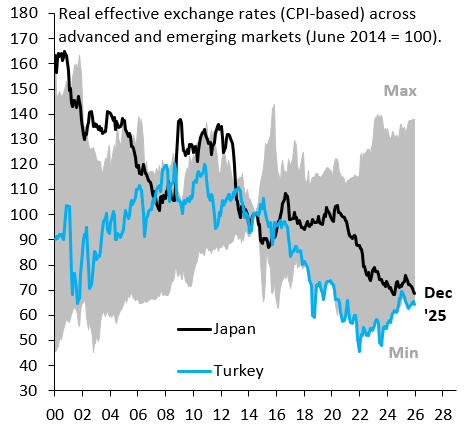
The BOJ's recent rate hike to 0.75% – its highest in three decades – signals a profound departure from decades of ultra-loose monetary policy. However, this modest adjustment has triggered significant market volatility, with the yen experiencing dramatic weakness against major currencies. The currency has sunk 1.3% against the euro and 1.4% against the US dollar, approaching levels comparable to the Turkish Lira in terms of vulnerability.
Underlying this currency turbulence is Japan's intricate economic challenge: massive public debt estimated at 240% of GDP, with the BOJ remaining a significant buyer of government bonds. This intervention prevents yields from reaching true market levels, effectively managing a potential debt crisis while simultaneously enabling continuous currency debasement. The real effective exchange rate charts starkly demonstrate the yen's declining global purchasing power.
The global implications are substantial. Japanese investors, who have traditionally sought returns overseas, may now reconsider their international investment strategies. The potential disruption of the carry trade could cause significant market volatility, with pension funds, insurers, and individual investors potentially repatriating overseas investments. This shift could impact global bond markets, stock prices, and currency valuations, particularly in the United States and Europe.
Policymakers face a trilemma: risk a debt crisis, continue currency devaluation, or pursue aggressive fiscal consolidation. With political consensus lacking for dramatic asset sales or privatization, the yen's weakness is likely to persist. Traders and investors are now closely watching BOJ Governor Kazuo Ueda's future communications, seeking any signals of more aggressive monetary tightening that could potentially stabilize the currency's value.
Questions 3
Why is the Japanese yen experiencing such significant weakness?
The yen's weakness stems from the Bank of Japan's complex monetary policy, including artificially suppressed bond yields, massive public debt (240% of GDP), and cautious interest rate increases. Despite raising rates to 0.75%, the BOJ's hesitant approach has failed to provide strong hawkish signals that might strengthen the currency.
What are the potential global implications of the yen's current trajectory?
The yen's devaluation could disrupt global investment strategies, particularly the carry trade. Japanese investors might repatriate overseas investments, potentially causing volatility in global bond markets, stock prices, and currency valuations. This could significantly impact international financial dynamics, especially in the US and European markets.