


NHL Dominance Dynamics Unveiled: Colorado Avalanche's Decisive Victory Over Minnesota Wild
- Revealing the Strategic Performance Gap in Professional Hockey Competitive Landscapes




























Overview
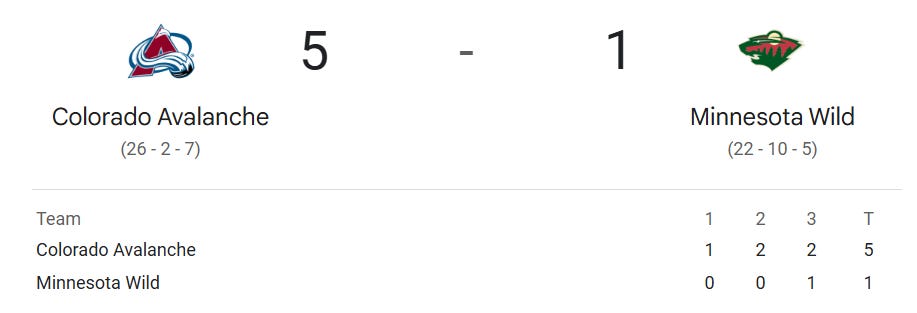
In the high-stakes world of professional hockey, the Colorado Avalanche have emphatically demonstrated their superiority, delivering a resounding 5-1 victory against the Minnesota Wild that goes far beyond a simple game result. This match represents a critical moment of competitive positioning, where tactical prowess and team dynamics converge to tell a deeper story of athletic excellence.
Performance Dominance Decoded: The game's outcome, featuring Nathan MacKinnon's two-goal performance and Cale Makar's impressive goal and two assists, is not merely a statistical anomaly but a strategic statement. The Avalanche's comprehensive 5-1 win signals a significant competitive advantage, suggesting they are currently the team to beat in the NHL landscape. This isn't just about one game, but about establishing a psychological and tactical supremacy that extends beyond the immediate match.
Tactical Implications: While the Minnesota Wild might have been generating buzz, this game brutally exposed the performance gap between the two teams. The Avalanche's decisive victory reveals a multi-layered competitive strategy: superior player coordination, individual brilliance, and a systematic approach to dismantling their opponent's game plan. MacKinnon and Makar emerge not just as players, but as strategic architects of their team's dominance.
The postgame narrative, captured in the Hynes Postgame transcript, further underscores the comprehensive nature of the Avalanche's victory. It's a stark reminder that in professional sports, reputation and previous expectations mean little when confronted with actual on-ice performance. The Wild's 5-1 loss is more than a score—it's a potential turning point in their season and team trajectory.
Strategic takeaway: In professional hockey, dominance is not just about individual talent, but about consistent, systematic excellence that can dismantle opponent strategies comprehensively and repeatedly.
Questions 3
What made the Colorado Avalanche's victory so significant?
The Avalanche's 5-1 win was more than a score—it was a comprehensive demonstration of tactical superiority, with key players like Nathan MacKinnon and Cale Makar showcasing individual brilliance and team coordination that systematically dismantled the Minnesota Wild's game strategy.
How does this game impact the NHL competitive landscape?
This victory positions the Avalanche as a dominant force, potentially reshaping perceptions about team hierarchies. It suggests they are currently the team to beat, with a performance level that goes beyond individual match results and indicates a deeper competitive advantage.