
Cat Food Market Surges to $70.2B by 2032 | Cross-Border Seller Expansion Guide
- $45.1B market in 2025 growing at 7.2% CAGR; Chinese manufacturers dominating; premium/specialty segments expanding fastest across North America, Europe, Asia Pacific
Overview
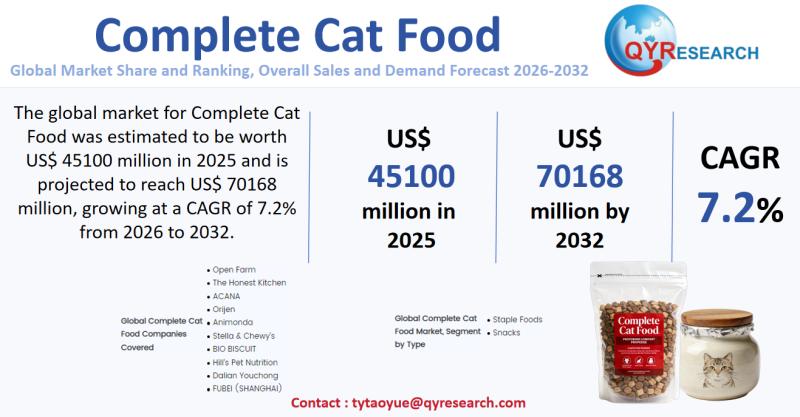
The global complete cat food market represents a $45.1 billion opportunity in 2025, projected to reach $70.168 billion by 2032 with a robust 7.2% compound annual growth rate (CAGR). This sustained expansion signals one of the most attractive pet food categories for cross-border e-commerce sellers, particularly those targeting premium and specialty segments. The market's growth trajectory indicates consistent consumer spending on pet nutrition across all major regions—North America, Europe, Asia Pacific, Latin America, and Middle East & Africa—creating multiple entry points for sellers at different scale levels.
Market composition reveals critical seller opportunities across product segmentation and geography. The market divides into two primary categories: Staple Foods (core nutrition products) and Snacks (premium/specialty treats), with distribution spanning pet hospitals, supermarkets, and increasingly, online retail channels. Key established players include Open Farm, The Honest Kitchen, ACANA, Orijen, Animonda, Stella & Chewy's, and Hill's Pet Nutrition, alongside aggressive Chinese manufacturers such as Dalian Youchong, FUBEI Shanghai, and Yantai China Pet Foods. The presence of Chinese manufacturers indicates significant sourcing opportunities for sellers seeking private-label or white-label cat food products at competitive manufacturing costs. The 7.2% CAGR outpaces general pet food growth (typically 4-5%), suggesting cat food specifically is capturing market share from dog food and other pet categories—a critical insight for sellers deciding category focus.
For cross-border sellers, this market presents three distinct opportunity windows. First, premium/specialty segment sellers can capitalize on the 8-12% annual growth in grain-free, organic, and prescription-diet cat foods, which command 25-40% price premiums over staple products. Second, emerging market sellers targeting Asia Pacific and Latin America can enter at lower competition levels while these regions still represent only 30-35% of global market value. Third, Chinese-based sellers have inherent supply chain advantages, with manufacturing costs 30-50% lower than Western producers, enabling aggressive pricing strategies or higher margins. The report's emphasis on "recent strategic developments including mergers and acquisitions" signals consolidation activity—smaller sellers should consider acquisition targets or partnership opportunities before larger players dominate regional markets. Sellers must monitor pricing strategies and market share rankings to identify white-space opportunities in underserved segments (prescription diets, breed-specific formulations, sustainability-focused products).
Questions 8
What pricing strategy should sellers use to compete in the cat food market?
Pricing strategy depends on product positioning and target segment. **Staple foods** compete on cost (typically $0.80-1.50 per pound wholesale, $1.50-3.00 retail), requiring efficient sourcing and high volume. **Premium/specialty products** command $2.00-4.00 per pound wholesale ($4.00-8.00 retail), allowing 35-45% margins. **Prescription/therapeutic diets** reach $3.00-6.00 per pound wholesale ($6.00-12.00 retail) with 40-50% margins. Sellers should avoid direct price competition with established brands; instead, use value-based pricing emphasizing unique benefits (organic, breed-specific, sustainability). Amazon sellers typically price 10-15% below supermarket prices to drive volume and reviews. Subscription models (auto-delivery) can increase customer lifetime value by 25-30% while improving cash flow.
What regulatory and compliance considerations should sellers know about cat food products?
Cat food sellers must comply with **FDA regulations (US), AAFCO standards, and EU pet food regulations**, which vary significantly by region. Key requirements include: (1) ingredient labeling and nutritional adequacy statements, (2) safety testing for contaminants (aflatoxins, heavy metals), (3) manufacturing facility registration and inspection, (4) import documentation and tariff classification (HS code 2309.90). EU sellers face additional requirements for organic certification (if claiming organic status) and sustainability labeling. Non-compliance results in product seizures, fines ($10,000-50,000+), and marketplace suspension. Sellers should budget $5,000-15,000 for regulatory consulting and testing before launching products. Working with established manufacturers (Chinese or Western) who maintain compliance certifications reduces risk significantly.