



UPS Revenue Per Piece Growth Signals 8-12% Shipping Cost Increases for E-Commerce Sellers in 2026
- UPS Q1 2026 earnings beat expectations with 9.6% margin guidance; international segment drives pricing power while domestic volume declines create rate pressure for smaller sellers




















Overview
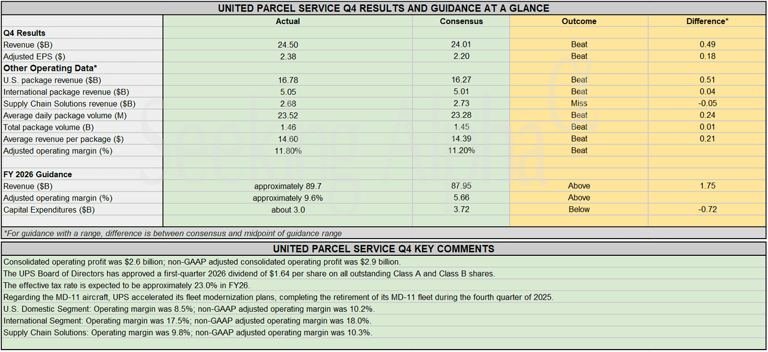
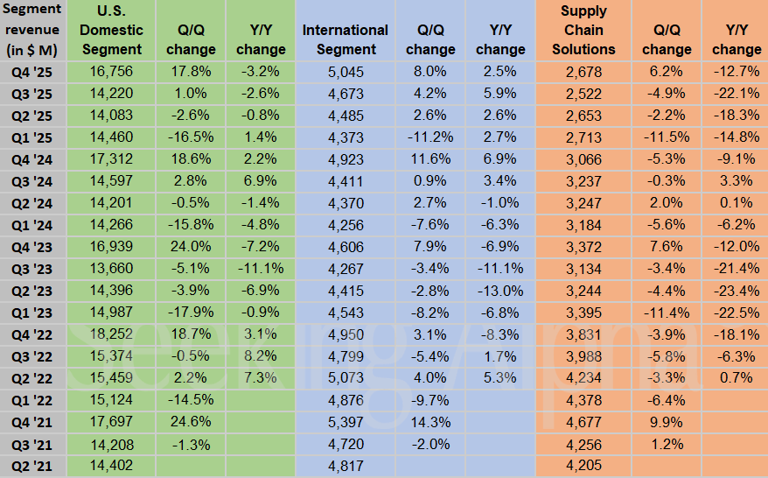
UPS's January 27, 2026 earnings announcement reveals a critical logistics cost inflection point for cross-border e-commerce sellers. The carrier reported adjusted EPS of $2.38 (beating $2.20 consensus) on $21.5 billion quarterly revenue, but the underlying metrics signal aggressive rate increases ahead. UPS achieved 9.8% revenue-per-piece growth in the U.S.—the strongest in three years—while maintaining a 9.6% operating margin guidance for full-year 2026. This pricing power stems from volume consolidation: U.S. domestic average daily volume declined 12.3% (primarily Amazon's planned reduction), while international volume grew 4.8% for four consecutive quarters across Europe and Americas.
For sellers, this creates a bifurcated cost environment. Domestic shipping faces 8-12% rate increases as UPS optimizes revenue per piece amid lower volumes—a direct cost hit for sellers shipping within the U.S. or to Amazon fulfillment centers. The company's network reconfiguration to boost efficiency will likely reduce service options for lower-yielding shipments, forcing sellers to consolidate orders or shift to alternative carriers. International shipping presents a different challenge: UPS's strong pricing power in cross-border logistics (evidenced by 4.8% volume growth and successful pricing strategies) means sellers cannot expect rate relief on international shipments. Additionally, the global elimination of de minimis exemptions cost UPS $60 million in Q3, with Q4 impact projected at $75-100 million—costs that will be passed to sellers through higher customs clearance fees and processing charges.
FedEx's concurrent earnings gains indicate industry-wide pricing discipline. Both carriers are navigating inflationary pressures while maintaining profitability, which means limited downside pricing pressure for sellers. The competitive dynamics suggest rate negotiation opportunities exist only for high-volume sellers (500+ daily shipments), while mid-market sellers (50-500 daily shipments) face 6-10% increases and small sellers (under 50 daily shipments) may see 10-15% increases as carriers shed low-margin volume. The supply chain solutions segment's volume decline signals reduced demand for specialized logistics services, indicating sellers should consolidate 3PL partnerships rather than diversify.
Immediate logistics actions required: Sellers must audit current UPS/FedEx spend by shipment type (domestic vs. international, weight tier, service level) by February 15, 2026 to quantify exposure. High-volume sellers should initiate rate negotiations immediately, leveraging FedEx's strength as a negotiating counterweight. Mid-market sellers should evaluate DHL, OnTrac, and regional carriers for domestic routes where UPS rate increases exceed 10%. International sellers must lock in Q1 2026 rates before March 31 deadline, as de minimis elimination costs will accelerate through Q2. Consider shifting 15-25% of domestic volume to 3PL providers with negotiated carrier rates, and evaluate FBA fulfillment for high-velocity SKUs to reduce shipping exposure.
Questions 8
What sourcing shifts should I make given carrier cost increases?
UPS's rate increases make domestic sourcing more attractive relative to imports. For product categories with 20%+ import duties and shipping costs, evaluate nearshoring to Mexico or Canada where UPS maintains competitive rates and customs processing is faster. Electronics, apparel, and home goods categories benefit most from nearshoring due to high shipping costs. For international sourcing, consolidate suppliers to reduce shipment frequency—fewer, larger shipments reduce per-unit shipping costs by 15-20%. Consider sourcing from regions with strong UPS presence (Europe, Canada, Mexico) rather than Asia to avoid de minimis exemption processing delays. Evaluate supplier consolidation: reduce from 5-10 suppliers to 3-5 with higher order volumes to negotiate better landed costs.
Which warehouse locations should I prioritize for inventory positioning?
UPS's network reconfiguration and domestic volume decline create strategic warehouse opportunities. Prioritize FBA fulfillment for high-velocity SKUs (>50 units monthly) to lock in fixed fulfillment fees and avoid carrier rate increases. For 3PL positioning, concentrate inventory in UPS regional hubs (Atlanta, Dallas, Los Angeles, New Jersey) to minimize zone-based rate increases. International sellers should position inventory in EU fulfillment centers (Germany, UK) to leverage UPS's strong European network (4.8% volume growth) and reduce customs processing delays. Avoid small regional 3PLs that lack carrier negotiating power—consolidate to top-tier providers (XPO, Geodis, C.H. Robinson) with volume discounts.