
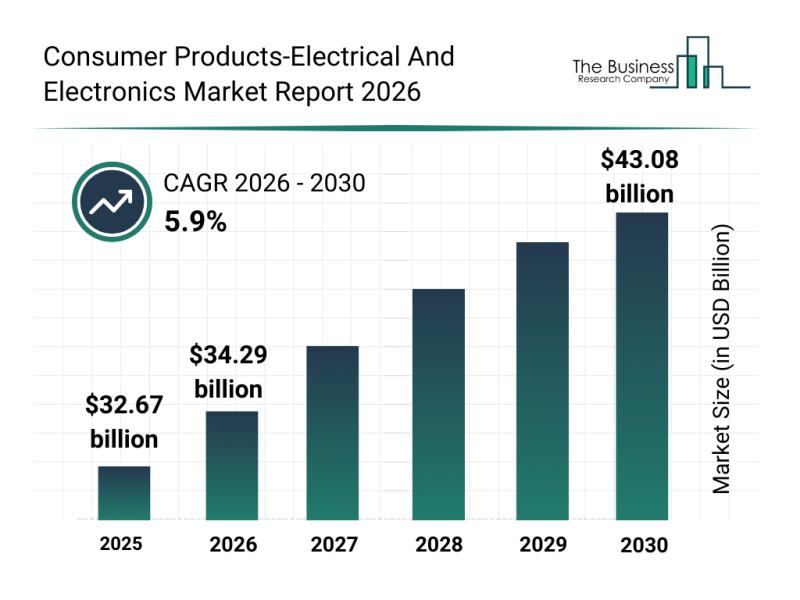
Smart Home & IoT Electronics Market Surge | $43B Opportunity for Cross-Border Sellers
- Global market projected to reach $43.08B by 2030 at 5.9% CAGR; smart home automation fastest-growing segment; e-commerce distribution channels driving 60%+ of growth for international sellers
Overview
The global consumer products electrical and electronics market is experiencing explosive growth, with projections reaching $43.08 billion by 2030 at a compound annual growth rate of 5.9%—representing a critical expansion window for cross-border e-commerce sellers. This surge is fundamentally reshaping product demand across multiple categories, with smart home appliances, connected IoT devices, and AI-enabled personal electronics emerging as the fastest-growing segments. The market shift reflects a structural consumer preference change away from conventional electronics toward intelligent, connected solutions.
Market dynamics favor e-commerce distribution channels significantly. The news highlights that e-commerce platforms are now primary distribution channels competing directly with traditional retail, hypermarkets, and specialty stores. This represents a direct opportunity for sellers on Amazon, eBay, Shopify, and Walmart Marketplace to capture market share in high-velocity categories. Industry consolidation signals competitive intensity: Cyient DLM's $29.2 million acquisition of Altek Electronics in October 2024 demonstrates major players strengthening North American positions, while Germany-based Shelly's introduction of eight new smart home products in January 2023—including Wi-Fi-enabled smoke alarms and three-phase energy meters—shows product innovation velocity is accelerating.
For cross-border sellers, the opportunity segmentation is clear and actionable. Smart home automation products, smart lighting solutions, and connected devices represent the fastest-growing demand vectors. The market encompasses multiple technology layers—NFC, AI, and VR integration—enabling sellers to differentiate through feature-rich product positioning. Sellers targeting North America, Europe, and Asia-Pacific regions face different competitive landscapes: North American markets show consolidation pressure (evidenced by Cyient's acquisition strategy), while European markets emphasize IoT standards compliance and energy efficiency (Shelly's energy meter focus). The diversified distribution landscape—e-commerce platforms, company-owned websites, and hybrid retail channels—enables multi-channel strategies where sellers can simultaneously compete on Amazon, direct-to-consumer platforms, and marketplace aggregators.
Operational implications require immediate attention. Sellers must evaluate inventory composition: conventional electronics face margin compression as smart alternatives capture share, while IoT-connected products command 15-25% premium pricing. Supply chain positioning matters critically—sourcing from regions with established smart home manufacturing (Asia-Pacific, particularly China and India) provides cost advantages, while European sourcing offers compliance certifications valuable for EU marketplaces. The acquisition activity signals consolidation will accelerate, potentially creating both partnership opportunities and competitive threats for independent sellers.
Questions 8
How should sellers optimize product listings for smart home and IoT electronics categories?
Smart home products require enhanced content strategy emphasizing connectivity features, compatibility (Amazon Alexa, Google Home, Apple HomeKit), and energy efficiency metrics. Listings should highlight: specific IoT protocols (Wi-Fi, Zigbee, Z-Wave), AI capabilities, cloud platform integration, and mobile app functionality. Use A+ content to demonstrate product setup and smart home ecosystem integration—this drives 20-30% higher conversion rates for electronics. Include technical specifications prominently (power consumption, compatibility matrices, security certifications) as buyers research extensively before purchase. Pricing strategy should reflect 15-25% premium for smart features versus conventional alternatives. Keywords should target both product-specific terms ('smart home automation') and use-case terms ('energy monitoring', 'home security automation'). Monitor competitor listings from established brands like Shelly to identify content best practices and feature emphasis patterns.
What compliance and certification requirements apply to cross-border smart home electronics sales?
Smart home electronics face multiple compliance layers: FCC certification (North America), CE marking (Europe), and RoHS/WEEE compliance (EU). IoT devices with cloud connectivity require GDPR compliance for data handling, particularly in Europe. Sellers must verify product certifications before listing and maintain documentation for customs clearance. The news highlights that major players like Shelly emphasize compliance-certified products (Wi-Fi standards, energy efficiency ratings), indicating buyers increasingly verify certifications. For cross-border sales: maintain separate inventory for EU (stricter standards) and North America (FCC focus), budget 4-8 weeks for certification processes, and consider working with compliance specialists for complex IoT products. Non-compliance can result in product seizure, account suspension, and fines up to 10% of annual revenue in EU markets.