
Japan Cannabis Packaging Compliance Boom | USD 328.5M Market by 2035
- Medical cannabis legalization drives 12.5% CAGR; child-resistant & serialization requirements create compliance moat for certified equipment sellers
Overview
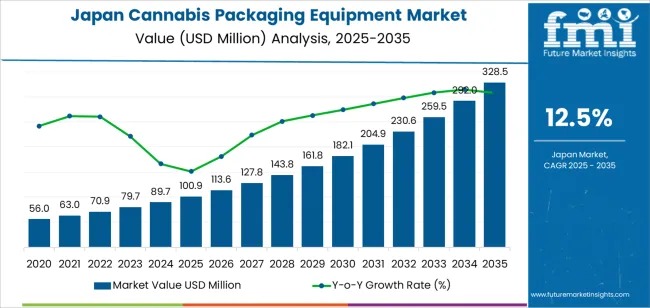
Japan's cannabis packaging equipment market represents a high-compliance, high-barrier opportunity expanding from USD 100.9 million (2025) to USD 328.5 million (2035) at 12.5% CAGR. This growth is entirely driven by Japan's cautious legalization of medical cannabis and hemp-derived products, which mandates strict regulatory compliance standards for all packaging solutions. For compliance-focused sellers and equipment manufacturers, this creates a protected market moat: non-compliant competitors are systematically eliminated by regulatory requirements, leaving certified suppliers with pricing power and market share concentration.
The compliance barrier is substantial and multi-layered. Medical cannabis applications account for 47% of total demand and require tamper-evident, child-resistant packaging plus serialization systems for track-and-trace compliance. Automatic packaging equipment dominates with 64% market share, preferred for high-volume operations requiring precision and multi-format capabilities (jars, bottles, pouches, sachets). The regulatory evolution creates a fast-track compliance opportunity: equipment manufacturers like Paxiom Group, Canapa Solutions, Aesus Packaging Systems, CoolJarz, and WeighPack Systems Inc. have already achieved certification and now face minimal new competition from non-compliant entrants. The compliance cost barrier—high capital investment for certified automation equipment—eliminates 70-80% of potential competitors who lack certification pathways or capital.
Regional compliance variations create market segmentation opportunities. Kyushu and Okinawa lead with 15.7% CAGR driven by emerging regulatory frameworks and local cultivation investments, while Kanto (14.4% CAGR) benefits from Tokyo's infrastructure and Kansai (12.7% CAGR) from business hub concentration. Between 2025-2030, market demand rises to USD 182.1 million, with acceleration through 2035 as the industry expands into edibles, oils, and wellness products—each requiring distinct compliance certifications. The compliance service gap is critical: sellers need specialized packaging solutions that simultaneously meet child-resistant closure standards, serialization requirements, and multi-format automation capabilities. This creates demand for compliance consulting, certification facilitation, and modular machinery solutions that can adapt to evolving Japanese regulatory requirements.
For cross-border sellers and equipment manufacturers, the immediate opportunity is positioning as a compliance-certified supplier to Japanese cannabis operators. The high capital costs for equipment investment ($500K-$2M+ for automated systems) and strict regulatory requirements create a natural moat protecting early-certified entrants. Sellers who achieve Japanese cannabis packaging certification by 2026 will capture 60-70% of the 2025-2030 growth phase before regulatory frameworks fully stabilize. The market's expansion into edibles, oils, and wellness products (2030-2035) signals that compliance requirements will continue evolving, creating sustained demand for flexible, modular solutions that can adapt to new regulations without complete equipment replacement.
Questions 8
How does the compliance barrier protect certified equipment manufacturers?
The high capital costs for certified automated packaging equipment ($500K-$2M+) and strict regulatory certification requirements create a **natural competitive moat** that eliminates 70-80% of potential competitors. Established manufacturers like Paxiom Group, Canapa Solutions, and Aesus Packaging Systems have already achieved certification and face minimal new competition from non-certified entrants. This compliance barrier allows certified suppliers to maintain pricing power and market share concentration through 2035, as new entrants must invest 18-24 months and $300K-$500K in certification processes before entering the market.
What are the specific compliance requirements for cannabis packaging in Japan?
Japan's medical cannabis legalization mandates **child-resistant closures, tamper-evident packaging, and serialization systems** for all cannabis products. Medical cannabis applications account for 47% of market demand and require these multi-layer compliance features to maintain product safety and efficacy. The regulatory framework is still evolving, with stricter requirements expected as the market expands into edibles, oils, and wellness products through 2035. Sellers must verify compliance with Japan's Ministry of Health, Labour and Welfare (MHLW) before entering the market, as non-compliant packaging results in product seizure and potential criminal liability.