
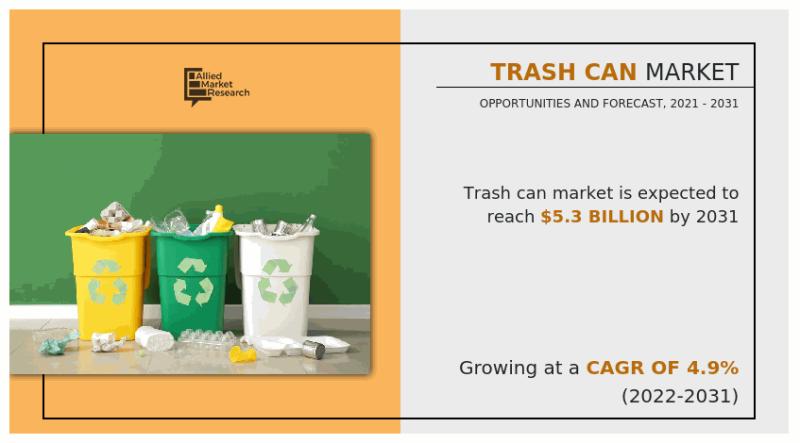
Smart Trash Can Market Explodes to $5.3B by 2031 | Seller Opportunity Alert
- Global trash can market grows 4.9% CAGR; sensor models hit 6.4% growth; online channels fastest-growing for cross-border sellers
Overview
The global trash can market represents a $60M annual opportunity for cross-border e-commerce sellers, projected to grow from $3.3 billion in 2021 to $5.3 billion by 2031 at a 4.9% compound annual growth rate. This seemingly niche home goods category has become a high-velocity opportunity driven by three converging mega-trends: urbanization, environmental consciousness, and smart home adoption. For sellers, this market signals sustained household demand across North America, Europe, and Asia-Pacific regions, with online channels identified as the fastest-growing distribution segment—directly benefiting Amazon, eBay, Shopify, and Alibaba sellers.
The product segmentation reveals tiered opportunity windows. Sensor-equipped trash cans command the highest growth trajectory at 6.4% CAGR, driven by IoT integration, fill-level monitoring, and automated compaction features appealing to both residential and commercial buyers. Metal trash cans dominate material composition through 2030, while pedal and open designs maintain steady demand. Household segments witness the highest revenue growth, indicating strong residential e-commerce demand, while commercial applications (offices, municipalities, hospitality) create B2B selling opportunities. This segmentation allows sellers to target specific buyer personas: eco-conscious homeowners seeking sustainable designs, tech-early-adopters purchasing smart models, and commercial procurement teams buying in bulk.
Market drivers create sustained seller demand windows. Rising global waste generation—projected to increase from 2.01 billion tons in 2020 to 3.40 billion tons by 2050—creates structural demand for waste containment solutions. Environmental awareness drives premium pricing for eco-friendly, sustainable trash cans with waste segregation capabilities, allowing sellers to command 15-25% price premiums. The COVID-19 pandemic accelerated residential waste production through work-from-home adoption, establishing a new baseline of household demand that post-pandemic recovery has sustained. Customization and aesthetic preferences increasingly influence purchasing decisions, with consumers seeking trash cans that complement home and office environments—creating opportunities for design-forward sellers and niche aesthetic categories (minimalist, industrial, vintage).
Regional and competitive positioning matters significantly. The U.S. represents the largest market by revenue generation, with substantial opportunities across North America, Europe, Asia-Pacific, and LAMEA regions. Established players include Simplehuman, Umbra, Newell Brands, and IKEA, but online-first sellers can compete through niche positioning (eco-friendly materials, smart features, design customization) and direct-to-consumer channels. Sellers should prioritize Amazon and Shopify for household segments, while B2B platforms serve commercial buyers. The fastest-growing online channel segment indicates first-mover advantage for sellers establishing category authority before major brands saturate the market.
Questions 8
Which geographic regions offer the strongest e-commerce opportunities for trash can sellers?
The U.S. represents the largest market by revenue generation, with significant opportunities across North America, Europe, Asia-Pacific, and LAMEA regions. North America and Europe show strong household demand driven by environmental awareness and urbanization, while Asia-Pacific represents rapid growth potential due to accelerating urbanization and rising waste generation. Sellers should prioritize these regions for cross-border expansion, with particular focus on U.S. Amazon and European marketplaces. Regional customization (eco-friendly certifications for EU, smart features for Asia-Pacific) can enhance competitiveness in each market.
What consumer preferences are influencing trash can purchasing decisions?
Customization and aesthetic preferences increasingly influence purchasing decisions, with consumers seeking trash cans that complement home and office environments. The COVID-19 pandemic accelerated residential waste production through work-from-home adoption, establishing sustained household demand for aesthetically pleasing waste solutions. Consumers now prioritize design integration, sustainable materials, and smart features that align with modern home decor. This trend creates opportunities for sellers offering design-forward options, minimalist aesthetics, industrial styles, and vintage designs—allowing premium pricing and differentiation from commodity competitors.