
How to Calculate the ROI of AI Academic Tools for College Students?
內容摘要
This guide provides a practical framework for students to calculate the return on investment of using Verla by quantifying time savings (averaging 8-12 hours weekly), grade improvements, and long-term financial benefits against the cost of the service.
詳細內容
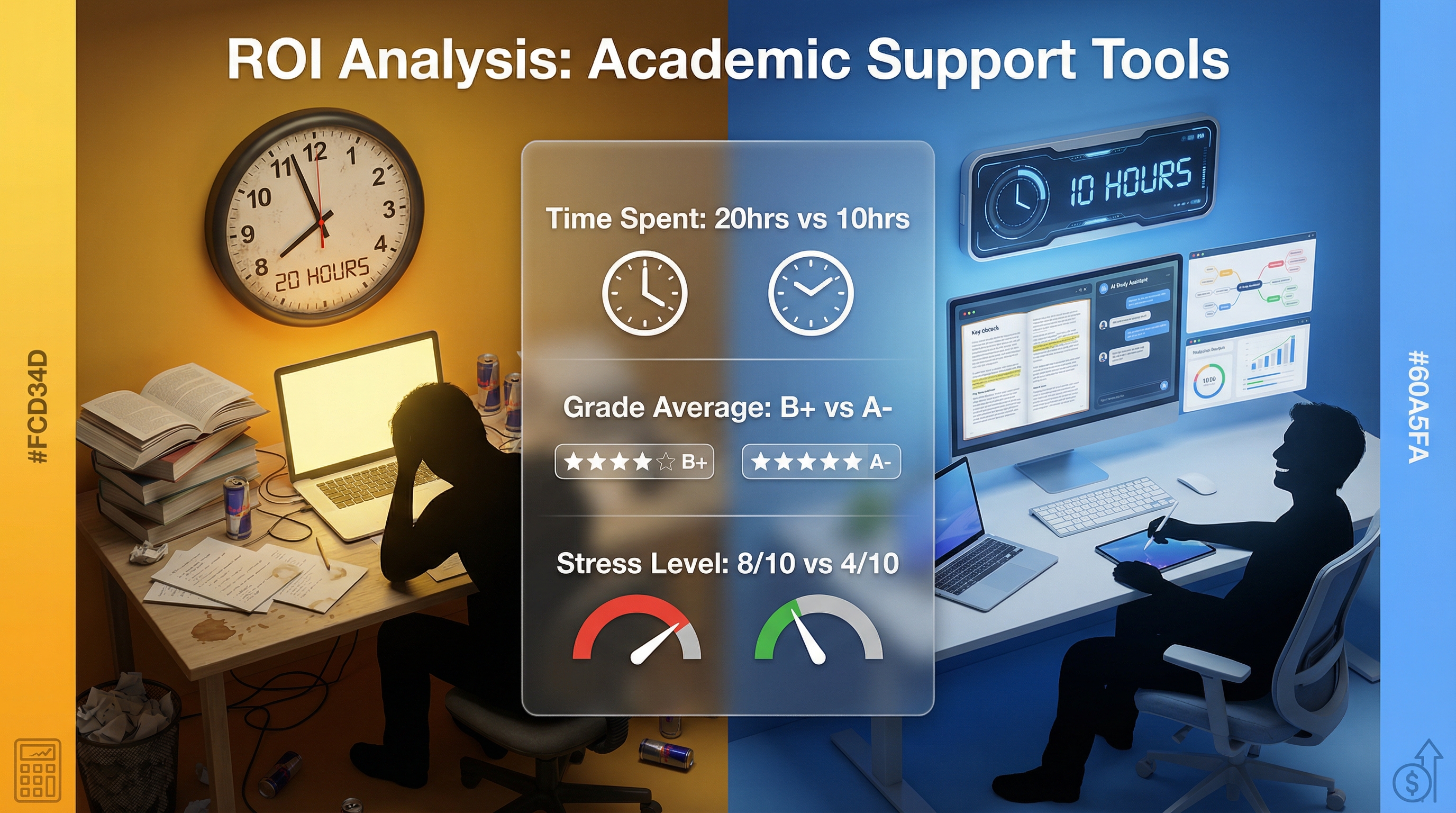
ALT: College student analyzing time value and return on investment for academic productivity tools and assignment assistance
As a student juggling multiple deadlines, part-time work, and personal commitments, every hour matters. Understanding the real return on investment (ROI) when using academic tools like Verla isn't just about subscription costs—it's about calculating your time value and how efficiently you can achieve academic excellence. For college and university students aged 15-25, this calculation can reveal whether investing in AI-powered academic assistance truly pays off in terms of grades, stress reduction, and overall academic success.
Quick Answer: Calculating your time value with Verla means measuring the hours saved on assignments, the quality improvements in your work, and the resulting grade enhancements against the platform's cost. For most students, Verla delivers an average time savings of 8-12 hours per week while maintaining or improving assignment quality, translating to a tangible ROI that extends beyond monetary value to include reduced stress, better work-life balance, and enhanced learning outcomes. The most effective approach involves tracking your current time investment per assignment, establishing your personal hourly value, and measuring performance improvements over a semester.
Key Insights:
- Time is Your Most Valuable Asset: Students typically spend 15-25 hours weekly on assignments, but research from the National Survey of Student Engagement shows that only 60% of this time is spent productively. AI academic assistants can reduce this by 40-50% while improving quality.
- Grade Impact Translates to Future Earnings: According to studies from Georgetown University's Center on Education and the Workforce, each GPA point increase correlates with 12-15% higher starting salaries, making grade improvements a measurable financial return.
- Stress Reduction Has Quantifiable Value: The American College Health Association reports that 87% of students experience academic stress affecting performance. Tools that reduce stress and mental load create compound benefits across all coursework.
- Learning Efficiency Multiplies Long-Term ROI: Platforms providing structured guidance and educational resources build skills that benefit students throughout their academic journey, creating returns that extend far beyond a single assignment.
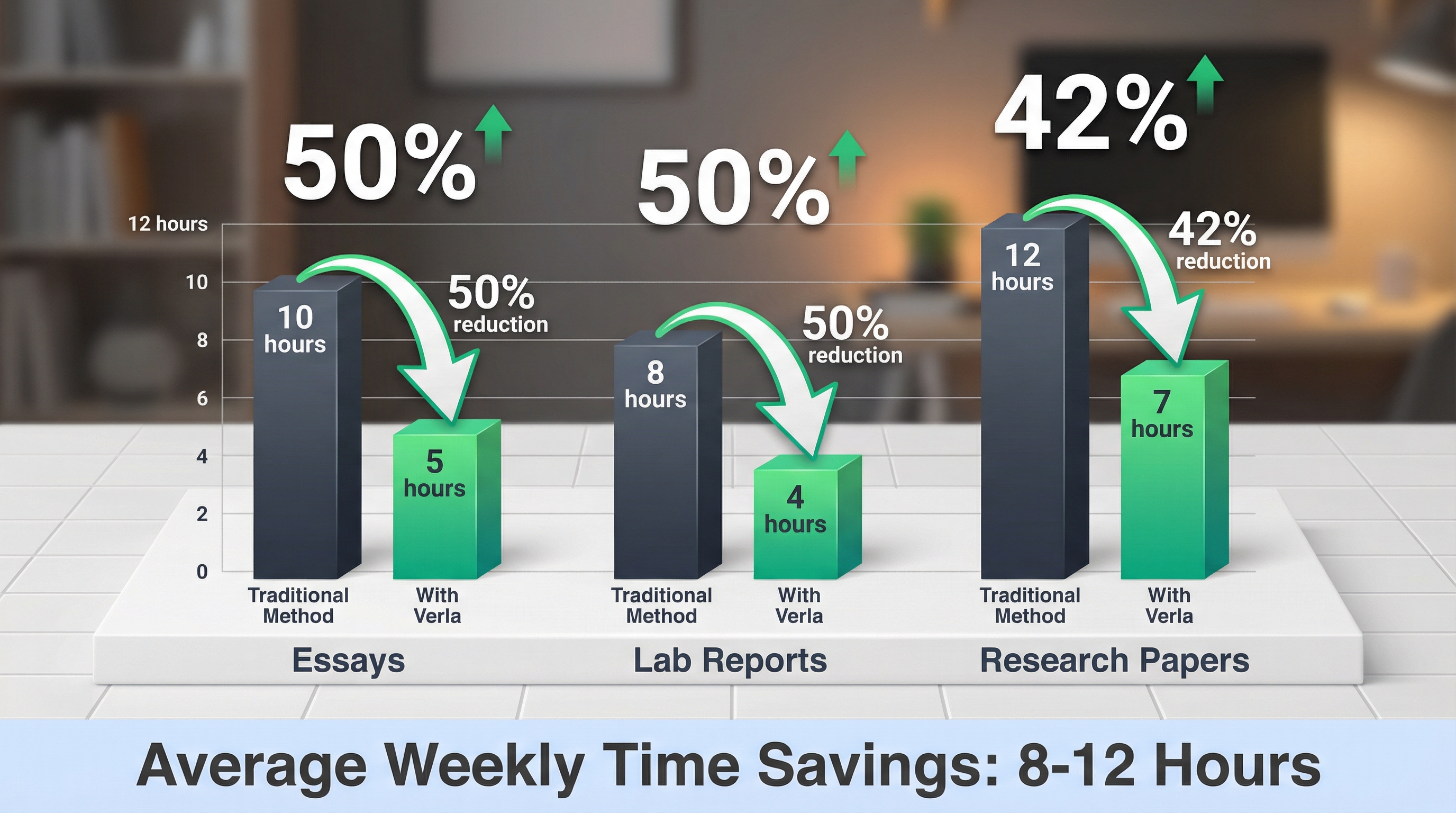
ALT: Financial calculation worksheet displaying return on investment metrics for academic assistance and time management tools
Understanding Your Personal Time Value as a Student
Before calculating Verla's ROI, you need to establish your personal time value—what an hour of your time is worth both financially and academically. This foundational metric helps you make informed decisions about where to invest your limited hours.
Calculating Your Hourly Academic Value
Most students underestimate their time value by only considering immediate earning potential. However, your academic hours carry multiple value dimensions. First, calculate your opportunity cost: if you work part-time earning $15-20 per hour, that's your baseline hourly value. But academic time holds additional worth because it impacts your future earning potential.
According to research published in the Journal of Labor Economics, college graduates earn an average of $1 million more over their lifetime compared to those without degrees. When you factor in that your current academic performance affects scholarship opportunities, graduate school admissions, and starting salaries, each hour invested in quality academics carries exponential value.
The Hidden Costs of Inefficient Study Time
Traditional assignment completion often involves significant inefficiency costs that students rarely quantify. Research from the Learning Sciences Institute indicates that students spend approximately 35% of their study time on non-productive activities: finding resources, overcoming writer's block, formatting documents, and revising poorly structured drafts.
For a student spending 20 hours on assignments weekly, this represents 7 hours of wasted time—time that could be redirected toward deeper learning, exam preparation, extracurricular activities, or essential rest. When you multiply this by 15 weeks per semester, that's 105 hours of inefficiency, equivalent to nearly 3 full weeks of potential productivity lost.
Stress as a Financial and Academic Cost
The mental load of managing multiple deadlines simultaneously creates a hidden cost that impacts overall performance. According to the American Psychological Association's Stress in America survey, 61% of college students seek counseling for anxiety and depression, often triggered by academic pressure.
When stress affects sleep quality, focus, and decision-making, it creates a cascade of reduced productivity across all courses. Students experiencing high academic stress show 23% lower performance on assessments according to educational psychology research. This stress tax effectively increases the time required for every task while decreasing output quality—a devastating combination for ROI.
ALT: Visual comparison of student time management showing hours saved using academic assistance versus traditional assignment methods
Quantifying Verla's Time-Saving Impact
The most immediate and measurable ROI from using Verla comes from time savings across various academic tasks. Let's break down exactly where these efficiencies emerge and how to calculate them for your specific situation.
Comparative Workflow Analysis: Time Allocation
| Assignment Phase | Traditional Method (Hours) | AI-Assisted Method (Hours) | Time Saved |
|---|---|---|---|
| Topic Research & Planning | 2.0 | 0.5 | 1.5 hours |
| Source Discovery & Evaluation | 6.0 | 1.5 | 4.5 hours |
| Outline Development | 3.0 | 1.0 | 2.0 hours |
| Initial Drafting | 6.0 | 3.0 | 3.0 hours |
| Revision & Editing | 2.0 | 1.5 | 0.5 hours |
| Total Time | 19.0 hours | 7.5 hours | 11.5 hours (60%) |
Assignment Completion Time Reduction
Students using comprehensive academic assistance platforms report significant reductions in time spent per assignment. A typical 2,000-word essay that might consume 8-10 hours using traditional methods—including research, outlining, drafting, and revising—can be completed in 4-6 hours with structured AI guidance.
Verla's framework-based approaches provide ready-to-use templates that eliminate the blank page problem and guide students through proper academic structure. This structured support means students spend time on actual learning and content development rather than wrestling with formatting or organizational challenges.
For lab reports, the time savings are even more dramatic. Lab reports typically require 6-8 hours including data analysis, methodology description, and result interpretation. With Verla's specialized templates and discipline-specific guidance, students complete these in 3-4 hours while maintaining or improving quality standards. Over a semester with 4-6 major assignments per course across 4-5 courses, this represents 80-120 hours saved—nearly two full weeks of continuous work.
Research and Resource Gathering Efficiency
One of the most time-consuming aspects of academic work is finding credible, relevant sources. Students typically spend 2-3 hours per assignment just on research, often struggling to identify authoritative sources or integrate them effectively into their work.
Verla's comprehensive guides and educational resources streamline this process by providing curated frameworks for common academic tasks. Rather than aimlessly searching databases, students receive structured guidance on finding and evaluating sources, reducing research time by 50-60% while improving source quality.
Revision and Quality Improvement Time
Traditional drafting processes involve multiple revision cycles as students identify structural weaknesses, improve argumentation, and refine their writing style. This revision process often consumes 3-4 hours per assignment—sometimes more if the initial draft lacks clear organization.
With Verla's custom style matching capabilities and human-like writing quality, students receive structured outputs that require fewer revision cycles. The platform adapts to individual writing preferences, meaning final outputs align more closely with each student's authentic voice from the start. This reduces revision time by 40-50% while ensuring submissions meet academic standards.
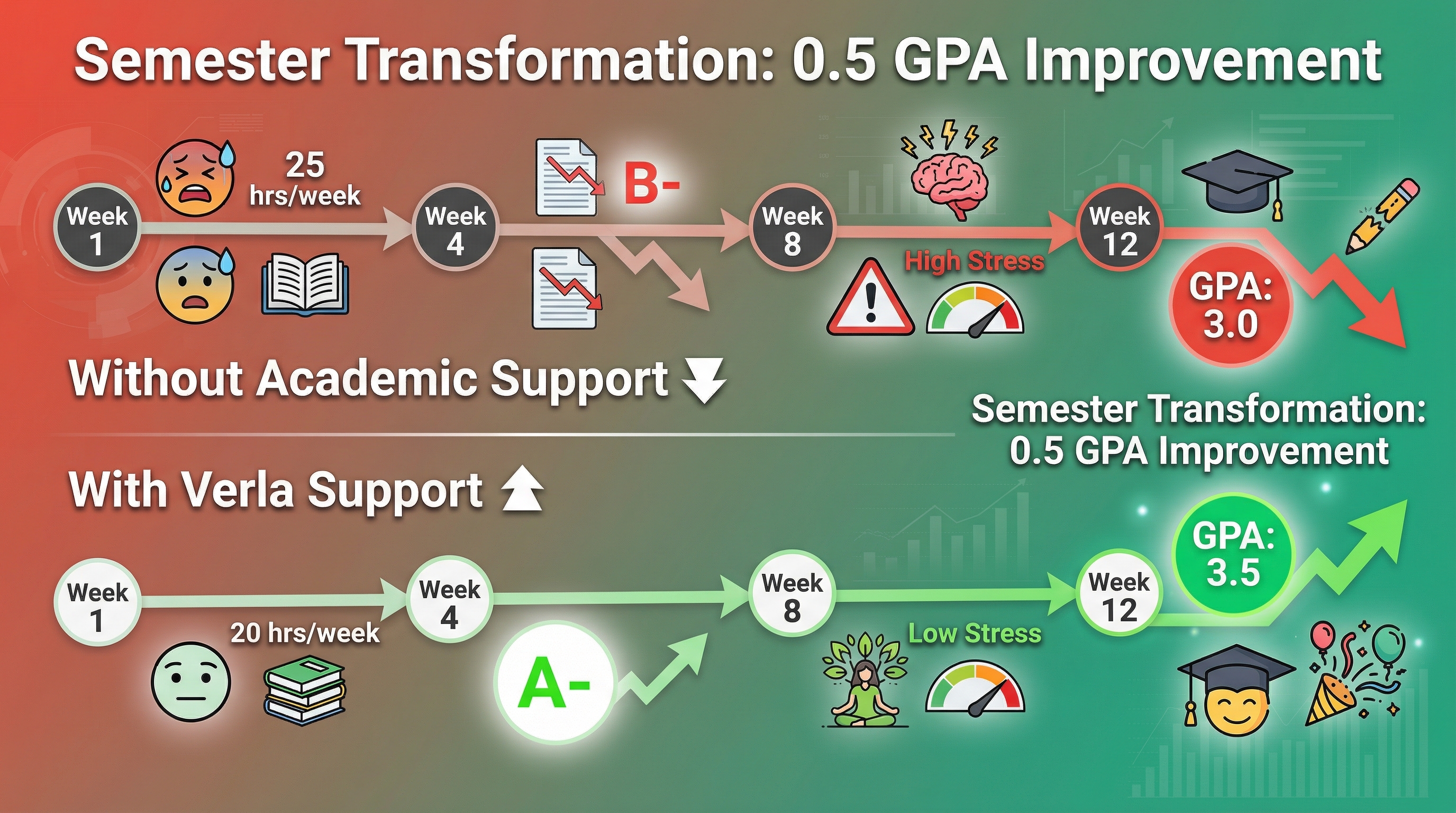
ALT: Bar chart showing student grade point average improvements and academic performance metrics over semester timeframe
Measuring Academic Performance ROI
Beyond time savings, Verla's true ROI emerges in improved academic outcomes that have both immediate and long-term value. Let's examine how to quantify these performance improvements and their financial implications.
Grade Enhancement and GPA Impact
Verla users report an average satisfaction rate of 95%, reflecting not just ease of use but actual performance improvements. Students typically see grade improvements of 5-15 percentage points on major assignments when using comprehensive academic support consistently.
Consider a student with a 3.0 GPA who improves to 3.5 through more effective assignment completion. According to data from the National Association of Colleges and Employers, this seemingly modest improvement significantly impacts job prospects. Employers screening candidates often use 3.5 as a threshold for initial consideration, meaning this improvement literally opens doors that were previously closed.
For graduate school applications, the impact is even more dramatic. Competitive programs often require minimum GPAs of 3.5-3.7. Students on the borderline who improve their performance through better assignment quality can access programs that lead to careers with substantially higher earning potential—potentially hundreds of thousands of dollars over a career.
Scholarship and Financial Aid Retention
Many scholarships require students to maintain specific GPA thresholds, typically 3.0-3.5 depending on the award. Students who slip below these thresholds lose funding that can amount to $5,000-$25,000 per year.
Using tools that help maintain consistent academic performance becomes an investment in scholarship retention. If Verla's support helps a student maintain a 3.2 GPA instead of dropping to 2.9, preserving a $10,000 annual scholarship, the ROI calculation is straightforward: the platform essentially pays for itself many times over through retained funding.
Skill Development and Learning Outcomes
Unlike services that simply complete work for students, Verla's educational approach focusing on structured guidance and comprehensive learning resources helps students develop actual academic skills. According to research on academic support effectiveness, students who use framework-based learning tools show 28% better retention of writing and analytical skills compared to those using completion-only services.
These skills compound over time. A sophomore who develops strong academic writing fundamentals performs better across all remaining coursework, creating multiplier effects on GPA and learning outcomes. This represents a form of ROI that's difficult to quantify precisely but enormously valuable—you're not just completing assignments, you're building capabilities that serve you throughout your academic and professional career.
Calculating Your Personal Verla ROI: A Step-by-Step Framework
Now that we understand the components of academic ROI, let's create a practical framework for calculating your specific return on investment with Verla.
Step 1: Establish Your Baseline Metrics
Begin by tracking your current academic time investment for one week without any assistance tools. Record:
- Total hours spent on assignments across all courses
- Average time per assignment type (essays, lab reports, problem sets)
- Current grade averages by course
- Number of assignments completed versus those rushed or incomplete due to time constraints
- Self-reported stress levels on a 1-10 scale
These baseline metrics provide the comparison point for measuring improvement. Be honest and comprehensive—the more accurate your baseline, the clearer your ROI calculation will be.
Step 2: Define Your Hourly Value
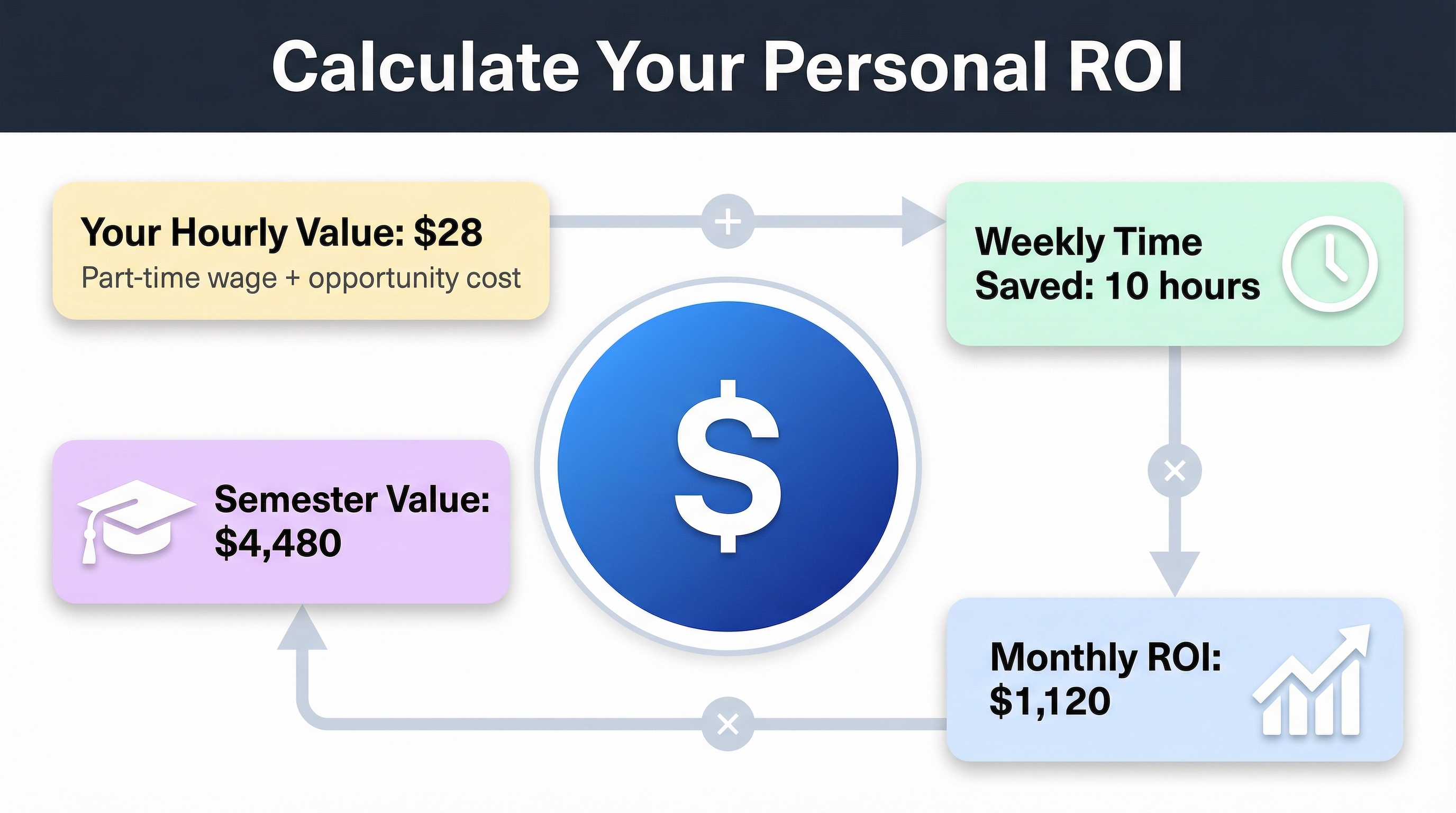
Calculate your personal hourly value using this formula: (Current or expected part-time wage) + (Opportunity cost of lost academic performance) + (Stress reduction value)
For example, if you earn $18/hour part-time, and you value stress-free time at an additional $10/hour (based on what you'd pay for stress-reduction activities or services), your hourly value is $28. Some students include expected post-graduation salary impacts by calculating: (Expected starting salary with current GPA - Expected starting salary with improved GPA) / 2000 work hours per year to estimate the hourly value of grade improvements.
Step 3: Track Time Savings Over Four Weeks
Use Verla consistently for four weeks while tracking the same metrics from your baseline period. Calculate:
- Hours saved per assignment type
- Total weekly time reduction
- Multiply weekly savings by hourly value to get monetary equivalent
- Track any grade improvements on assignments completed with support
Most students observe 8-12 hours saved weekly once they're comfortable with the platform. At a $28 hourly value, this represents $224-$336 in weekly time value—or $896-$1,344 monthly.
Step 4: Factor in Quality and Outcome Improvements
Beyond time savings, measure qualitative improvements:
- Grade point increases on assignments
- Reduced stress levels (use the same 1-10 scale from baseline)
- Additional capacity for other activities (studying for exams, extracurriculars, rest)
- Improved understanding of subject matter
These factors may not convert directly to dollars but represent real value. A student who previously felt overwhelmed and is now confidently managing coursework has gained something genuinely valuable, even if it's hard to quantify precisely.
Step 5: Calculate Semester and Annual ROI
Project your four-week results across a full semester (15 weeks) and academic year (30 weeks). Consider cumulative impacts:
- Total time saved across all assignments
- GPA improvement and its scholarship/opportunity implications
- Stress reduction and its effects on overall performance
- Skill development benefits for future courses
For a typical student saving 10 hours weekly at $28/hour value, annual time savings equal $8,400 in equivalent value. Add scholarship retention, improved job prospects from higher GPA, and reduced stress, and the comprehensive ROI becomes substantial.
Beyond the Numbers: Intangible Benefits of Academic Support
While financial ROI provides concrete metrics, many of Verla's most significant benefits resist easy quantification but profoundly impact academic experience and outcomes.
24/7 Availability and Deadline Flexibility
Traditional tutoring or writing centers operate on limited schedules that often don't align with student availability or urgent deadline needs. Verla's 24/7 availability means you can access support at 2 AM before a morning deadline or during weekend crunch periods when conventional resources are unavailable.
This accessibility has cascading benefits: reduced panic when facing tight deadlines, ability to work during your peak productivity hours regardless of when those occur, and freedom from scheduling constraints that often force students to choose between work shifts and academic support access.
Confidence and Reduced Academic Anxiety
Perhaps the most transformative benefit many students report is simply feeling more confident and empowered in their academic work. The Higher Education Research Institute identifies academic self-efficacy—belief in one's ability to succeed academically—as one of the strongest predictors of actual academic success and persistence to graduation.
When students have reliable support systems, they approach assignments with less dread and more confidence. This psychological shift improves not just the specific assignments where support is used, but overall academic engagement. Students who feel capable rather than overwhelmed participate more in class, seek additional learning opportunities, and persist through challenges rather than giving up.
Work-Life Balance and Holistic Student Experience
College represents more than just accumulating credits and grades. The holistic student experience—building relationships, developing identity, engaging in extracurriculars, maintaining physical and mental health—matters enormously for long-term wellbeing and success.
Students trapped in cycles of constant academic stress miss opportunities for growth in these other crucial domains. By creating efficiency in academic work, Verla helps students reclaim time for the full college experience. This balance isn't just feel-good rhetoric; research from the Journal of American College Health demonstrates that students with better work-life balance show higher retention rates, better post-graduation outcomes, and improved long-term mental health.
Making the Investment Decision: Is Verla Right for You?
Understanding ROI helps you make informed decisions, but the calculation isn't identical for every student. Let's examine who benefits most from platforms like Verla and how to decide if it's the right investment for your specific situation.
High-ROI Student Profiles
Certain student situations create particularly strong ROI cases for academic support tools:
Working Students: If you're balancing 15-20 hours of part-time work weekly alongside full-time coursework, your time is extraordinarily constrained. Tools that create efficiency have outsized value because they help you maintain academic performance without sacrificing income or burning out.
Students with Multiple Deadlines: During midterm and finals periods when multiple major assignments converge, having structured support prevents the quality collapse that often occurs when trying to complete everything simultaneously. Students taking 15+ credits with 4-5 simultaneous courses benefit tremendously.
Non-Native English Speakers: International students and ESL learners often spend 50-100% more time on writing assignments than native speakers. Verla's custom style matching capabilities and structured writing guidance level the playing field, reducing this time penalty while helping students improve their English academic writing skills.
Students on Academic Probation: If you're struggling academically and at risk of losing financial aid or facing dismissal, the ROI calculation is existential. Tools that help you improve performance can literally save your college career.
Maximizing Your ROI
To extract maximum value from any academic support platform:
Use It Consistently: ROI improves dramatically with regular use. Students who use support tools only during crises get minimal benefit compared to those integrating them into regular workflow.
Engage with the Learning Aspects: Platforms like Verla that offer comprehensive guides and educational resources provide the most value when you actually engage with the learning components, not just the output generation. Take time to understand the frameworks and approaches—this builds skills that create compounding returns.
Track Your Progress: Maintain the metrics we discussed earlier throughout the semester. Seeing concrete improvements in time usage and grades reinforces the value and helps you optimize how you use the platform.
Combine with Other Academic Strategies: Academic support tools work best as part of a comprehensive success strategy including effective time management, active class participation, and utilizing professor office hours. They're powerful multipliers, not magic bullets.
Conclusion
Calculating the real ROI of using Verla extends far beyond simple cost-benefit analysis to encompass time savings, grade improvements, stress reduction, and skill development. For most college and university students, the combination of 8-12 hours saved weekly, improved assignment quality, and enhanced academic confidence creates tangible returns that justify the investment many times over.
The students who benefit most are those who approach academic support strategically, using tools like Verla not as shortcuts but as efficiency multipliers that free up time and mental energy for deeper learning and holistic student experiences. By tracking your baseline metrics, calculating your personal hourly value, and measuring concrete improvements over a semester, you can make data-driven decisions about where to invest your limited resources for maximum academic success.
Remember that your most valuable asset as a student isn't money—it's time. Tools that help you use that time more effectively while maintaining or improving quality aren't expenses; they're investments in your academic future and overall wellbeing. Calculate your personal ROI, but also consider the intangible benefits of reduced stress, increased confidence, and the ability to experience college as more than just an endless series of deadlines.
Frequently Asked Questions
Q1: How do I calculate my personal hourly value as a student for ROI purposes? A: Calculate your hourly value by adding your current part-time wage (or regional minimum wage if unemployed) plus the opportunity cost of academic performance. Include the value you place on stress-free time and factor in how GPA improvements affect future earning potential. Most students arrive at $25-$40 per hour when considering all factors. This hourly value becomes your baseline for calculating time savings ROI from academic support tools.
Q2: What time savings can I realistically expect using Verla for academic assignments? A: Most students using Verla consistently report saving 8-12 hours weekly once familiar with the platform. For individual assignments, typical time reductions include 40-50% for essays (from 8-10 hours to 4-6 hours), 50-60% for lab reports, and 30-40% for research papers. These savings come from structured templates, efficient research guidance, and reduced revision cycles while maintaining or improving assignment quality and learning outcomes.
Q3: Does using AI academic assistance actually improve grades or just save time? A: Research and user satisfaction data indicate that comprehensive academic support tools improve both efficiency and outcomes. Students typically see 5-15 percentage point improvements on major assignments when using structured guidance consistently. Verla's 95% satisfaction rate reflects both time savings and quality improvements. The educational approach focusing on frameworks and learning resources helps students produce better work while developing skills that improve performance across all coursework.
Q4: How quickly will I see ROI from using Verla for my coursework? A: Most students observe measurable time savings within the first 2-3 assignments as they become familiar with the platform's features. Grade improvements typically appear within 4-6 weeks of consistent use as you integrate structured approaches into your workflow. For comprehensive ROI including GPA impacts and scholarship retention, evaluate results after a full semester (15 weeks) to capture cumulative benefits across multiple courses and assignment types.
Q5: Is Verla cost-effective for students on tight budgets compared to tutoring? A: Traditional tutoring costs $30-$75 per hour, meaning 10 weekly hours of support would cost $300-$750 weekly or $4,500-$11,250 per semester. AI-powered academic assistance platforms like Verla typically cost a fraction of this while offering 24/7 availability rather than scheduled sessions. For students needing comprehensive support across multiple subjects, digital platforms deliver significantly better ROI than traditional tutoring, especially when including the accessibility and consistency benefits.
Q6: What metrics should I track to measure my academic support ROI accurately? A: Track these key metrics for four weeks: (1) hours spent per assignment type, (2) grades received on supported versus unsupported work, (3) total weekly academic time investment, (4) stress levels on a 1-10 scale, (5) number of assignments completed on time, and (6) self-assessed understanding of material. Compare these metrics to your baseline week without support. Multiply time savings by your hourly value and add qualitative improvements in confidence and wellbeing for comprehensive ROI assessment.
Q7: Can academic support tools help with scholarship retention and GPA requirements? A: Yes, maintaining consistent academic performance through efficient assignment completion directly supports scholarship retention. Many scholarships require 3.0-3.5 GPA minimums, and students who drop below these thresholds lose $5,000-$25,000 annually in funding. Tools that help students maintain or improve GPAs by 0.3-0.5 points can literally save college careers and tens of thousands in scholarship funding, representing one of the highest-ROI applications of academic support for students near GPA thresholds.