
How to Choose the Correct Citation Style for College Assignments: A Student's Guide
內容摘要
This guide explains the core differences between APA, MLA, and Chicago citation formats, helping students select the correct style based on their academic discipline to ensure integrity and improve grades.
詳細內容
ALT: College student comparing APA MLA and Chicago citation format guidelines for academic essay assignment
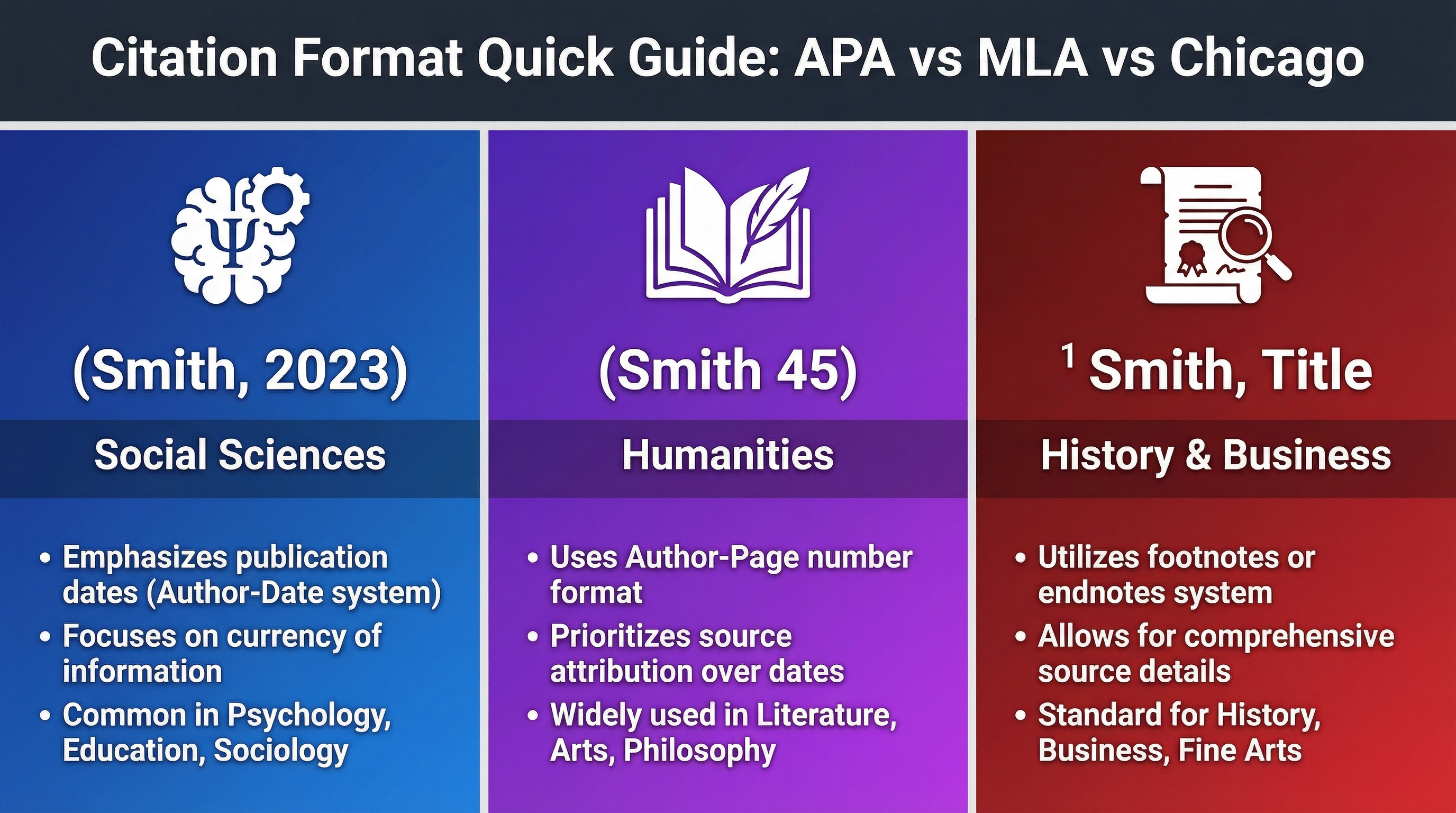
Choosing the right citation format is a fundamental skill for academic success, yet many students struggle with determining whether to use APA, MLA, or Chicago style for their assignments. The quick answer: APA format is primarily used for social sciences, psychology, and education; MLA format dominates humanities, literature, and arts disciplines; while Chicago style serves history, business, and some fine arts fields. For students managing multiple assignments across different courses, understanding which citation format to use—and why—can significantly impact your grades and help you maintain academic integrity. The most effective approach involves identifying your discipline's standard format, reviewing your professor's specific requirements, and utilizing structured templates to ensure consistency throughout your paper.
Quick Answer: Citation formats serve as standardized systems for acknowledging sources in academic writing. For college and university students, selecting the correct format means matching your discipline's conventions: APA for social sciences, MLA for humanities, and Chicago for history and business. The most effective approach involves checking your assignment guidelines first, then applying the appropriate format consistently using reliable templates and tools.
- Key Finding 1: Your academic discipline determines which citation format is most appropriate, with APA dominating social sciences (psychology, education, nursing), MLA preferred in humanities (literature, language arts, cultural studies), and Chicago used extensively in history, business, and some fine arts programs
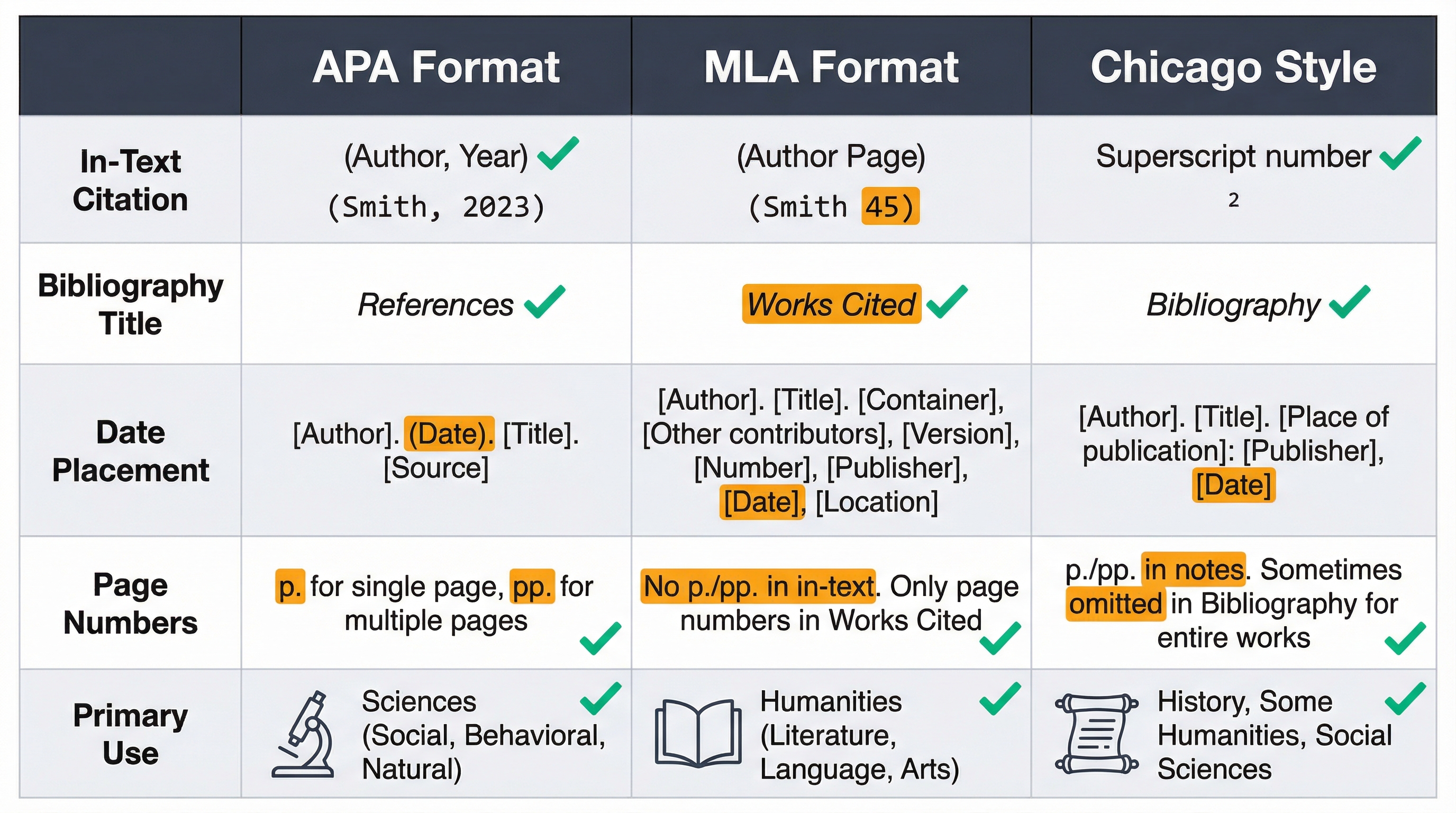
- Key Finding 2: Understanding the core differences between formats—including in-text citation styles, bibliography organization, and formatting rules—enables students to switch confidently between styles across different courses and assignments
- Key Finding 3: Utilizing citation format templates and framework-based approaches reduces formatting errors by up to 80%, helping students focus on content quality while maintaining proper academic standards and avoiding unintentional plagiarism
ALT: Visual comparison chart displaying key differences between APA MLA and Chicago style citation formats for students
Understanding the Three Major Citation Formats
Citation formats represent more than arbitrary rules—they're discipline-specific communication systems that help scholars track knowledge development and verify sources. According to research from the Modern Language Association, proper citation practices form the foundation of academic integrity, with different fields developing distinct conventions based on their unique research methodologies and information priorities.
The three dominant citation systems—APA, MLA, and Chicago—each evolved to serve specific academic communities. The American Psychological Association developed APA format in 1929 to standardize scientific writing in social sciences, emphasizing publication dates to highlight research currency. The Modern Language Association created MLA format for humanities scholars who prioritize authorship and textual analysis over chronology. The Chicago Manual of Style, first published in 1906, offers the most comprehensive and flexible system, accommodating diverse publication types from historical documents to contemporary business reports.
Why Citation Format Selection Matters
Selecting the appropriate citation format demonstrates your understanding of disciplinary conventions and scholarly communication standards. Academic research from educational institutions indicates that consistent, accurate citation practices correlate with higher grades and reduced plagiarism accusations. Beyond grades, mastering multiple citation formats prepares you for interdisciplinary research and professional writing across various fields.
For students managing coursework across different departments, the challenge intensifies. A psychology major might use APA for research papers, MLA for a general education literature course, and Chicago for a history elective—all within the same semester. This complexity makes understanding the core principles behind each format essential rather than memorizing every detail.
The Academic Integrity Connection
Proper citation protects both you and the original researchers whose work informs your arguments. According to studies on academic misconduct, many plagiarism cases result from citation confusion rather than intentional dishonesty. Understanding which format to use and applying it correctly demonstrates respect for intellectual property while building your credibility as a developing scholar.
APA Format: The Social Sciences Standard
APA format (American Psychological Association style) dominates social science disciplines including psychology, education, nursing, social work, criminology, and related fields. This format prioritizes publication dates in citations because social science research values currency—recent studies often supersede older findings as methodologies improve and societal contexts evolve.
Core APA Format Characteristics
APA style uses author-date citations within the text, placing the author's last name and publication year in parentheses: (Smith, 2023). This immediate date visibility helps readers assess research relevance quickly. The reference list at the paper's end organizes sources alphabetically by author surname, providing complete publication details for reader verification.
Key APA formatting elements include:
- In-text citations: Author and year format like (Johnson, 2022) or Johnson (2022) found that...
- Reference page: Alphabetical list titled "References" with hanging indents
- Running head: Shortened title in page header (required for professional papers)
- Abstract: 150-250 word summary on page 2 for many academic papers
- Heading levels: Five hierarchical levels for organizing content sections
According to the official APA Publication Manual, the 7th edition introduced significant changes including simplified student paper formats, updated digital source citation rules, and inclusive language guidelines. These updates reflect evolving scholarly communication practices and increased online research sources.
When to Use APA Format
Choose APA format when writing for courses or publications in:
- Psychology and psychiatry
- Education and pedagogy
- Nursing and healthcare sciences
- Social work and counseling
- Business and economics (in many contexts)
- Criminal justice and criminology
Your course syllabus typically specifies the required citation format. If unstated, check previous assignment examples or ask your instructor directly. Many social science journals exclusively accept APA format, making familiarity essential for students pursuing research careers in these fields.
APA Citation Examples
Book citation: Author, A. A. (Year). Title of work: Capital letter also for subtitle. Publisher Name.
Journal article: Author, A. A., & Author, B. B. (Year). Title of article. Title of Periodical, volume number(issue number), page range. https://doi.org/xxxxx
Website: Author, A. A. (Year, Month Day). Title of page. Site Name. URL
ALT: MLA format works cited page example demonstrating proper citation structure for academic papers
MLA Format: The Humanities Approach
MLA format (Modern Language Association style) serves humanities disciplines including literature, language studies, cultural studies, philosophy, religion, and the arts. Unlike APA's emphasis on publication dates, MLA prioritizes authorship and page numbers, reflecting humanities scholars' focus on close textual analysis and interpretation rather than chronological research progression.
Core MLA Format Characteristics
MLA style uses parenthetical citations containing only the author's last name and specific page number: (Smith 45). This brevity keeps focus on the text while providing precise location information for quote verification. The Works Cited page at the document's end provides complete bibliographic details organized alphabetically.
Essential MLA formatting elements include:
- In-text citations: Author and page number format like (Johnson 132) or As Johnson argues, "quote" (132)
- Works Cited page: Alphabetical list using hanging indents, titled "Works Cited"
- Header: Your last name and page number in upper right corner
- Double spacing: Throughout entire document including Works Cited
- Container concept: Flexible system for citing sources within larger sources (article in journal, episode in series)
The MLA Handbook 9th edition introduced the "core elements" system, providing a universal template applicable to any source type—from traditional books to tweets. This flexibility addresses the rapidly expanding range of source formats students encounter in digital research environments.
When to Use MLA Format
Select MLA format for courses and publications in:
- English literature and composition
- Foreign language and literature studies
- Comparative literature
- Cultural studies and film analysis
- Religious studies
- Philosophy
- Theater and performing arts
MLA format dominates undergraduate humanities courses, making it often the first citation style students learn. Many high school English programs teach exclusively MLA, requiring college students to adapt when entering social science courses requiring APA.
MLA Citation Examples
Book citation: Author Last Name, First Name. Title of Book. Publisher, Publication Year.
Journal article: Author Last Name, First Name. "Article Title." Journal Title, vol. number, no. number, Year, pp. page range.
Website: Author Last Name, First Name. "Page Title." Website Title, Publisher, Date published, URL.
The MLA Works Cited format emphasizes accessibility and readability, with a consistent pattern students can apply across diverse source types by identifying core elements: author, title, container, contributors, version, number, publisher, publication date, and location.
Chicago Style: The Historian's Choice
Chicago style (from the Chicago Manual of Style) offers the most comprehensive and flexible citation system, serving history, business, fine arts, and publications requiring extensive footnoting. Chicago accommodates two distinct systems: Notes-Bibliography (preferred in humanities) and Author-Date (used in sciences), making it uniquely adaptable to different scholarly contexts.
Core Chicago Format Characteristics
Chicago's Notes-Bibliography system uses footnotes or endnotes for citations rather than parenthetical references, keeping the main text clean while providing detailed source information at page bottom or document end. A bibliography follows, listing all consulted sources alphabetically. This dual-layer approach allows for both precise citations and substantive commentary that would interrupt text flow if placed parenthetically.
Key Chicago formatting elements include:
- Footnotes/Endnotes: Superscript numbers in text corresponding to full citations at page bottom or document end
- Bibliography: Alphabetical source list with different formatting than footnotes
- Author-Date option: Similar to APA for scientific fields preferring in-text citations
- Flexibility: Accommodates primary sources, archival materials, and non-traditional sources more easily
- Shortened citations: After first full footnote, subsequent references use abbreviated format
According to The Chicago Manual of Style, the 17th edition expanded guidance for digital sources and multimedia content while maintaining the system's traditional thoroughness. This comprehensiveness makes Chicago the reference of choice for book publishers and many professional publications.
When to Use Chicago Format
Choose Chicago format for courses and publications in:
- History and historiography
- Business and management (often Author-Date variant)
- Fine arts and art history
- Music and musicology
- Some theology and religious studies programs
- Book publishing and trade publications
Graduate programs in history typically require Chicago format exclusively, while business schools may specify either Chicago Author-Date or APA depending on the program's research orientation. Clarifying which Chicago variant (Notes-Bibliography vs. Author-Date) is required prevents formatting mistakes.
Chicago Citation Examples
Footnote format (Notes-Bibliography):
- Author First Name Last Name, Title of Book (Place of Publication: Publisher, Year), page number.
- Author First Name Last Name, "Article Title," Journal Title volume, no. issue (Year): page range.
Bibliography format:
Author Last Name, First Name. Title of Book. Place of Publication: Publisher, Year.
Author-Date in-text citation: (Author Last Name Year, page number)
Chicago's flexibility makes it ideal for complex projects citing diverse source types including unpublished manuscripts, archival documents, historical newspapers, and multimedia sources that challenge simpler citation systems.
ALT: Decision flowchart helping students choose between APA MLA Chicago citation formats based on academic discipline
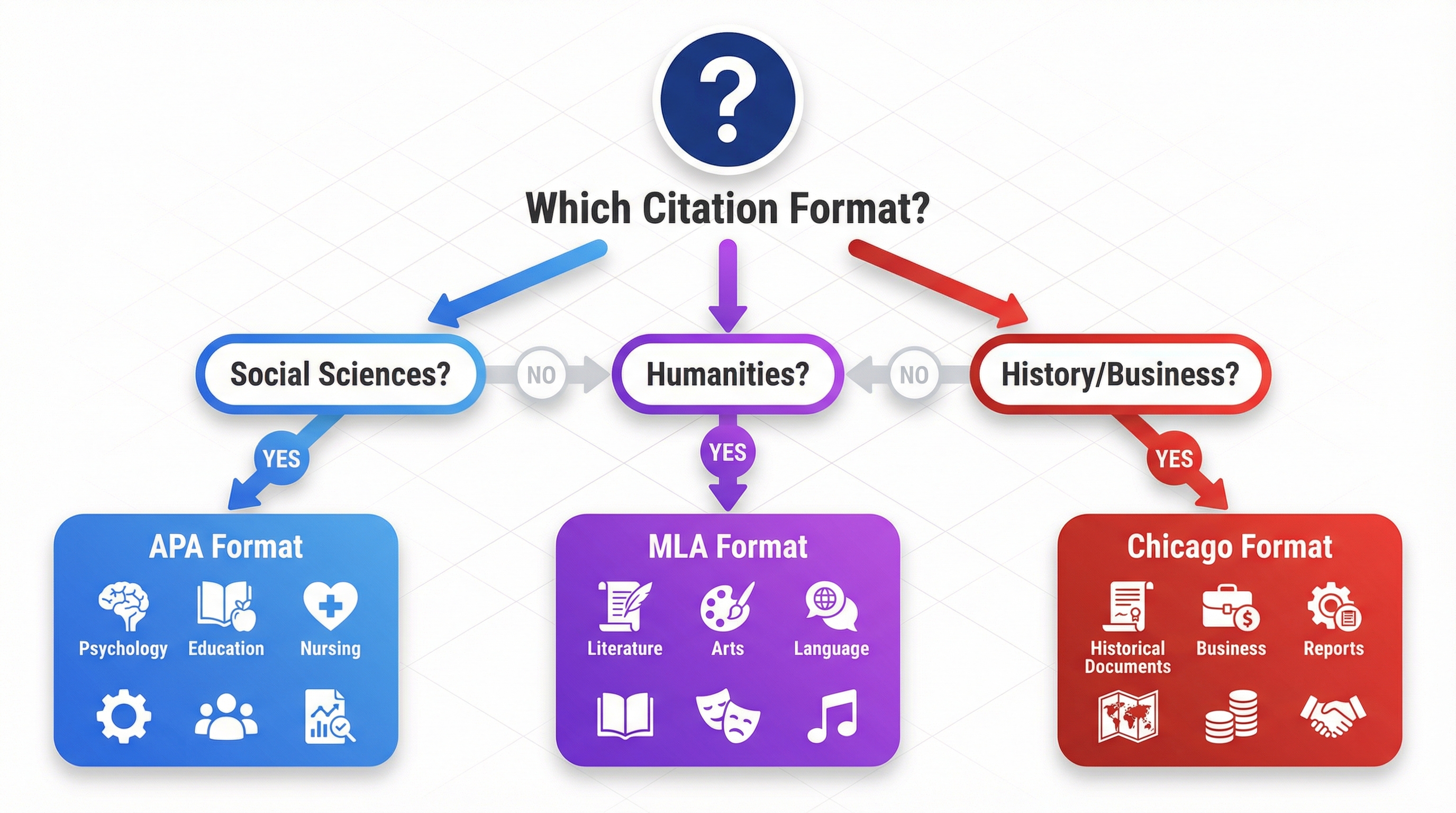
How to Choose the Right Citation Format: A Decision Framework
Selecting the appropriate citation format requires evaluating multiple factors beyond just your major. This systematic framework helps students confidently determine which style fits each specific assignment, reducing anxiety and formatting errors.
Step 1: Check Assignment Guidelines First
Your professor's instructions override all other considerations. Syllabi, assignment sheets, and learning management system descriptions typically specify required citation formats. According to academic best practices research, explicit format requirements appear in approximately 78% of college assignment descriptions, making this your most reliable starting point.
When guidelines don't specify a format:
- Review previous assignment feedback for format indications
- Check course syllabus for general citation expectations
- Examine sample papers or rubrics for format clues
- Email your instructor for clarification before beginning
Never assume the format based on your major alone—interdisciplinary courses, general education requirements, and team-taught classes often have unique format preferences that differ from departmental norms.
Step 2: Consider Your Academic Discipline
If guidelines remain unclear, disciplinary conventions provide reliable guidance:
Use APA format for:
- Empirical research reporting original studies
- Literature reviews synthesizing research findings
- Courses emphasizing scientific methodology
- Papers requiring abstract summaries
- Fields prioritizing research currency
Use MLA format for:
- Literary analysis and close reading
- Cultural criticism and interpretation
- Creative writing with scholarly citations
- Language acquisition papers
- Textual comparison essays
Use Chicago format for:
- Historical analysis with primary sources
- Papers requiring extensive quotations
- Business case studies (Author-Date variant)
- Projects citing archival materials
- Art historical analysis
Step 3: Evaluate Source Types
Some citation formats handle specific source types more effectively. Chicago excels at citing historical documents, archival materials, and unpublished manuscripts. MLA's container system elegantly addresses digital sources like social media posts, streaming content, and online-only publications. APA provides clear guidelines for grey literature, conference papers, and technical reports common in social sciences.
If your paper relies heavily on unconventional sources, choose the format offering the clearest guidance for those materials. The Purdue Online Writing Lab provides comprehensive examples across all three formats, helping you preview citation complexity before committing.
Step 4: Consider Department and Institutional Norms
Some universities establish institution-wide preferences, particularly for theses, dissertations, and capstone projects. Graduate programs often mandate specific formats across all coursework to ensure consistency. Check your department handbook, graduate school website, or academic advising resources for any standardized requirements.
Professional programs (nursing, education, social work) typically align with their respective field's dominant format to prepare students for professional writing demands. Understanding these contextual factors helps you anticipate format requirements and develop appropriate competencies.
Building Format Fluency Across Styles
Rather than memorizing every rule for every format, focus on understanding core principles:
- APA thinking: Emphasize dates and scientific methodology
- MLA thinking: Focus on authors and precise textual locations
- Chicago thinking: Provide comprehensive source context with formatting flexibility
This conceptual approach, combined with reliable templates and citation management tools, enables confident format switching as course requirements change. Many successful students maintain example papers in each format as personal references, adapting them for new projects rather than starting from scratch.
Essential Citation Format Rules and Common Mistakes
Mastering citation format fundamentals prevents the most common errors that lower assignment grades. According to writing center data analysis, citation mistakes account for 15-25% of all grading deductions in undergraduate papers, yet most errors fall into predictable categories students can easily avoid with proper guidance.
Universal Citation Principles Across All Formats
Regardless of which format you use, these fundamental principles apply:
Cite every borrowed idea, not just direct quotes. Paraphrases, summaries, statistics, theories, and unique perspectives all require citations. Many students mistakenly believe only quotations need attribution, leading to unintentional plagiarism.
Maintain consistency throughout your paper. Never mix citation formats within a single document. If you use APA, apply it to every source from first citation to reference page. Format switching within papers signals careless work and confuses readers.
Match in-text citations to bibliography entries. Every parenthetical reference must correspond to a complete source listing in your Works Cited, References, or Bibliography. Orphaned citations (appearing in text but missing from source list) and ghost references (listed but never cited) both indicate poor citation management.
Use credible, appropriate sources for academic work. Citation format cannot salvage weak sources. Prioritize peer-reviewed journals, academic books, reputable news sources, and official data over Wikipedia, unverified websites, and user-generated content.
Format-Specific Error Patterns
Common APA mistakes:
- Forgetting to include retrieval dates for sources without publication dates
- Incorrectly formatting DOIs (should be formatted as URLs: https://doi.org/xxxxx)
- Using "p." or "pp." for journal article citations (only use for books and reports)
- Capitalizing article titles incorrectly (only capitalize first word and proper nouns)
- Missing the database or URL for online sources
Common MLA mistakes:
- Including URLs when not required (MLA 9 generally omits URLs unless source is difficult to locate)
- Forgetting periods after each bibliographic element
- Incorrect container identification (journal is container for article, website is container for page)
- Using first name initials instead of full first names
- Alphabetizing "The" in titles (alphabetize by next word: The Great Gatsby appears under G)
Common Chicago mistakes:
- Inconsistent footnote formatting (mixing full and shortened citations incorrectly)
- Bibliography formatting matching footnotes (formats differ despite containing same information)
- Incorrect use of "Ibid." (means "in the same place," only valid when immediately following citation to same source)
- Missing publication location for books
- Incorrect placement of access dates for online sources
Citation Management Best Practices
Successful students develop systematic citation habits:
Collect complete citation information immediately when finding sources. Recording full bibliographic details during research prevents frustrating searches later when you can't relocate a source or remember where you found specific information.
Use citation management tools appropriately. Software like Zotero, Mendeley, and EndNote automate formatting, but always verify accuracy—automated tools make errors, particularly with unusual source types or recent format updates. Many academic databases offer "cite" buttons generating formatted references, though these also require verification.
Maintain a working bibliography throughout your writing process. Add each source to your bibliography as you incorporate it into your paper rather than compiling the list after drafting. This practice prevents accidentally omitting sources and helps track which materials you've actually used versus merely consulted.
Create format-specific templates containing correctly formatted examples for common source types (book, journal article, website, etc.). Adapting these templates proves faster and more accurate than searching format guides repeatedly. For framework-based support with ready-to-use templates, explore comprehensive academic assistance platforms offering structured citation guidance.
Tools and Resources for Citation Format Success
Leveraging the right citation tools dramatically reduces formatting time while improving accuracy. Modern students have access to resources far beyond traditional style manuals, though understanding when and how to use each tool type maximizes their benefits.
Official Style Manuals and Websites
The authoritative source for each format provides the most reliable guidance:
- APA Style Website: Official guidelines, tutorials, and citation examples from the American Psychological Association
- MLA Style Center: Modern Language Association's comprehensive resource with practice template
- Chicago Manual of Style Online: Subscription-based comprehensive manual with searchable Q&A
These official resources receive updates reflecting evolving citation practices, making them essential for unusual source types or ambiguous situations not covered in abbreviated guides.
Academic Writing Labs and Guides
University writing centers provide excellent free resources:
- Purdue OWL (Online Writing Lab): Comprehensive citation guides for APA, MLA, and Chicago with hundreds of examples
- University of Wisconsin-Madison Writing Center: Clear explanations with discipline-specific guidance
- Your institution's writing center: Often provides institution-specific requirements and local support services
These resources excel at explaining concepts in accessible language with abundant examples, making them ideal for students learning formats independently.
Citation Management Software
Automated tools help organize sources and generate citations:
Zotero (free, open-source): Browser integration captures source information automatically; generates bibliographies in multiple formats; ideal for students managing large research projects across multiple papers.
Mendeley (free): Combines citation management with PDF annotation and academic social networking; particularly strong for science students working with journal articles.
EndNote (subscription): Professional-grade tool with advanced features; often provided free through university libraries; best for graduate students and extensive research projects.
EasyBib, Citation Machine, BibMe (free/freemium web tools): Quick citation generation for individual sources; convenient but less powerful than dedicated software; always verify accuracy before using generated citations.
When to Use Which Tool
Use official manuals when encountering unusual sources, conflicting information, or high-stakes submissions (theses, dissertations, publications). The investment in subscription access or print copies pays dividends through authoritative guidance.
Use academic writing labs for learning format fundamentals, viewing examples, and understanding conceptual frameworks. These resources teach format thinking rather than just mechanical rules.
Use citation management software for organizing large source collections, generating bibliographies, and managing citations across multiple projects. The time investment in learning the software returns benefits throughout your academic career.
Use quick web tools for generating occasional citations in familiar formats when you need fast results. Always double-check generated citations against official guidelines, as these tools frequently contain errors, particularly with digital sources.
Integrating AI-Powered Academic Assistance
Modern students increasingly leverage AI-driven academic tools that provide framework-based citation support alongside writing assistance. Comprehensive platforms offering structured templates, format-specific guides, and intelligent suggestions help students understand citation logic while ensuring technical accuracy. These tools prove particularly valuable when balancing multiple assignments with different format requirements, providing personalized guidance adapted to your specific needs.
For students seeking efficient, authentic support that teaches proper citation practices while delivering submission-ready work, exploring specialized academic assistance platforms designed specifically for college-level coursework can provide the structured guidance needed for consistent citation success across all your classes.
Conclusion
Mastering APA, MLA, and Chicago citation formats empowers students to meet diverse academic expectations while maintaining scholarly integrity across disciplines. The key to citation format success lies not in memorizing every rule but in understanding core principles: APA emphasizes currency for social sciences, MLA focuses on authorship for humanities, and Chicago provides flexibility for history and business. By systematically checking assignment guidelines, recognizing disciplinary conventions, and leveraging appropriate tools and templates, you can confidently navigate citation requirements throughout your academic journey.
Remember that citation formats exist to facilitate scholarly communication, not to create arbitrary obstacles. Developing citation fluency demonstrates your growing expertise as an academic writer while protecting the intellectual contributions of researchers whose work informs your learning. Start by mastering the format most relevant to your major, then gradually build competency in other styles as your coursework demands.
Ready to transform citation confusion into confident academic writing? Explore comprehensive guides, ready-to-use templates, and framework-based approaches that make proper citation accessible and manageable, helping you focus on developing compelling arguments while maintaining impeccable academic standards.
Frequently Asked Questions
Q1: What's the main difference between APA and MLA citation formats? A: The primary difference lies in how each format presents author information and what each emphasizes. APA format uses author-date citations like (Smith, 2023) and prioritizes publication dates to highlight research currency, making it ideal for social sciences. MLA format uses author-page citations like (Smith 45) and emphasizes precise textual locations, serving humanities disciplines focused on close reading. APA's reference page lists sources by author and date, while MLA's Works Cited alphabetizes by author with publication year appearing later in the citation.
Q2: Can I use different citation formats in different sections of the same paper? A: No, never mix citation formats within a single paper. Consistency is essential—if you begin with APA format, maintain it throughout every citation, from in-text references to your reference page. Mixing formats signals careless scholarship and confuses readers trying to locate your sources. If your paper draws on multiple disciplines, choose the single format most appropriate for your paper's primary field or the format specified by your instructor. Cross-disciplinary research still requires format consistency.
Q3: How do I cite social media sources like tweets or Instagram posts in academic papers? A: All three major formats now include social media citation guidelines. For APA format, cite tweets as: Author, A. A.
. (Year, Month Day). Content of tweet up to first 20 words
. Twitter. https://url. For MLA format: @Username. "Content of tweet." Twitter, Day Month Year, URL. Chicago format follows similar patterns but uses footnotes. Include the complete post text (up to character limits) or the first portion followed by ellipses, the platform name, posting date, and direct URL to the specific post.
Q4: What should I do if I can't find all the citation information for a source? A: Include all available information and follow format-specific guidelines for missing elements. For sources without authors, begin the citation with the title. For sources without dates, APA uses (n.d.) for "no date," MLA omits the date field, and Chicago includes "n.d." in the publication date position. For sources without page numbers (like websites), APA and Chicago formats generally omit page numbers, while MLA uses paragraph numbers if available (par. 4) or section headings. Never fabricate missing information—citation integrity requires honesty about source limitations.
Q5: Is it plagiarism if I cite the source but use the wrong citation format? A: Using incorrect citation format is not plagiarism if you properly acknowledge the source, but it can result in grade penalties and suggest careless scholarship. Plagiarism involves presenting others' ideas as your own without any attribution. Incorrect formatting indicates a mechanical error rather than intellectual dishonesty. However, consistently poor citations may raise concerns about your understanding of academic integrity standards. Focus on including all required citation elements first, then refine formatting details—proper attribution matters more than perfect punctuation, though both are important for academic excellence.
Q6: Should I cite common knowledge or only specialized information? A: Cite any information that isn't common knowledge, which means facts widely known and easily verified across multiple general sources. The common knowledge test asks: Would someone outside your field know this without research? For example, "World War II ended in 1945" doesn't require citation, but "Approximately 75 million people died during World War II, accounting for 3% of the global population" does need a source because it presents specific data requiring verification. When uncertain, cite—over-citing is academically safer than under-citing and demonstrates thoroughness rather than weakness.
Q7: Can citation management software completely replace learning citation formats manually? A: No, citation tools should complement rather than replace format knowledge. While software like Zotero and Mendeley automate citation generation and organization, these tools frequently make errors with unusual sources, recent format updates, or complex materials. Understanding format logic allows you to recognize when automated citations need correction. Additionally, many academic situations (exams, timed essays, professional communications) don't allow software assistance, making foundational format knowledge essential. Use tools to increase efficiency while maintaining the expertise to verify accuracy and handle exceptions.