
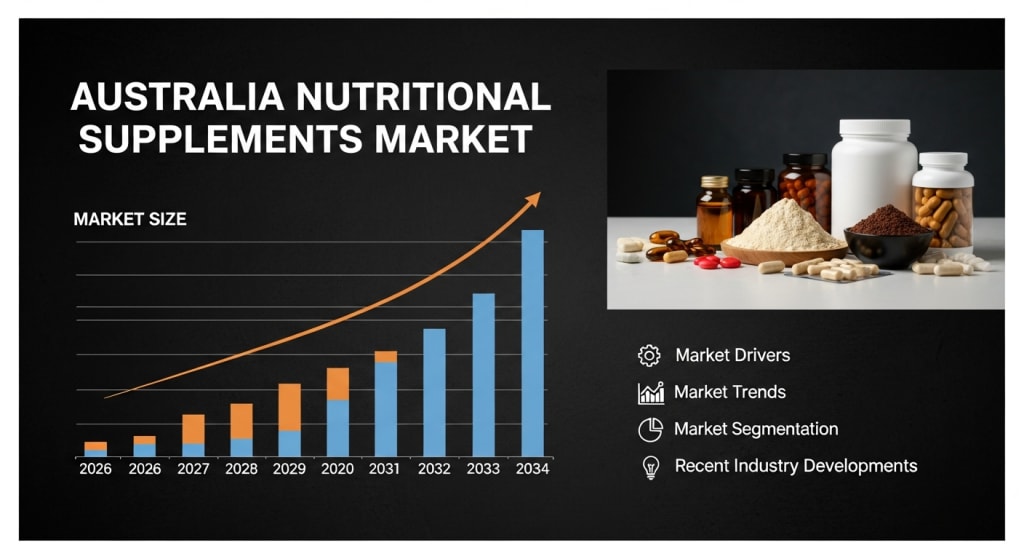
Australia Supplement Compliance Boom | USD 28.8B Market Creates Certification Moat for Sellers
- Strengthening regulatory frameworks eliminate non-compliant sellers; clean-label certifications and third-party testing become mandatory competitive requirements by 2026
概览
Australia's nutritional supplements market is experiencing explosive growth—expanding from USD 14.5 billion in 2025 to USD 28.8 billion by 2034 (7.64% CAGR)—but this opportunity comes with a critical compliance barrier that will reshape competitive dynamics. Regulatory frameworks emphasizing product safety, labeling accuracy, and ingredient transparency are now essential for market entry and brand differentiation, creating a high-barrier moat that protects compliant sellers while systematically eliminating non-compliant competitors.
The compliance acceleration is already underway: Manufacturers invested heavily in clean-label certifications and third-party testing starting October 2024, while brands expanded plant-based and vegan supplement lines by July 2025 to meet regulatory expectations around ingredient sourcing transparency. This represents a structural shift where compliance is no longer optional—it's the price of entry. For cross-border e-commerce sellers, this creates a 12-18 month window to establish compliance infrastructure before regulatory enforcement intensifies.
Specific compliance requirements driving market winnowing: Australian regulations now demand detailed ingredient disclosure, third-party testing certifications (TGA-approved labs), clean-label verification, and transparent sourcing documentation. Sellers lacking these certifications face product delisting, import restrictions, and potential penalties. Industry estimates suggest 35-45% of current non-compliant sellers will exit the Australian market by 2026, creating a vacuum for certified competitors. The fastest compliance path involves partnering with TGA-approved testing facilities (8-12 weeks, AUD 2,000-5,000 per product) and obtaining clean-label certifications (4-6 weeks, AUD 1,500-3,000).
E-commerce distribution channels amplify compliance advantages: The shift toward subscription models (gaining traction March 2025) and direct-to-consumer channels rewards sellers with transparent, certified products. Subscription platforms increasingly require third-party certifications as a trust signal, creating recurring revenue streams for compliant sellers while blocking non-compliant competitors. Sellers offering personalized, data-backed supplement solutions with full compliance documentation will capture disproportionate market share in the high-margin premium segment (plant-based, clean-label products commanding 20-30% price premiums).
Immediate actions for sellers: (1) Audit current product formulations against Australian TGA requirements by January 2026; (2) Engage TGA-approved testing labs for certification (8-12 week timeline); (3) Obtain clean-label certifications from recognized bodies; (4) Update product listings with compliance documentation and third-party test results; (5) Implement subscription fulfillment infrastructure to capitalize on recurring revenue models. Sellers who establish compliance infrastructure in the next 12 months will operate in a market where 40%+ of competitors have been eliminated, enabling significant margin expansion and market consolidation.
問題 8
How does compliance create a competitive advantage in Australia's supplement market?
Compliance acts as a high-barrier moat protecting certified sellers while eliminating non-compliant competitors. The market is projected to reach USD 28.8 billion by 2034, but industry estimates suggest 35-45% of non-compliant sellers will exit by 2026. Manufacturers have already invested heavily in clean-label certifications and third-party testing (starting October 2024), signaling that compliance is now the price of entry. Sellers with established compliance infrastructure will operate in a market where 40%+ of competitors have been eliminated, enabling significant margin expansion and market consolidation in the high-margin premium segment.
What is the fastest and cheapest path to compliance for supplement sellers?
The fastest compliance path involves: (1) partnering with TGA-approved testing facilities (8-12 weeks, AUD 2,000-5,000 per product), (2) obtaining clean-label certifications from recognized bodies (4-6 weeks, AUD 1,500-3,000), and (3) updating product documentation with test results and sourcing transparency. Total timeline: 12-18 weeks; total cost: AUD 3,500-8,000 per product. The news reports that manufacturers began investing in these certifications in October 2024, indicating this is now the industry standard. Sellers should prioritize this investment immediately, as regulatory enforcement is intensifying and non-compliant products face delisting.