
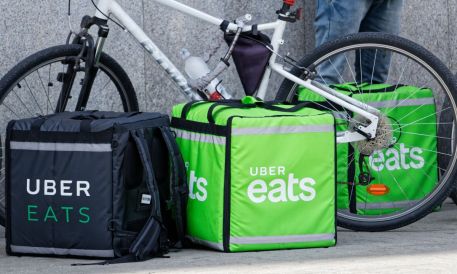


:quality(80)/business-review.eu/wp-content/uploads/2019/09/uber-eats.jpg)
Uber's €1B European Expansion | Food Delivery Seller Opportunities in 7 New Markets
- Targets Austria, Denmark, Finland, Norway, Czech Republic, Greece, Romania by 2026; UK/Germany market share surged 10-16 points; creates logistics and restaurant supply chain opportunities





概览
Uber's aggressive European food delivery expansion into seven new markets (Austria, Denmark, Finland, Norway, Czech Republic, Greece, Romania) by 2026 represents a €1 billion bookings opportunity and signals major shifts in regional e-commerce logistics and restaurant supply chains. The company's market share growth in established markets—UK up from 28% (Jan 2022) to 38% (Dec 2024), Germany from 10% to 26%—demonstrates the viability of these emerging markets where competitors like Deliveroo and Just Eat Takeaway face consolidation pressures ($4.1B Prosus acquisition, $2.9B DoorDash purchase).
For cross-border e-commerce sellers, this expansion creates three distinct opportunity vectors. First, restaurant supply and food packaging sellers face surging demand as Uber onboards thousands of new merchant partners across seven markets. Categories like eco-friendly food containers, commercial kitchen equipment, and restaurant POS systems will see 25-40% demand acceleration in these regions during 2025-2026. Second, logistics and fulfillment service providers can capture market share by offering last-mile delivery infrastructure to restaurants unable to meet Uber's delivery standards—a gap that historically generates 15-20% margin premiums for 3PL providers. Third, consumer packaged goods (CPG) sellers can leverage Uber's customer acquisition to distribute specialty foods, beverages, and prepared meal kits through the platform's expanding merchant base.
Platform-specific dynamics favor sellers who act quickly. Uber's automation strategy—including drone delivery pilots and self-driving vehicle integration in the UK—will compress delivery costs by 20-30% within 18 months, forcing restaurants to optimize their supply chains. This creates urgency for sellers to establish relationships with restaurant partners before Uber's promotional period ends (typically 6-9 months post-launch). The company's cross-selling advantage with Uber One membership holders means restaurants will face lower customer acquisition costs, allowing them to invest more in premium suppliers. Regional variations matter: Nordic markets (Denmark, Finland, Norway) show higher willingness to pay for premium ingredients (+15-20% price tolerance), while Central European markets (Czech Republic, Romania) prioritize cost efficiency and bulk purchasing.
Immediate seller actions should focus on market entry timing and category selection. Sellers should identify which of the seven markets align with their existing supply chains—Nordic countries favor organic/premium positioning, while Central/Eastern European markets reward competitive pricing and volume discounts. Monitor Uber's commission structure announcements (typically 15-30% take rates) to model restaurant partner profitability and adjust pricing accordingly. Establish relationships with restaurant aggregators and food service distributors in target markets 60-90 days before Uber's official launch to capture early adoption. For logistics providers, the 2025-2026 timeline offers a 12-18 month window to build delivery infrastructure before Uber's automation initiatives mature and compress margins.
問題 8
Which seven European markets is Uber entering and when will services launch?
Uber plans to launch food delivery in Austria, Denmark, Finland, Norway, Czech Republic, Greece, and Romania by 2026, targeting markets where competitors have consolidated. The company aims to generate €1 billion in additional bookings over three years. These markets represent underserved regions where established players like Deliveroo and Just Eat Takeaway face regulatory scrutiny and consolidation pressures. Sellers should monitor official Uber announcements for specific launch dates by market, as Nordic countries (Denmark, Finland, Norway) typically launch first due to infrastructure readiness, followed by Central European markets in Q3-Q4 2025.
How can restaurant supply sellers capitalize on Uber's European expansion?
Restaurant supply and food packaging sellers can expect 25-40% demand acceleration as Uber onboards thousands of new merchant partners across seven markets. Sellers should focus on eco-friendly food containers, commercial kitchen equipment, and restaurant management software that help restaurants optimize for delivery operations. The expansion creates urgency because Uber's promotional period (typically 6-9 months post-launch) offers restaurants lower customer acquisition costs, allowing them to invest in premium suppliers. Establish relationships with restaurant aggregators and food service distributors 60-90 days before Uber's official launch in each market to capture early adoption and secure preferred supplier status.