
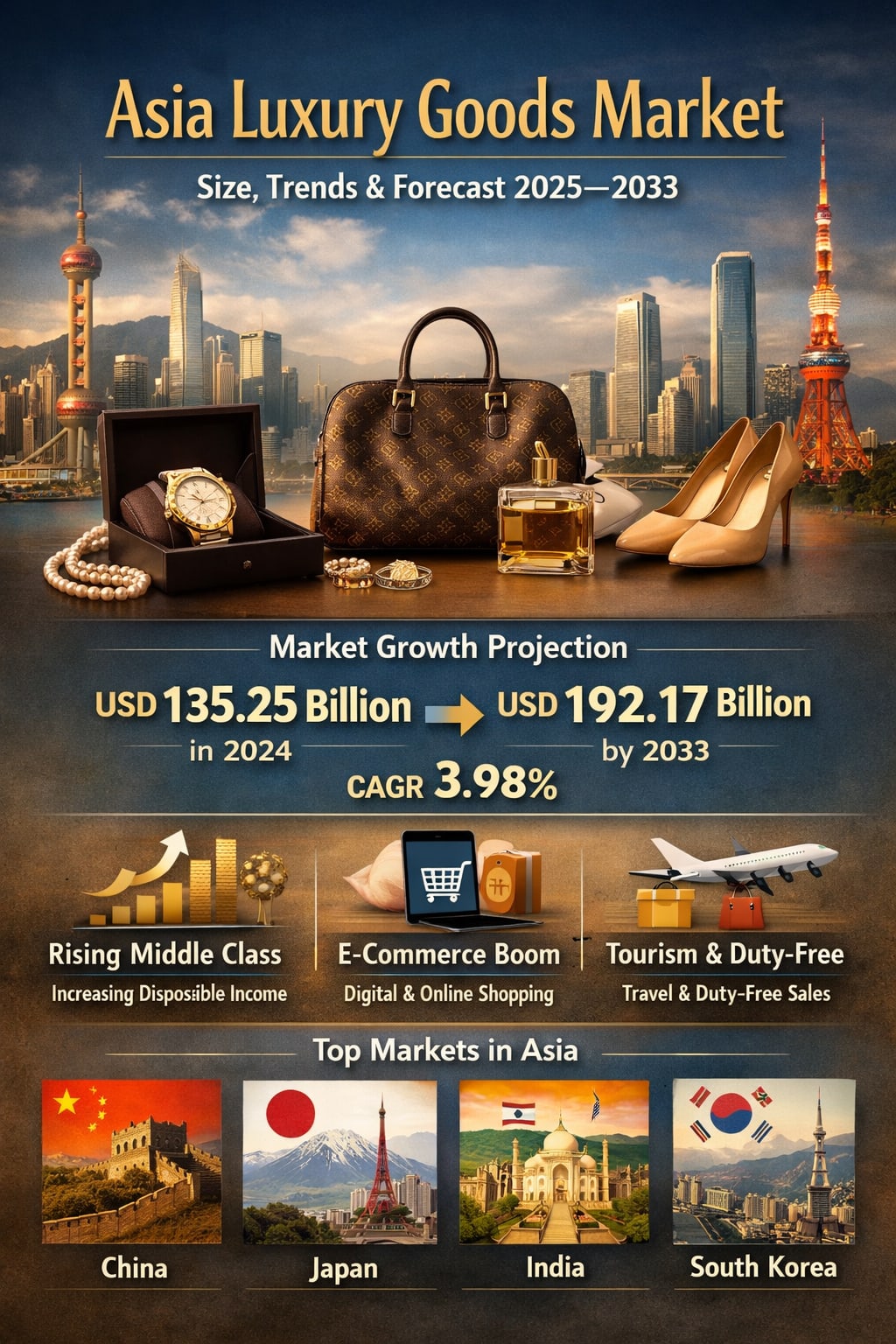
Asia Luxury E-Commerce Boom | $57B Growth Opportunity for Cross-Border Sellers
- Market expands from $135.25B to $192.17B by 2033; live-shopping events projected to drive 20% of global online purchases by 2026; 3.5B Asian middle-class consumers create unprecedented demand for premium goods
概览
Asia's luxury goods market is experiencing a structural transformation that represents one of the most significant e-commerce opportunities of the decade. The market is projected to expand from USD 135.25 billion in 2024 to USD 192.17 billion by 2033, representing a 3.98% CAGR and creating approximately USD 57 billion in incremental revenue. This growth is fundamentally reshaping cross-border e-commerce dynamics, driven by Asia's rapidly expanding middle class—expected to comprise 65% of the global middle-class population by 2030 (approximately 3.5 billion consumers). For digital marketing experts and e-commerce sellers, this represents a critical inflection point where digital transformation is the primary growth lever, with live-shopping events projected to account for 20% of global online purchases by 2026.
Mobile-first platforms and experiential retail are driving the highest-converting traffic channels. Major luxury brands are investing heavily in digital showrooms, virtual try-ons, and immersive shopping experiences, with Asian consumers showing the strongest engagement on mobile-first platforms. This creates immediate channel arbitrage opportunities: TikTok Shop and WeChat Commerce are capturing luxury traffic at significantly lower CPM costs (estimated $2-5 CPM) compared to traditional Google Shopping ($8-15 CPM) for luxury categories. The strongest performing segments include luxury apparel (driven by urbanization and social media influence), sustainable footwear (steady growth from eco-conscious consumers), and watches as investment pieces (robust demand from wealth accumulation). Online luxury sales are emerging as the fastest-growing distribution channel, supported by improved logistics, secure payment systems, and data-driven personalization—creating opportunities for sellers to capture market share through curated multi-brand stores and discovery-focused content strategies.
Country-level variations present distinct targeting opportunities with varying CAC profiles. Japan's duty-free market alone generated USD 450.7 million in May 2024 from luxury goods purchases, signaling strong tourism-driven demand. China remains the cornerstone market despite short-term consumption headwinds, while India and Japan present emerging high-growth opportunities. However, sellers face critical challenges including counterfeit product proliferation (eroding brand trust and requiring blockchain-based authentication investments) and currency fluctuation risks (particularly impacting China operations where cautious domestic consumption has driven increased overseas shopping behavior). Multi-brand online stores are gaining traction by offering curated selections and discovery experiences, creating partnership opportunities for emerging premium brands. The convergence of digital commerce, experiential retail, and cross-border travel creates a dynamic environment where sellers positioned with mobile-first content strategies, live-shopping capabilities, and authentication infrastructure will capture disproportionate market share from the 3.5 billion emerging Asian luxury consumers.
問題 8
What is the projected size of Asia's luxury e-commerce market by 2033?
Asia's luxury goods market is projected to expand from USD 135.25 billion in 2024 to USD 192.17 billion by 2033, representing a 3.98% CAGR and creating approximately USD 57 billion in incremental revenue opportunities. This growth is driven by Asia's rapidly expanding middle class, expected to comprise 65% of the global middle-class population by 2030 (approximately 3.5 billion consumers). For e-commerce sellers, this represents an unprecedented opportunity to capture market share in the fastest-growing luxury segment globally. Sellers should prioritize establishing mobile-first storefronts and live-shopping capabilities to capitalize on this expansion before 2026.
What authentication and supply chain investments are necessary for luxury sellers?
Blockchain-based authentication and supply chain controls are becoming essential investments as counterfeit products erode consumer trust and brand value in Asia's luxury market. Sellers should implement: blockchain-verified product certificates, QR code authentication systems, and transparent supply chain tracking visible to consumers. These investments typically cost $5,000-50,000 depending on scale but create significant competitive advantages by enabling premium positioning and consumer confidence. Authentication systems also reduce return rates by 20-30% and enable sellers to command 10-15% price premiums through verified authenticity positioning. Sellers should prioritize authentication for high-value categories (watches, designer apparel) and establish partnerships with blockchain providers offering white-label solutions to minimize implementation costs.