



AI-Powered Legacy System Automation Disrupts $12.5B IBM Revenue Stream | Enterprise Tech Sellers Must Adapt
- IBM stock drops 26.8% in February 2026 as Claude Code automates COBOL modernization, compressing 2-3 year projects to quarters and threatening consulting-dependent business models across enterprise infrastructure


















/tpg/sources/c6306648-4910-47c2-a6af-5d64575d02aa.jpeg)



概览
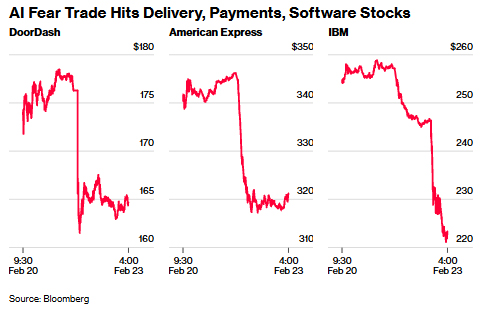
On February 23, 2026, IBM's stock plummeted 13.2% in a single day—marking its worst performance since March 2020—after Anthropic announced Claude Code capabilities that automate COBOL modernization. This represents a critical inflection point for e-commerce sellers relying on enterprise infrastructure, payment processing, and legacy system modernization services. IBM's stock is down 26.8% since February's start, positioning it for its worst month since December 1992, directly threatening the company's $12.5 billion cumulative generative-AI business and its Z mainframe division which achieved 48% year-over-year growth in Q4 2025.
The core disruption: Claude Code can automate what previously required months of human analysis. COBOL, developed in 1960, powers 95% of U.S. ATM transactions and critical infrastructure in banking, travel, insurance, and government—sectors that depend on IBM's consulting services for system modernization. Anthropic's technology maps dependencies across thousands of code lines and identifies risks that would traditionally require specialized teams working for months or years. This compresses modernization timelines from 2-3 years to quarters, directly attacking IBM's consulting-dependent revenue model that generated substantial profits from labor-intensive projects.
For cross-border e-commerce sellers, this disruption cascades through multiple operational layers. Enterprise-level sellers using IBM's cloud services, Watson AI platform, or Z mainframe infrastructure for logistics, inventory management, and payment processing face potential service disruptions or pricing changes as IBM's financial position weakens. The broader "AI scare trade" triggered by Citrini Research's February 22-23 report amplified market concerns, causing payment processing companies and SaaS providers—critical infrastructure for online merchants—to experience significant stock declines. This investor reassessment directly impacts these companies' capacity to invest in service improvements, maintain competitive pricing, and ensure operational reliability.
The competitive intelligence angle is crucial: IBM is developing competing solutions through its Watsonx platform, with CEO Arvind Krishna noting capabilities to refactor COBOL into Java and improve code comprehension. However, the market's reaction reveals that AI-driven automation fundamentally reshapes the economics of legacy system modernization—a historically stable, high-margin business segment. Sellers should monitor whether IBM's financial challenges lead to service consolidation, pricing increases, or reduced investment in e-commerce-specific features. The incident demonstrates how AI capabilities can rapidly obsolete traditional service models, particularly in enterprise infrastructure where IBM maintained competitive advantages for decades. This creates both risk (service disruption) and opportunity (alternative vendors gaining market share) for sellers dependent on enterprise technology infrastructure.
問題 8
How does Claude Code's COBOL automation affect e-commerce sellers using IBM infrastructure?
Claude Code compresses COBOL modernization from 2-3 years to quarters by automating dependency mapping and risk identification that previously required specialized consulting teams. For e-commerce sellers relying on IBM's Z mainframe infrastructure for payment processing or inventory management, this creates two risks: (1) IBM's weakened financial position (stock down 26.8% in February 2026) may reduce investment in e-commerce features, and (2) IBM's consulting revenue decline could trigger service consolidation or pricing increases to maintain profitability. Enterprise sellers should audit their IBM service dependencies and evaluate alternative vendors like AWS, Azure, or specialized payment processors to reduce concentration risk.
What is the 'AI scare trade' and why does it matter for payment processing?
The AI scare trade refers to the market downturn triggered by Citrini Research's February 22-23, 2026 report warning of AI's disruptive potential on established business models. Payment processing companies and SaaS providers experienced significant stock declines as investors reassessed their vulnerability to AI-driven automation. For cross-border e-commerce sellers, this matters because payment processors are critical infrastructure—stock declines reduce their investment capacity for service improvements and increase bankruptcy risk. Sellers should monitor the financial health of their payment gateway providers (Stripe, Square, PayPal, etc.) and maintain relationships with multiple processors to ensure transaction continuity.