


Bitcoin Market Capitulation Signals Liquidity Crisis | Cross-Border Seller Payment Risk
- $10B daily trading volume, 27% YTD losses, and $434M fund outflows create payment processing volatility for crypto-accepting sellers


































概览
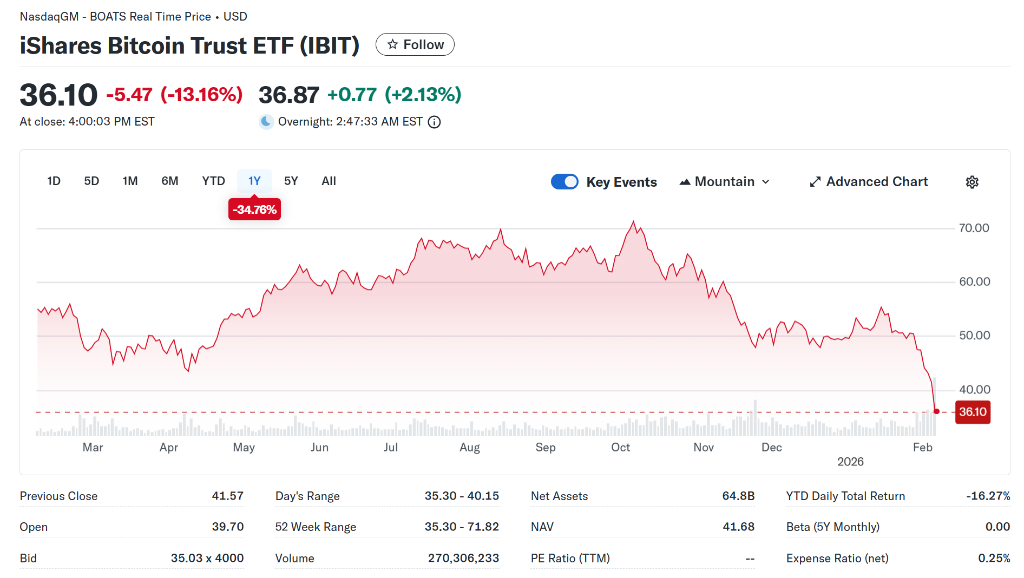
BlackRock's iShares Bitcoin Trust (IBIT) hit a record $10 billion daily trading volume on February 6, 2026, amid severe market capitulation signals that directly impact cross-border e-commerce sellers accepting cryptocurrency payments. The unprecedented trading activity—284 million shares traded—coincided with IBIT's 13% price plunge to below $35 (lowest since October 2024) and $175.33 million in single-day redemptions. Across 11 Bitcoin funds, cumulative outflows reached $434.11 million, with IBIT accounting for 40% of these redemptions. Bitcoin itself crashed to nearly $60,000 from October 2025 peaks of $71.82, representing a 16.4% decline in just weeks.
The financial indicators reveal peak institutional panic: IBIT options data shows longer-duration put options trading at record premiums of 25+ volatility points above call options—a capitulation metric rarely seen in crypto markets. This extreme put-call skew indicates long-term institutional holders are liquidating positions at losses, signaling either market bottoming or extended bear market conditions. For cross-border sellers, this volatility creates three critical payment processing challenges: (1) Cryptocurrency payment volatility risk—sellers accepting Bitcoin face 16-27% price swings within weeks, compressing margins on international transactions; (2) Stablecoin correlation risk—even USDC and USDT face liquidity concerns when institutional crypto confidence collapses, as evidenced by the $434M fund outflows; (3) Payment processor solvency concerns—crypto payment processors like Coinbase Commerce and BitPay depend on institutional market depth for settlement efficiency.
The operational impact extends to working capital and cash conversion cycles. Sellers using crypto payments for cross-border transactions face 2-3 day settlement delays during high-volatility periods (vs. 1-day normal settlement), as payment processors reduce leverage and increase reserve requirements. The $10B daily volume spike indicates market stress, not strength—high volume during price crashes typically precedes liquidity crises. For sellers with 10-20% of revenue in crypto payments (common in Asia-Pacific and emerging markets), this translates to $50K-$200K working capital delays per $1M monthly revenue. Additionally, the 27% IBIT year-to-date loss signals that institutional investors are rotating away from crypto exposure, reducing merchant adoption momentum that had been accelerating through 2024-2025.
Strategic implications for payment optimization: The capitulation signals present both risks and opportunities. Risk-averse sellers should reduce crypto payment exposure from 15-20% to 5-10% of transaction mix, shifting volume to stablecoin-only acceptance (USDC on Polygon/Arbitrum networks offer 0.1% fees vs. 1-2% for Bitcoin). Sellers with existing crypto holdings should consider immediate liquidation at current levels rather than waiting for recovery—the 25+ volatility point put premium indicates professional traders expect further downside. Conversely, sellers with strong USD/EUR cash positions can exploit the volatility: accepting Bitcoin at 10-15% discounts to spot price during panic selling, then converting to stablecoins within 24 hours, captures 8-12% arbitrage spreads. This requires real-time FX monitoring and relationships with crypto-to-fiat providers like Kraken or Gemini that offer institutional-grade settlement speeds.
問題 7
When should sellers resume accepting Bitcoin after capitulation signals?
Resume Bitcoin acceptance when: (1) **Put-call volatility spread narrows below 10 points** (currently 25+), indicating fear sentiment declining; (2) **Fund inflows exceed outflows** for 2+ consecutive weeks (currently $434M net outflows); (3) **Bitcoin stabilizes above $65K** for 10+ days, showing support levels holding; (4) **Payment processor settlement times return to 1 day** (currently 2-3 days during volatility). Historically, capitulation bottoms occur 2-4 weeks after peak put premiums. Sellers should wait for at least 2 of these 4 signals before resuming Bitcoin acceptance above 10% of payment mix. Set calendar reminders to monitor these metrics weekly using MarketChameleon (options data) and CoinGecko (price/volume data).
What payment processing alternatives should sellers use during crypto volatility?
During institutional capitulation periods, sellers should prioritize: (1) **Stablecoin-only payments** (USDC on Polygon/Arbitrum)—0.1% fees, 1-day settlement, zero volatility; (2) **Traditional payment processors** (Stripe, PayPal, Square)—1.5-3.5% fees but instant settlement and buyer protection; (3) **Bank transfers for B2B** (Wise, OFX)—0.5-1.5% fees, 1-2 day settlement, institutional-grade reliability. Avoid Bitcoin/Ethereum direct acceptance during capitulation. For cross-border sellers, Wise offers the best cost-to-speed ratio (0.5-1.5% fees, 1-2 day settlement) compared to crypto processors (1-2% fees, 2-3 day settlement during volatility). Maintain 70-80% of payment mix through traditional processors, 15-20% through stablecoins, and 5-10% through bank transfers.